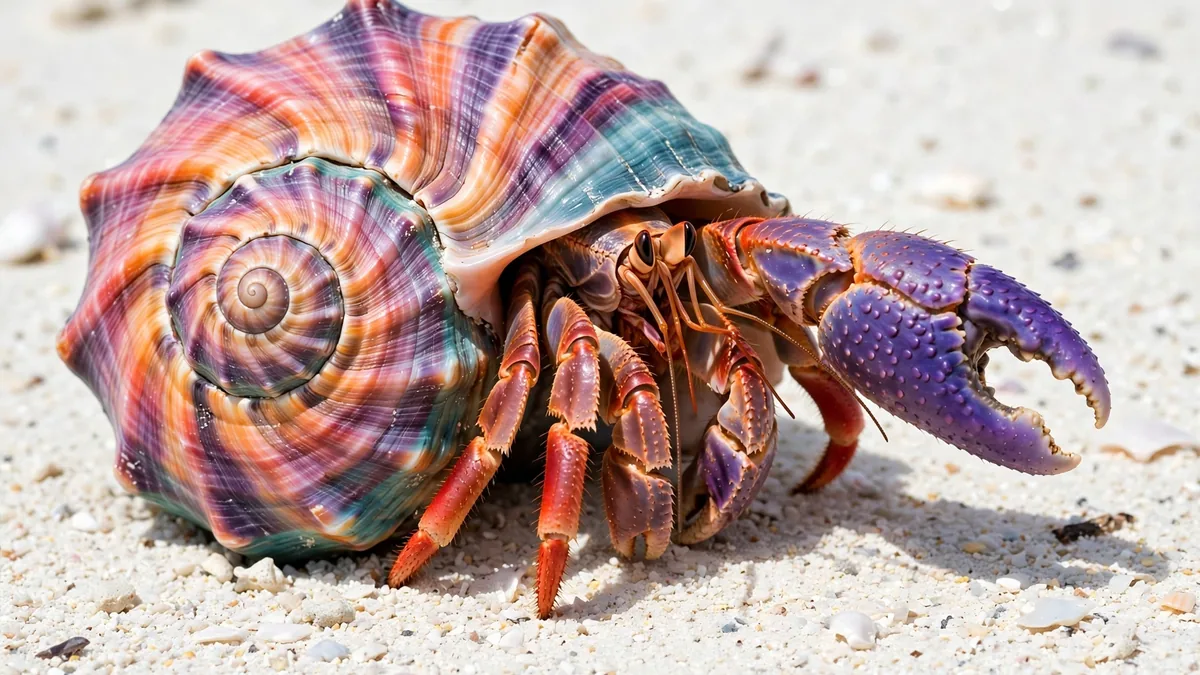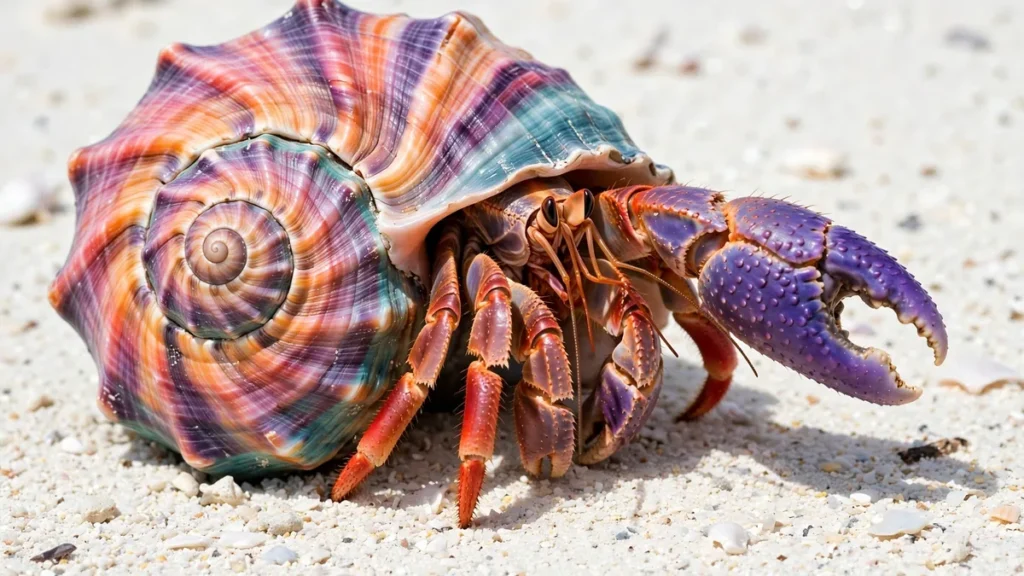
The hermit crab species are the great borrowers of the animal kingdom, soft-bodied crustaceans that live their whole lives in empty snail shells they did not make and cannot grow. If you are asking what a hermit crab is, the short answer is a decapod crustacean of the superfamily Paguroidea, with a hard front half like any crab and a soft, curled abdomen that it tucks into a borrowed shell for protection, carrying its home wherever it goes and moving into a bigger one each time it outgrows the last. There are more than 800 species, from tiny reef hermits a few millimetres across to land hermit crabs the size of a coconut, and almost all of them are scavengers of the shore, the seabed and the tropical beach.
What makes hermit crabs so fascinating is that their whole life is a housing problem. A hermit crab never grows its own shell, so every time it grows it needs a bigger one, and good shells are always in short supply. The search for the next shell drives some of the cleverest behaviour in the invertebrate world, with crabs queuing in size order to swap homes in a chain, rapping on a rival’s shell to evict it, and even moving into bottle caps when no real shell can be found.
Key takeaways
- The hermit crab species make up the superfamily Paguroidea, a group of more than 800 species of decapod crustaceans, and recent counts put the total at about 1,110 species.
- They are not true crabs, since their abdomen is soft and curled, and they protect it by living inside empty snail shells, moving into a larger shell each time they grow.
- They live on shorelines, in tide pools and on seabeds worldwide, and about 15 species of land hermit crabs live on tropical beaches and coastal forests, returning to the sea only to breed.
- They are omnivorous scavengers, eating algae, plankton, dead animals, fruit and fallen leaves, and they help clean the shoreline as they feed.
- When a new shell turns up, hermit crabs form queues of up to about 20 animals in size order and trade up in a chain, and wild land hermit crabs can live for up to 40 years.
The hermit crab species and their relatives
Hermit crabs belong to the order Decapoda, the ten-legged crustaceans, and to the infraorder Anomura, the false crabs, a group that also holds the porcelain crabs, the squat lobsters and the king crabs. Within the Anomura they make up the superfamily Paguroidea, a group of more than 800 species, and recent counts put the total at about 1,110 species, in around nine families. They are not true crabs, which belong to the infraorder Brachyura, and the difference is easy to see. A true crab has a hard shell over its whole body, while a hermit crab has a hard shell over only the front half, with a soft, curled abdomen behind it that needs a borrowed home. National Geographic puts the number of hermit crab species at more than 800, and almost all of them live in the sea, though people are most familiar with the land hermit crabs, which are often kept as pets.
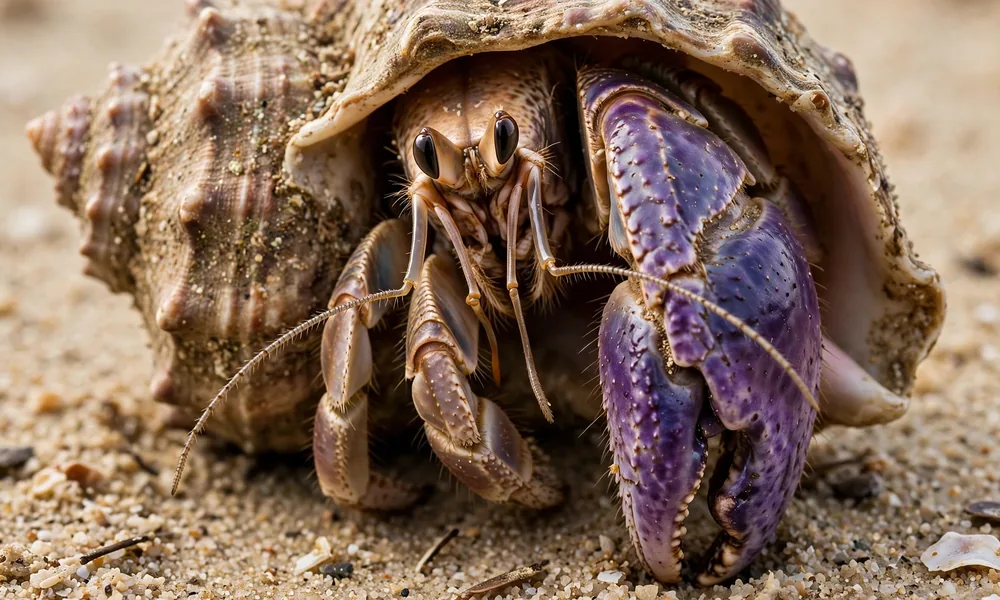
The Caribbean hermit crab, Coenobita clypeatus, is the lead species of this guide, and it is the hermit crab that most people picture when they hear the name. It lives on the shores of the Caribbean and the western Atlantic, from Florida and the Bahamas through the Caribbean islands to northern South America, and it grows to about 5 to 15 centimetres across, shell included, with reddish-orange legs and a large purple claw that gives it its other name, the purple pincher.
| Type | Animal | Where it lives | Best-known food | Size |
|---|---|---|---|---|
| Superfamily | Hermit crabs (Paguroidea) | Shores and seabeds worldwide | Algae, carrion and scraps | A few millimetres to 40 cm |
| Family | Right-handed hermits (Paguridae) | Seas worldwide | Algae, plankton and carrion | A few millimetres to a few centimetres |
| Family | Left-handed hermits (Diogenidae) | Seas worldwide | Algae, carrion and scraps | A few millimetres to a few centimetres |
| Family | Land hermit crabs (Coenobitidae) | Tropical coasts worldwide | Fruit, leaves and carrion | A few centimetres to the size of a coconut |
| Genus | Land hermit crabs (Coenobita) | Tropical shores worldwide | Fruit, leaves and carrion | A few centimetres to the size of a coconut |
| Species | Caribbean hermit crab (Coenobita clypeatus) | Caribbean and western Atlantic shores | Fruit, leaves, algae and carrion | About 5 cm to 15 cm across |
| Species | Coconut crab (Birgus latro) | Tropical islands of the Indo-Pacific | Coconuts, fruit and carrion | Up to 4.1 kg, leg span up to 1 m |
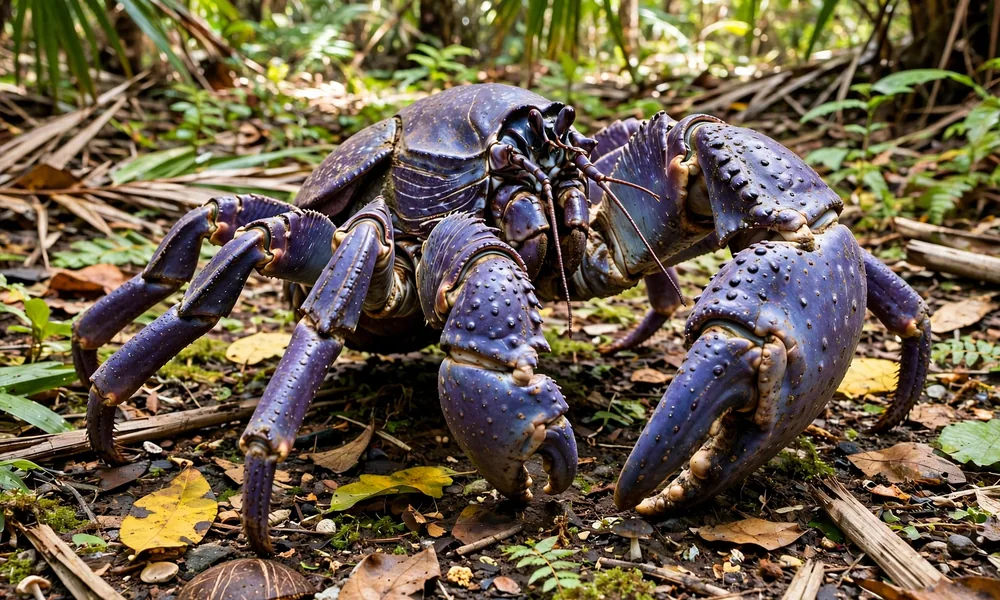
The closest relatives of the Caribbean hermit crab are the other land hermit crabs of its own family, the Coenobitidae, a small family with only two genera. The genus Coenobita holds about 15 terrestrial species, including the Australian land hermit crab, Coenobita variabilis, the Ecuadorian hermit crab, Coenobita compressus, and the strawberry hermit crab, Coenobita perlatus, a bright red species of the Indo-Pacific. The other genus, Birgus, holds a single species, and it is the most extraordinary hermit crab of all. The coconut crab, Birgus latro, is a hermit crab that outgrew its shell, and as an adult it abandons the borrowed shell for good, its abdomen hardening into tough plates, until it becomes the largest land arthropod in the world, with a weight of up to 4.1 kilograms and a leg span of up to 1 metre.
The marine hermit crabs are a much bigger group, and they are the ones that fill the seas. The family Paguridae, the right-handed hermits, is the largest family, with about 76 genera, and in these crabs the right claw is usually the larger one. The family Diogenidae, the left-handed hermits, is named for the opposite pattern, since the left claw is usually the larger one in these crabs. Marine hermits spend their whole lives in the water, while land hermits live on the beach and in the coastal forest, and must keep their gills damp with seawater carried in the shell.
What hermit crabs look like
A hermit crab is unmistakable once you have seen one, and it is hard to mistake for anything else. The front half of the animal is armoured like any crab, with a hard exoskeleton, stalked eyes, long antennae and a pair of claws, while the back half is a long, soft abdomen, curled to the right so that it fits the spiral of a snail shell. The last pairs of legs and the tail appendages are changed into hooks that grip the inside of the shell, so the crab can brace itself and be almost impossible to pull out. The whole animal is a compromise between a crab and a snail, and the shell is what makes the compromise work.
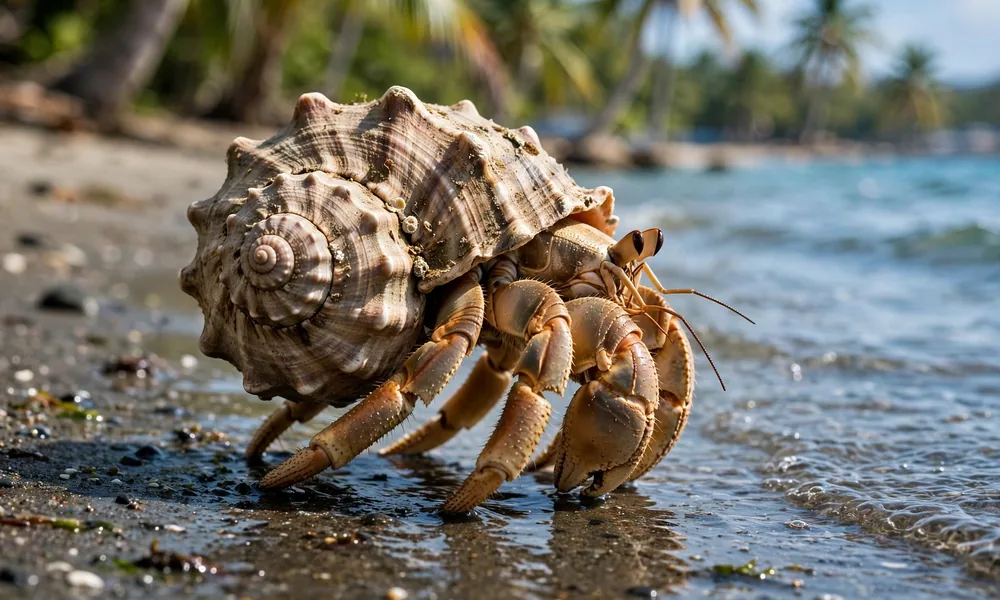
The claws are the first thing anyone notices, and they are the animal’s tools and its front door. The larger claw is used for defence and for tearing food, and when the crab is threatened it pulls its whole body into the shell and shuts the opening with the big claw, like a door closing on a house. The smaller claw is used for feeding, picking up small pieces of food and passing them to the mouth. In the Caribbean hermit crab the big claw is a deep purple, which is why the species is also called the purple pincher, and the legs are a warm reddish orange, with darker tips. Other species are coloured very differently, and the shell is often the most colourful part of the animal, since the crab did not choose it for its looks.
The eyes sit on stalks, and they can be raised and lowered like periscopes, which lets the crab look out of its shell while keeping its body hidden. The antennae are long and sensitive, and they taste and smell the world, finding food, finding other crabs and finding shells. The crab has ten legs, like all decapods, and the front pair carry the claws, the next two pairs are long walking legs, and the last two pairs are small and hidden, used only for gripping the shell.
Where hermit crabs live
Hermit crabs live on shorelines, in tide pools and on seabeds worldwide, from the cold waters of the far north to the warm tropics, and from the shallowest rock pool to the deep sea. Almost all of them are ocean dwellers, and they are found wherever there are empty snail shells to live in, which is to say almost everywhere in the sea. They are animals of the edge, and they are most common where the land meets the water, in the rock pools, the sandy shallows and the reefs where shells are plentiful and food washes in with every tide.
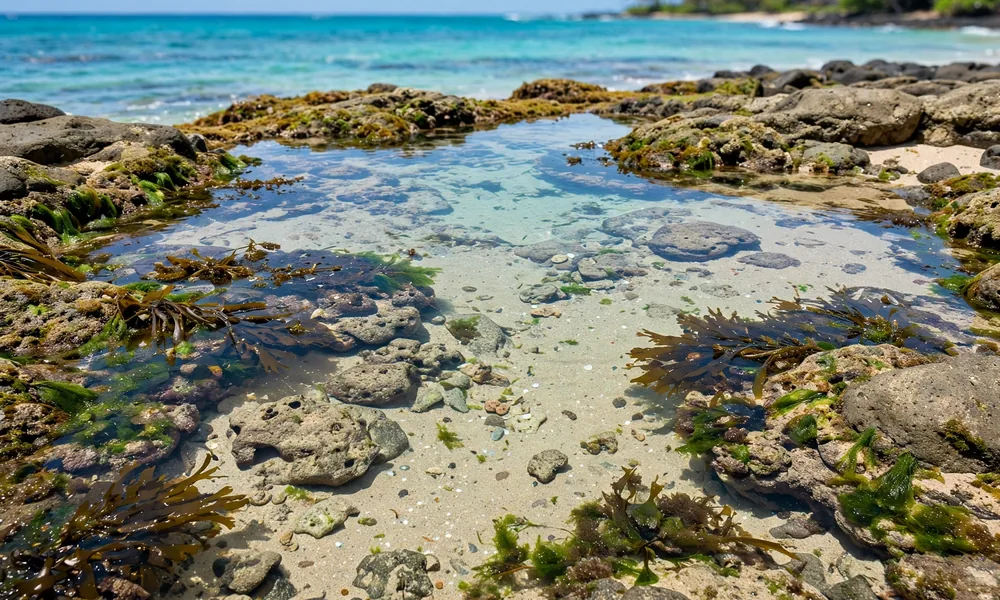
The land hermit crabs live a different life, and they are the ones most people meet. About 15 species in the genus Coenobita live on tropical beaches and in coastal forests, and they come out mostly at night to forage. They need the sea all the same, and they need both fresh water and salt water to keep their gills damp and to breed, so they never live far from the coast.
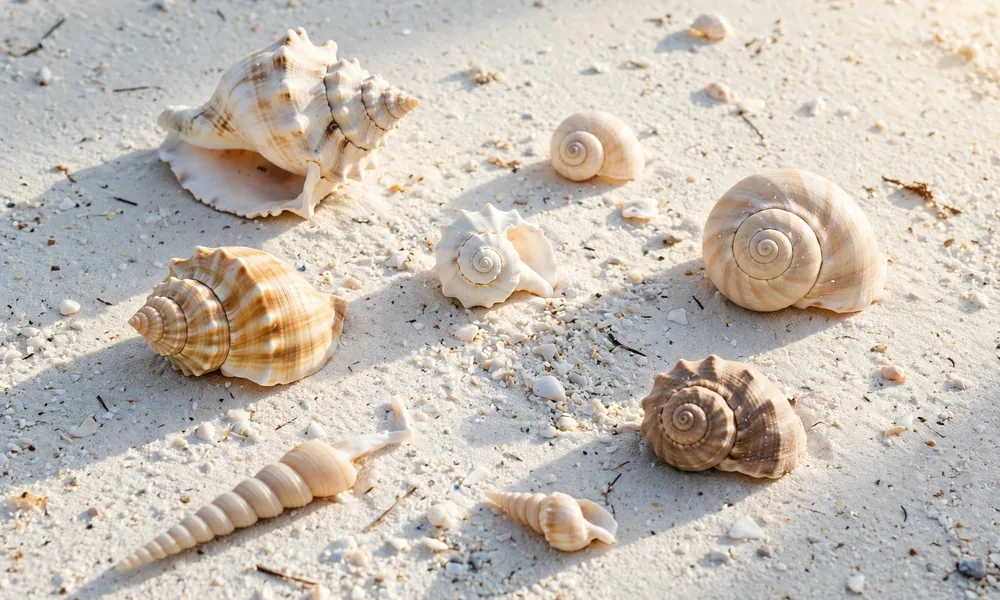
The home of a hermit crab is a borrowed shell, and it is the most important thing in the animal’s life. Most species use the empty shells of sea snails, and the shell must fit just right, since a shell that is too small leaves the abdomen exposed, and a shell that is too big is heavy to carry and easy for a predator to grip. Other species live in tusk shells, in bivalve shells, in hollow wood, in sponges or in holes in coral, and some will use almost anything that offers a spiral to hide in. When natural shells are scarce, hermit crabs use bottle caps, cans and pieces of plastic, and a study published in 2024 found 10 of 16 land hermit crab species using artificial shells somewhere in their range, which is a sad sign of how much plastic now washes up on the world’s beaches.
What hermit crabs eat
Hermit crabs are omnivorous scavengers, and they eat almost anything they can find on the shore. Their staple food is algae, which they scrape from rocks with their small claw, along with microscopic mussels and clams, bits of dead animals and seaweed, and on land they add fallen fruit, leaves, seeds and carrion. They are the cleaners of the shoreline, and they eat the dead and the rotting things that other animals leave behind, which keeps the beach clean and returns nutrients to the sand. A hermit crab is never fussy, and it will eat whatever the tide brings in.
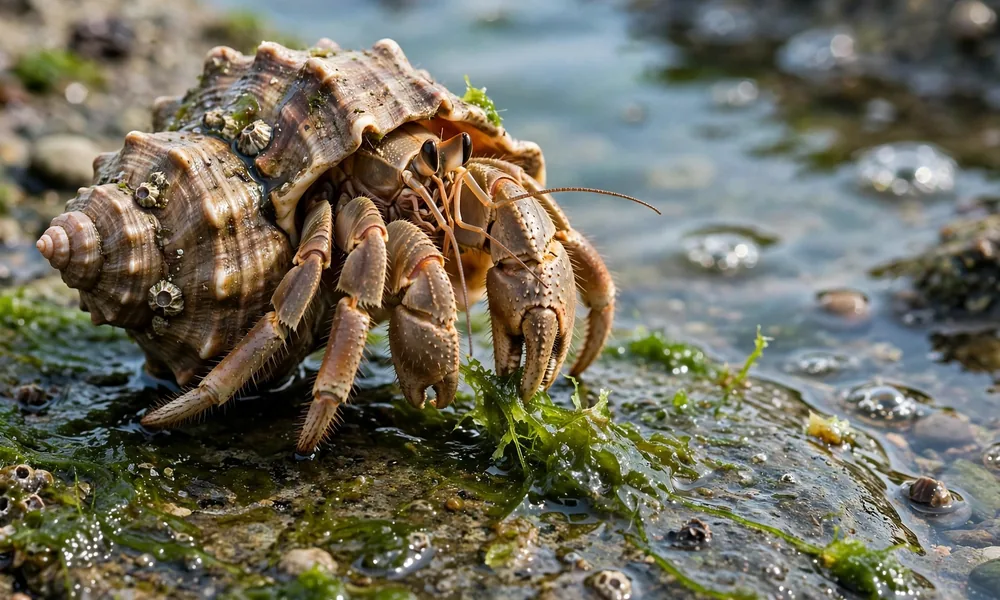
The feeding is a slow and patient business. The crab walks the shore with its antennae tasting the air, and when it finds something to eat, it holds the food with its small claw and tears off tiny pieces with its mouthparts. It will eat a dead fish, a piece of fruit, a clump of seaweed or a scrap of meat with the same enthusiasm, and it will also eat its own old exoskeleton after moulting, to reclaim the calcium it needs to harden the new one.
How hermit crabs behave
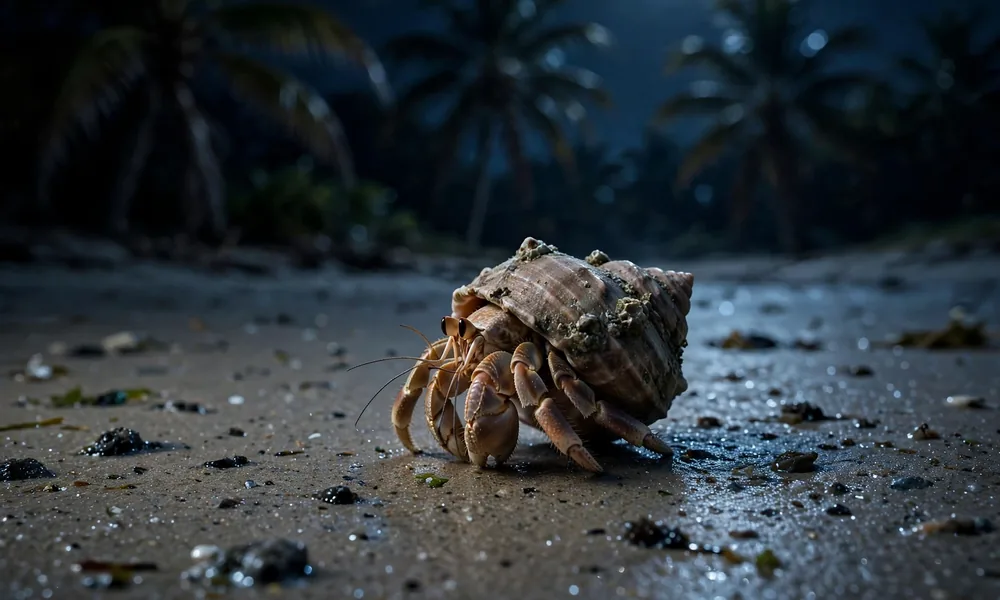
Hermit crabs are social animals, and they live in large groups in the wild, which is unusual for a crustacean. They are mostly nocturnal, hiding by day in their shells under logs and stones, and coming out after dark to feed, to find shells and to meet other crabs. They are generally peaceful, though larger species are more aggressive than smaller ones, and they will fight over a good shell, which is the most valuable thing in a hermit crab’s life. A crab that loses its shell is a crab in danger, since its soft abdomen is exposed to every predator on the beach, so it is no wonder that shells are fought over.
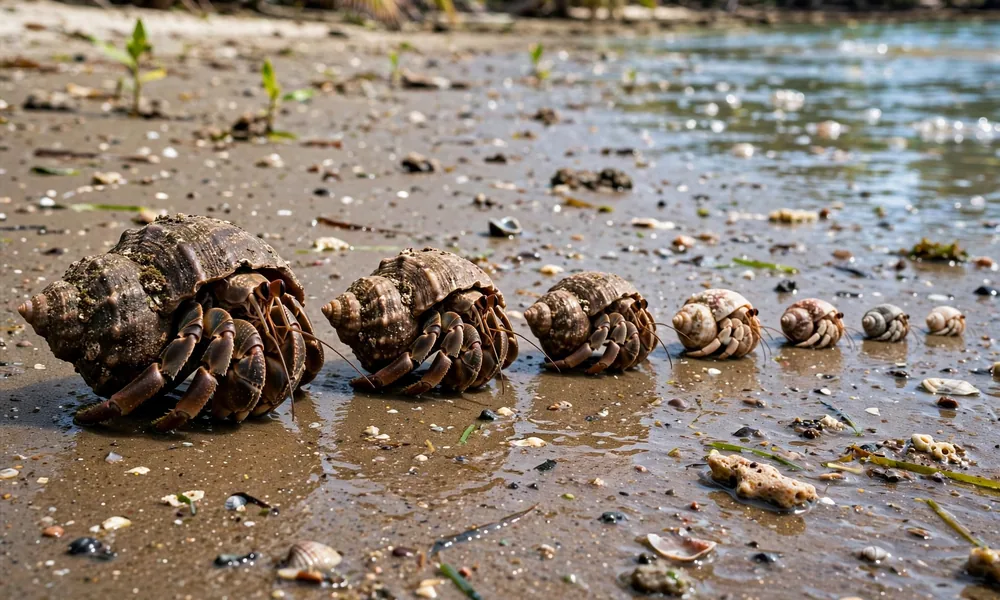
Shell swapping is the most famous behaviour of the hermit crab, and it is one of the best-studied social behaviours in invertebrates. When a crab finds an empty shell that is too big for it, it may wait beside it, sometimes for up to about 8 hours. Other crabs arrive and line up in size order, and the queue can reach about 20 animals. When a crab that fits the new shell arrives and moves in, everyone in line trades up in quick succession, each crab taking the shell just vacated by the one in front. Researchers call this a vacancy chain, and it was first documented in the Caribbean hermit crab, Coenobita clypeatus, in Belize, though it has since been seen in marine species too. Not all trading is polite, and hermit crabs also fight, rapping their shells against a rival’s shell until it gives up its home.
Breeding and life cycle
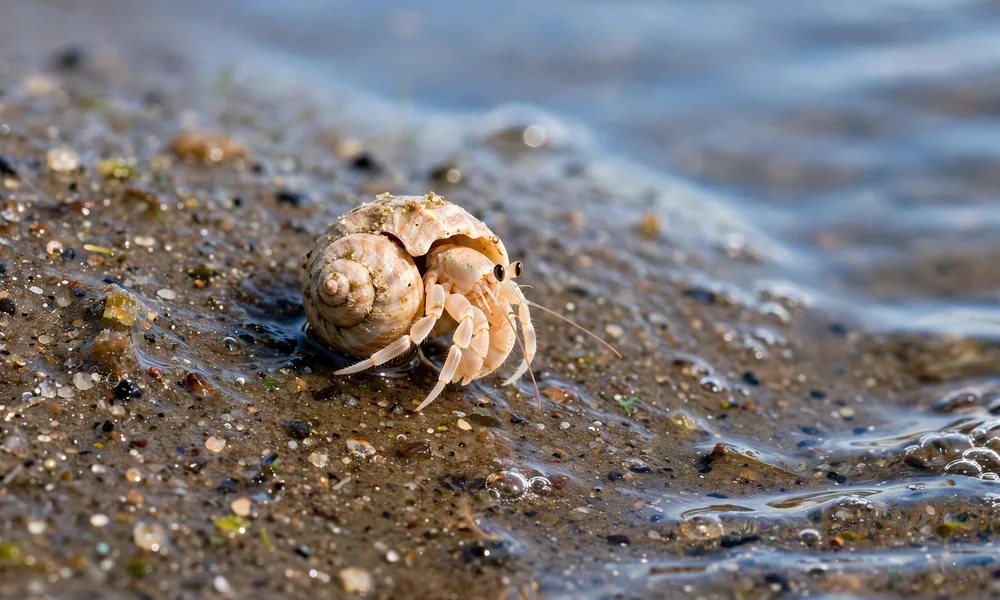
Hermit crabs breed in the sea, even the ones that live on land, and their life begins in the water. The females carry their eggs under the abdomen, tucked inside the shell, and when the eggs are ready, the female returns to the shore and releases them into the surf. In the Caribbean hermit crab, females gather at the seashore in huge numbers when it is time to mate, and they come partly out of their shells so that the male can transfer a packet of sperm to the female, which fertilises her eggs.
The larvae hatch as zoea, tiny planktonic animals that drift in the ocean currents and feed on microscopic plankton. They moult several times as they grow, and the number of stages varies by species and by water temperature. In the Caribbean hermit crab there are usually five zoeal stages, lasting about 20 to 25 days, while other species take as little as a week or as long as 80 days. After the final zoeal moult, the larva becomes a megalopa, also called a glaucothoe, which looks more like a tiny crab than a larva, and it sinks to the sea floor to find its first shell. The whole journey from hatching to land takes about 40 days in the Caribbean hermit crab, and most of the larvae do not survive it, since the open ocean is full of animals that eat plankton.
Once on land, the young crab burrows into sand or moist soil and completes its change into the first crab stage, and from then on it grows by moulting. To grow, a hermit crab must shed its exoskeleton, and it does so in hiding, often burying itself in sand, until the new, soft exoskeleton hardens. Young crabs moult every few weeks, and older crabs moult less often, and each moult is followed by a search for a bigger shell, since the crab has grown and the old shell no longer fits.
Conservation status
Most hermit crab species have not been assessed on the IUCN Red List, so they have no formal Red List category, and the Caribbean hermit crab itself has not been formally assessed, which means its global conservation status remains unclear. The one exception in the family is the coconut crab, which was assessed as Vulnerable in 2018, after a global reassessment moved it up from Data Deficient, on the basis of widespread declines on island after island, and that listing is a warning for the whole group.
The pet trade is the best-known threat to the land hermit crabs, and it is the reason the species is so widely known outside the tropics. Hermit crabs do not breed well in captivity, so the land hermit crabs seen in pet stores and tourist shops are taken from the wild, and that collection is considered an unsustainable practice. A pet hermit crab often lives for only a few years, while a wild one can live for decades, and the gap between those two numbers is a measure of how much the trade costs the wild population.
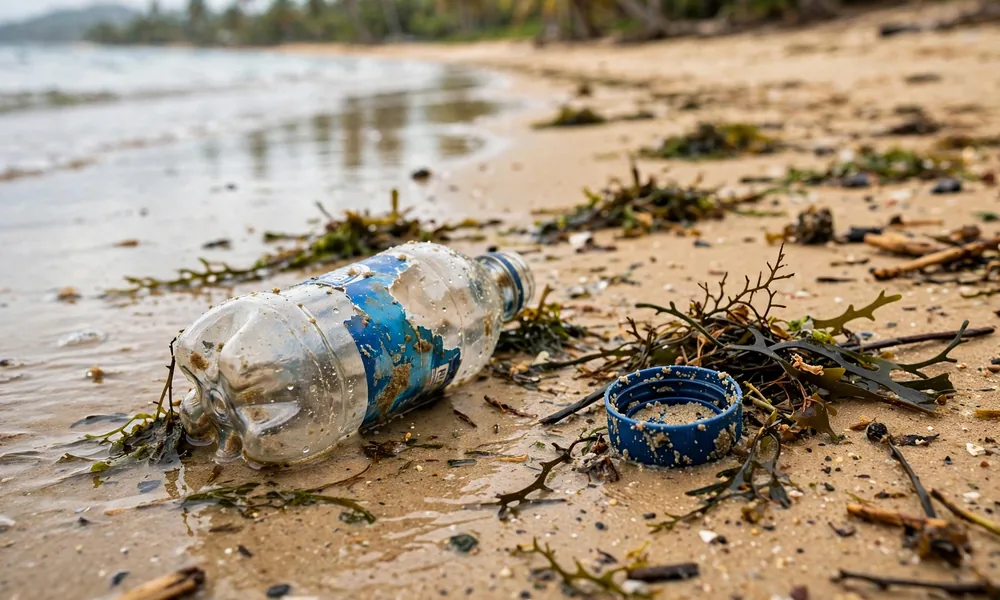
Plastic pollution is the other threat, and it is a strange and cruel one. Hermit crabs often mistake a plastic bottle cap or a small container for a new home, and when they crawl inside they can become trapped, since the smooth plastic gives their gripping legs nothing to hold. When a trapped crab dies, it releases a scent that signals to other crabs that a shell may be available, which lures even more crabs into the same trap, and one piece of plastic can kill crab after crab. Habitat loss is the quieter threat, and it matters just as much, since a beach that is built over, a mangrove that is cleared, or a reef that is damaged leaves the crabs with nowhere to live and no shells to move into.
Best seasons for hermit crab watching
The best time to look for hermit crabs is the warm season, when the tides are low and the beaches are at their busiest. In the Caribbean the warm months run roughly from May to October, and this is when the land hermit crabs are out feeding most nights, and the tide pools are at their richest, with the water warm and the algae thick on the rocks. The best watching follows the moon, since the lowest tides fall around the new moon and the full moon, and a low tide exposes the rock pools where the marine hermit crabs live.
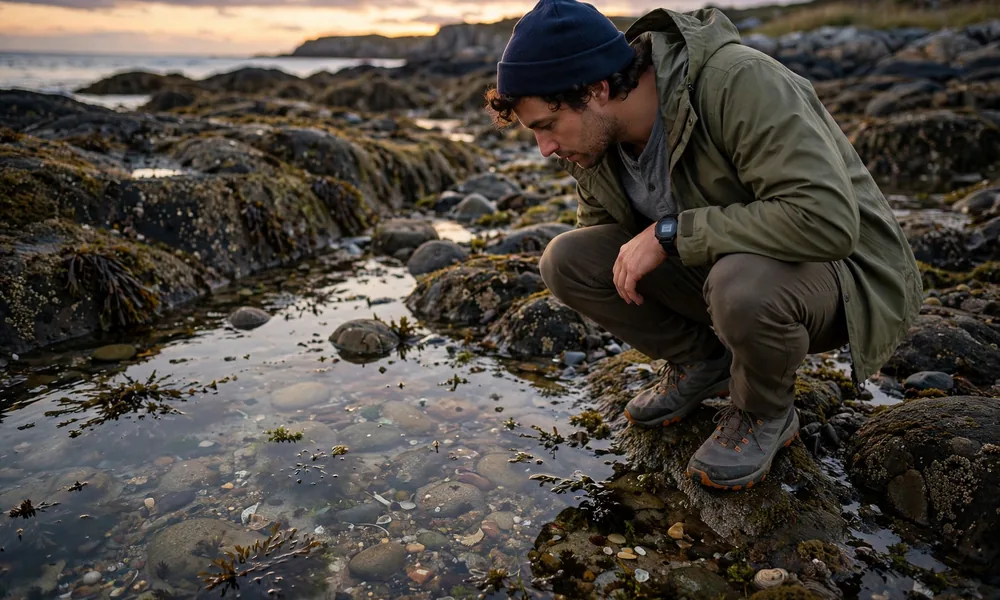
Low tide is the only time that matters for the marine species. Hermit crabs in tide pools can only be seen when the tide is out, so the best watching is done on a falling tide, starting an hour or two before low water, when the pools are exposed and the crabs are out feeding. A good guide will know the pools to check, and will know how to find a crab in its shell without disturbing it. The land hermit crabs are best seen after dark, on a guided night walk along the beach, when they come out of hiding to feed, and a walk after rain is better than a walk in dry weather, since the damp brings the crabs out and keeps their gills wet.
Staying safe around hermit crabs
Hermit crabs are among the least dangerous animals on the shore, but they are still wild animals with claws, and they deserve respect. Their claws can give a sharp pinch, and a large land hermit crab can pinch hard enough to draw blood, though the pinch is not venomous and is not medically significant for most people. The crabs are shy and quick to retreat into their shells, and they will almost always pull in and shut the door with the big claw before they pinch, so a pinch usually means the animal was trapped, cornered or handled. Like the octopus of the reef, the hermit crab is a shy animal that would rather hide than fight, but where the octopus escapes with a jet of water and a cloud of ink, the hermit crab escapes by pulling into its shell and waiting for the danger to pass.
The rules for staying safe are simple and they work. Wear strong shoes when you walk a rocky shore, and watch where you put your hands, since a crab in a shell will pinch if a hand lands on it. Never pick up a hermit crab by its shell and pull, since the crab grips the inside of the shell with hooked legs, and pulling can tear its soft abdomen and kill it. If you want a closer look, use a torch, and let the guide do the finding, since they know how to lift a rock or a piece of seaweed safely and put it back exactly as it was.
If you are pinched, stay calm and put the crab down gently, since it will let go once it feels safe. Wash the pinch with soap and water, and watch for signs of infection, such as redness or swelling that spreads, which need medical help. For most people a pinch will hurt for a few minutes and then fade, and a cold cloth will help with the pain, but anyone who is unsure, or who feels unwell, should see a doctor. The best safety rule of all is the simplest: look, do not touch, and let the crab go about its business on the shore.
Hermit crab watching checklist
Use this checklist before a walk on a tropical shore, and tick each item off as you pack and prepare.
- Check the tide times and plan to arrive an hour or two before low water, when the tide pools are exposed and the crabs are out feeding.
- Book a local guide who knows the shore, the pools and the beaches, and who can find crabs without disturbing them.
- Wear strong closed shoes with grip for wet rock, and carry a torch with spare batteries for a night walk on the beach.
- Carry drinking water, sun protection and a small first aid kit, and tell someone where you are going and when you expect to be back.
- Walk slowly, watch the ground, and never put your hand under a rock or into a crevice where a crab may be hiding.
- Keep your distance when a crab is found, stay quiet, and never pull a crab from its shell or take a shell from the beach.
- Leave every rock, shell and stone exactly as you found it, and take nothing from the shore but photographs.
Frequently asked questions
How big do hermit crabs get?
Hermit crabs vary enormously in size, from tiny marine species only a few millimetres across, living in shells the size of a grain of rice, to land hermit crabs the size of a coconut. The Caribbean hermit crab grows to about 5 to 15 centimetres across, shell included, and a large adult fits in a shell the size of a small fist. The biggest of all is the coconut crab, which is a hermit crab that outgrew its shell, with a body length of up to 40 centimetres, a weight of up to 4.1 kilograms and a leg span of up to 1 metre.
Why do hermit crabs live in shells?
Hermit crabs live in shells because their abdomen is soft and curled, with no hard shell of its own, and the borrowed shell is the only protection they have. The shell guards the soft abdomen from predators and from drying out, and the crab grips the inside of the shell with hooked legs and tail appendages, so it can brace itself and be almost impossible to pull out. When the crab is threatened, it pulls its whole body into the shell and shuts the opening with its big claw, like a door closing on a house.
How do hermit crabs swap shells?
Hermit crabs swap shells by finding a bigger empty shell and moving into it, and they often do so in a queue. When a crab finds an empty shell that is too big for it, it may wait beside it, sometimes for up to about 8 hours, and other crabs arrive and line up in size order, with the queue reaching about 20 animals. When a crab that fits the new shell arrives and moves in, everyone in line trades up in quick succession, each crab taking the shell just vacated by the one in front, in what researchers call a vacancy chain. Not all trading is polite, and hermit crabs also fight, rapping their shells against a rival’s shell until it gives up its home.
Where do hermit crabs live?
Hermit crabs live on shorelines, in tide pools and on seabeds worldwide, from the cold waters of the far north to the warm tropics, and from the shallowest rock pool to the deep sea. Almost all of them are ocean dwellers, and they are found wherever there are empty snail shells to live in. About 15 species of land hermit crabs live on tropical beaches and in coastal forests, including the Caribbean hermit crab, which lives on the shores of the Caribbean and the western Atlantic, from Florida and the Bahamas through the Caribbean islands to northern South America.
How long do hermit crabs live?
Hermit crabs can live for a long time, and wild land hermit crabs can live for up to 40 years, with some Caribbean hermit crabs living for more than 32 years. Pet hermit crabs often live for far less, since they are taken from the wild and kept in tanks that rarely match the warm, humid shore they came from, and a pet crab that lives for five to ten years has done well.
How is this guide different from the goliath birdeater guide?
This guide covers the hermit crab, a superfamily of more than 800 species, Paguroidea, whose animals are soft-bodied crustaceans that borrow snail shells, swap homes in queues of up to 20 animals, feed as scavengers on algae and carrion, and begin life as tiny larvae drifting in the sea, while our goliath birdeater guide covers a single species of giant tarantula, Theraphosa blondi, a huge brown spider of the Amazon rainforest that weighs up to 175 grams, digs a silk-lined burrow, hunts earthworms and frogs at night, and defends itself with fangs, a hiss and a cloud of itchy hairs. One is a shy scavenger of the shore that carries its home on its back; the other is a great hairy hunter of the forest floor that never leaves its burrow without a reason.
Our crab guide covers crabs as a whole, from swimming crabs to spider crabs and shore crabs, and it explains how true crabs live, with a hard shell over the whole body and no borrowed home. This guide goes much further for one group, with the full life of the hermit crabs in one place: the soft curled abdomen and the borrowed shell, the vacancy chains and the shell rapping, the nine families and the giant coconut crab, the larvae that drift in the sea for 40 days, the plastic bottle caps that trap crabs on the beach, and the low-tide watching and the safety rules for a walk on a tropical shore.
Conclusion
The hermit crab species are a reminder that the humblest animal on the beach can live the cleverest life. A small scavenger with a soft body and a borrowed shell, it spends its long life searching for the next home, queuing in size order to trade up, rapping on a rival’s shell when it must, and cleaning the shoreline as it goes, asking for nothing more than a beach with shells of every size and a sea to breed in.
If you walk on its shore, give it that room: wear your shoes, watch the tide, bring a torch and a good guide, and leave every shell where it lies, since a shell that looks empty may be the next home of a crab that is waiting in line for it.