The Humboldt squid species is Dosidicus gigas, a large red squid of the eastern Pacific Ocean that fishermen in Mexico call the red devil, and it is the largest squid in its family. If you are asking what a Humboldt squid is, the short answer is a fast growing predator that lives in deep water by day, rises to the surface at night to hunt in shoals of up to 1,200 animals, and flashes its skin from deep red to white several times a second. A large adult reaches a mantle length of 1.5 metres and a weight of up to 50 kilograms, and it lives for only one to two years.
What makes the Humboldt squid worth a whole guide is the speed of its life and the size of its appetite. It hatches at about one millimetre long, and it can grow to more than a metre of mantle in a single year, the fastest growth ever reported for a squid. It hunts in schools that work together, it eats its own kind when food runs short, and it supports the largest invertebrate fishery in the world. This guide follows that whole story, from the single species in its genus through looks, habitat, diet, behaviour, breeding, and conservation to the seasons and the checklist that will help you understand this animal without ever getting in the water with it.
Key takeaways
- The Humboldt squid species is Dosidicus gigas, the only known species in the genus Dosidicus, in the family Ommastrephidae.
- A large adult reaches a mantle length of 1.5 metres, a total length of about 2 metres, and a weight of up to 50 kilograms, which is 110 pounds.
- Humboldt squid live in shoals of up to 1,200 animals, swim at speeds of up to 24 kilometres per hour, and rise from depths of 200 to 700 metres by day to near the surface at night.
- The species flashes its skin from deep red to white at two to four times a second, a change of colour that is thought to be a signal between animals in a shoal.
- The Humboldt squid lives for only one to two years, grows at up to 80 millimetres of mantle a month as a juvenile, and is listed as Data Deficient by the International Union for Conservation of Nature.
The Humboldt squid species and their relatives
Humboldt squid belong to the family Ommastrephidae, the family of flying squids, and the family sits in the order Oegopsida, alongside the other open ocean squids, in the class Cephalopoda, with the octopuses, the cuttlefish, and the nautiluses. The family holds three subfamilies, 11 genera, and more than 20 species, and its members are found in oceans around the world. The Humboldt squid is the largest member of the family, and it is the only known species in its genus, Dosidicus.
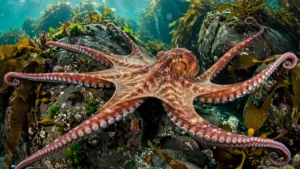
The Humboldt squid, Dosidicus gigas, is the lead species of this guide, and it is the squid most people in the eastern Pacific meet first, a large red animal that comes up in the nets of fishermen from Chile to Alaska. Its mantle is typically 1 to 1.5 metres long in a mature animal, and the largest animals reach a mantle length of 1.5 metres and a weight of up to 50 kilograms. It is a pelagic squid, which means that it lives in the open water, far from the shore and far from the sea floor, and it is found from Tierra del Fuego in the south to California in the north, with its range now spreading further north in warm years. Like the octopus, the Humboldt squid is a cephalopod with eight arms, a beak, and skin that changes colour, yet the octopus is a solitary animal that lives on the sea floor while the Humboldt squid is a schooling animal that lives in the open water and hunts in groups of hundreds.
| Type | Animal | Where it lives | Best-known food | Length or Weight |
|---|---|---|---|---|
| Family | Flying squids (Ommastrephidae) | Oceans worldwide | Fish and crustaceans | About 9 cm to 1.5 m mantle |
| Genus | Humboldt squid (Dosidicus) | Eastern Pacific | Fish and crustaceans | Up to 1.5 m mantle |
| Species | Humboldt squid (Dosidicus gigas) | Eastern Pacific | Lanternfish and squid | Mantle up to 1.5 m, up to 50 kg |
| Species | Neon flying squid (Ommastrephes bartramii) | Oceans worldwide | Fish and squid | Mantle up to about 60 cm |
| Species | Japanese flying squid (Todarodes pacificus) | Northwest Pacific | Fish and crustaceans | Mantle up to about 50 cm |
| Species | Glassy flying squid (Hyaloteuthis pelagica) | Tropical oceans | Small crustaceans | Mantle up to 9 cm |
The closest relatives of the Humboldt squid are the other flying squids of the family Ommastrephidae, and the family holds more than 20 species, from the tiny glassy flying squid to the Humboldt squid itself. The neon flying squid, Ommastrephes bartramii, is a squid of oceans around the world, with a mantle of up to about 60 centimetres, and it is named for the light organs along its body. The Japanese flying squid, Todarodes pacificus, is a squid of the northwest Pacific, with a mantle of up to about 50 centimetres, and it supports a large fishery in Japan and Korea. The glassy flying squid, Hyaloteuthis pelagica, is the smallest member of the subfamily, with a mantle of up to 9 centimetres, and it is a clear, delicate animal of tropical waters. None of them reaches the size of the Humboldt squid, and none of them lives in shoals as large as its shoals.
What Humboldt squid look like
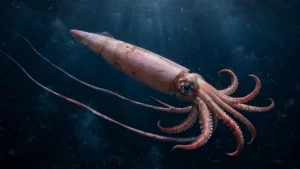
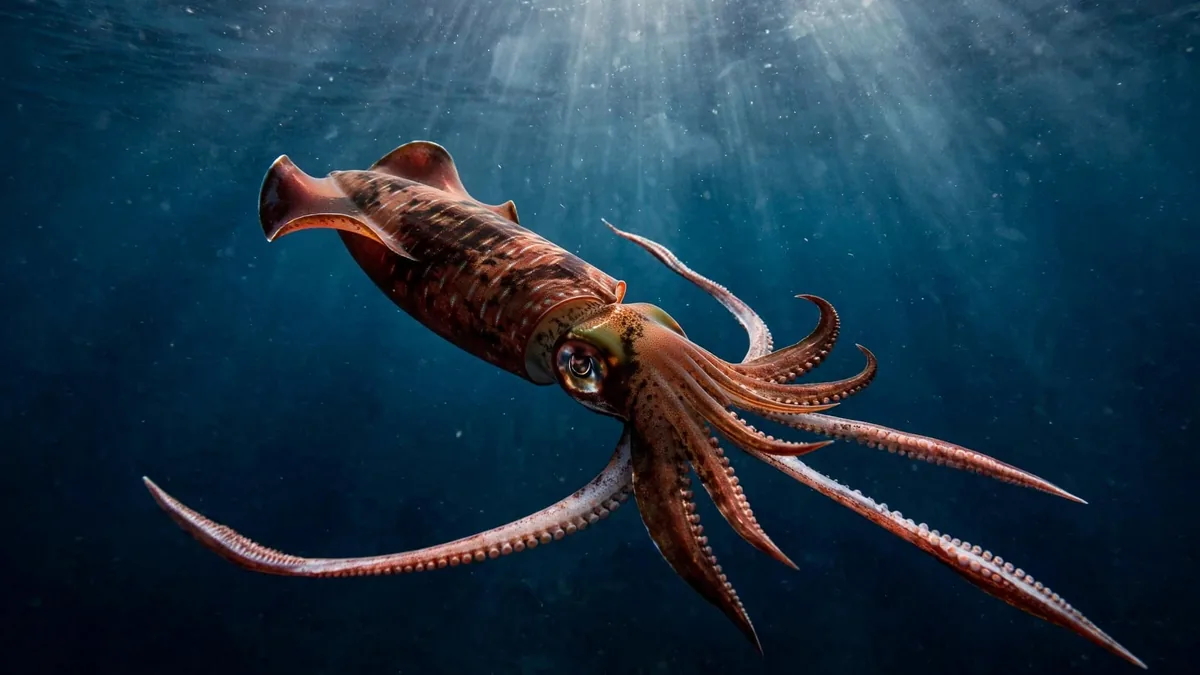
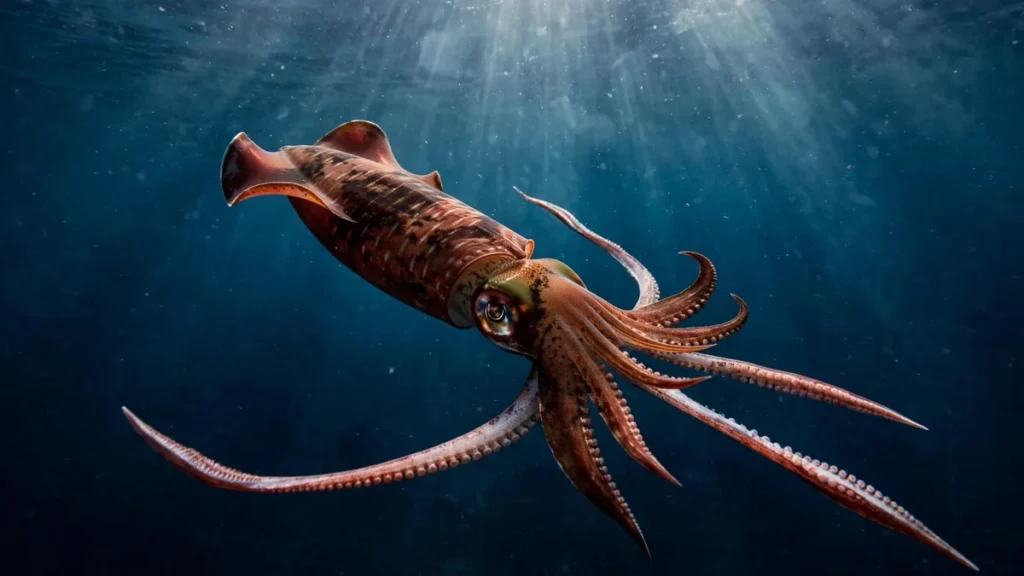
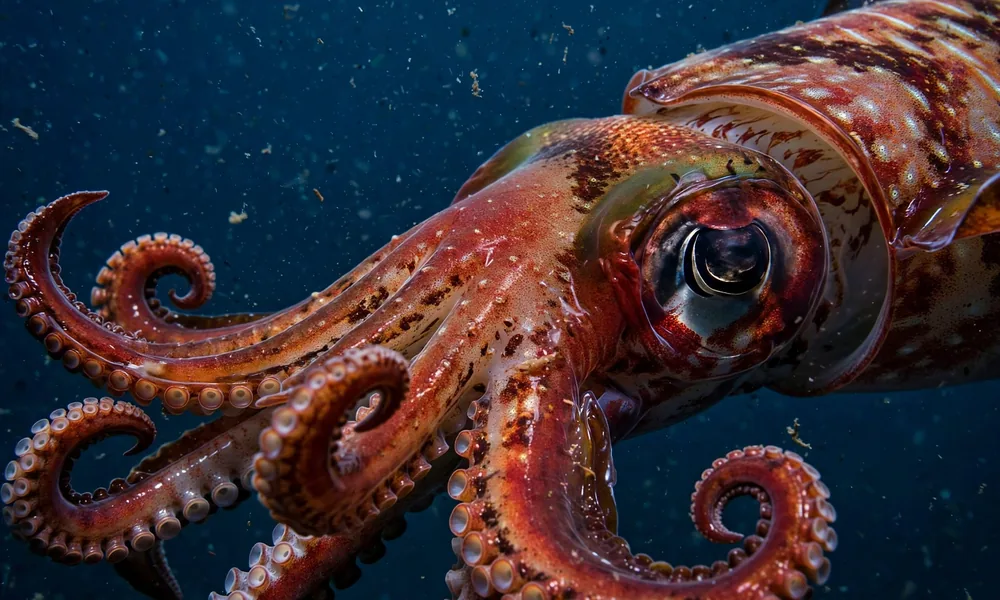
A Humboldt squid looks like a large, muscular torpedo, and the first thing anyone notices is the colour. The body is reddish brown to brick red at rest, and it can flash to white and back to red several times a second, in waves that run up and down the body. The mantle is long, conical, and muscular, and it tapers to a point at the tail, where two large triangular fins run along nearly the full length of the mantle. The head carries two large eyes, and below the head are eight arms and two long tentacles, and the arms carry suckers lined with sharp teeth. The mouth sits at the centre of the arms, and it holds a large, sharp beak that can shear through fish bone.
The size of a Humboldt squid depends on the animal and on the season, and the difference is easy to see once you know to look for it. A mature animal typically has a mantle of 1 to 1.5 metres, and the largest animals reach a mantle length of 1.5 metres and a weight of up to 50 kilograms, which is 110 pounds. The arms and the tentacles together push the total length toward 2 metres. The females mature at larger sizes than the males, on average, and the mantle makes up about 56 to 62 per cent of the mass of the animal, while the arms and tentacles make up about 11 to 15 per cent, and the head, with the eyes and the beak, makes up about 10 to 13 per cent.
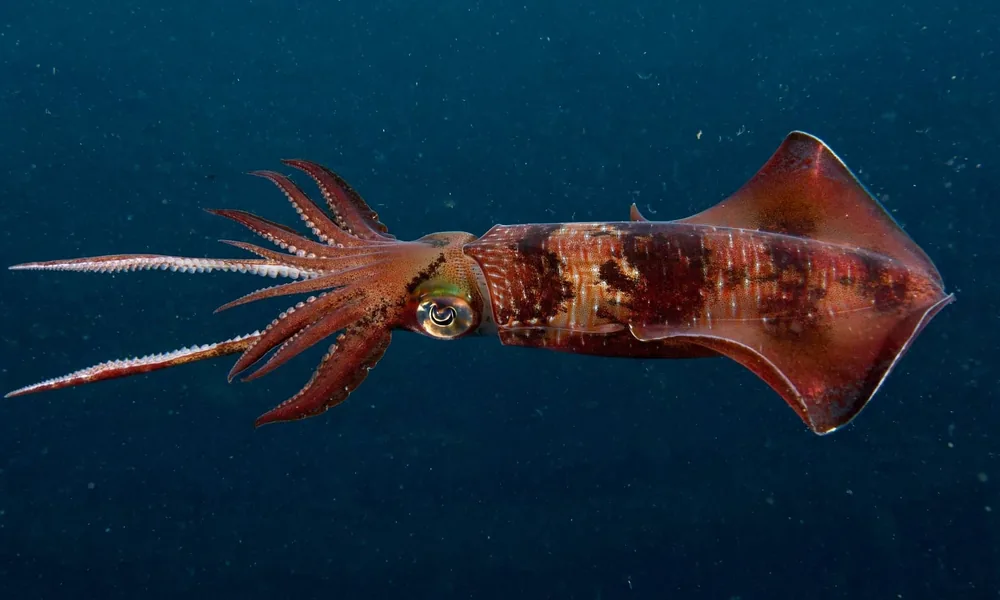
The skin is not decoration. It is a language, and it is what makes the Humboldt squid so striking to watch. The skin holds chromatophores, small sacs of pigment that the squid can open and close in a fraction of a second, and the squid can change from deep red to white and back again at two to four times a second. Cameras fixed to Humboldt squid have shown two kinds of colour change. The first is a fast flash of the whole body between red and white, which is thought to be a signal between animals in a shoal. The second is a slower flicker of red and white waves that travel up and down the body, which is thought to be a kind of camouflage, like the pattern of sunlight on the bottom of a swimming pool.
Where Humboldt squid live
Humboldt squid live in the open eastern Pacific Ocean, and they are found from Tierra del Fuego in the south to California in the north. Their heartland is the productive water of the Humboldt Current off Peru and Chile, the California Current off Mexico and the United States, and the Costa Rica Dome, a patch of upwelling water off Central America. They are most commonly found at depths of 200 to 700 metres, in water that is cool and rich in the small fish and crustaceans they eat. In warm years their range spreads further north, and they have been found in Oregon, Washington, British Columbia, and Alaska, and they have even ventured into Puget Sound.
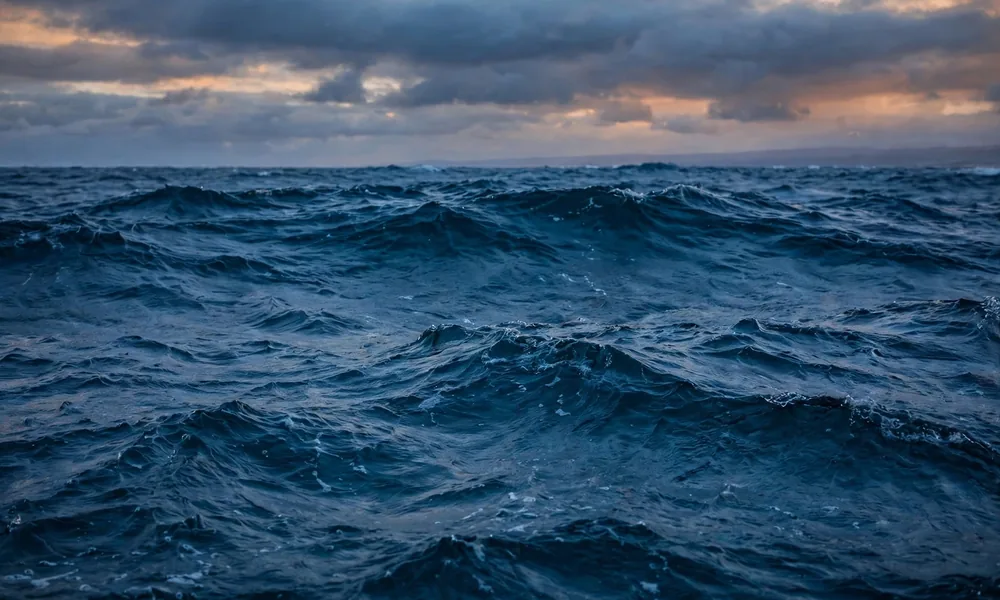
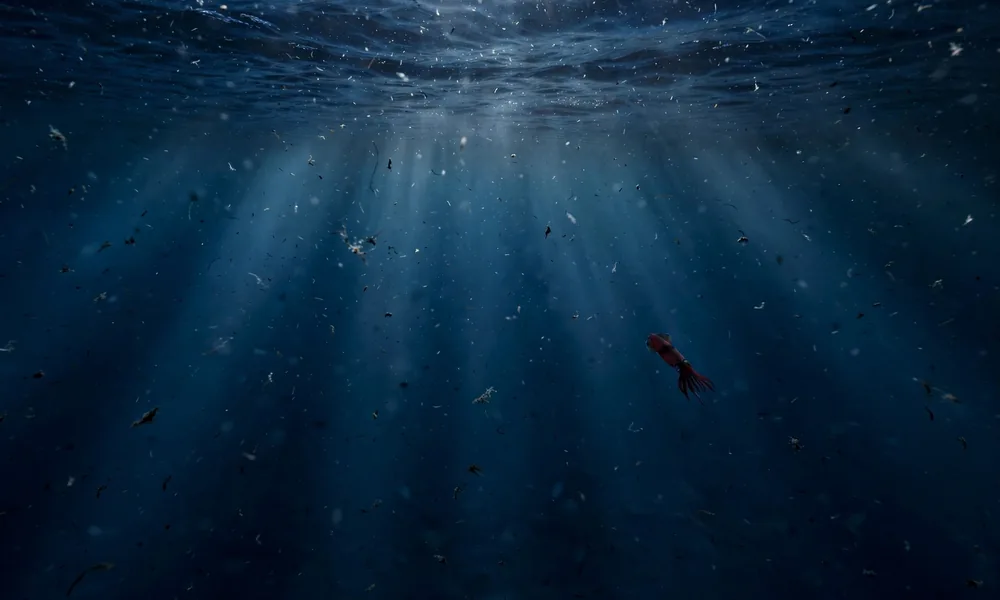
The habitat a Humboldt squid needs is not one place but a column of water, and it moves up and down that column every day. By day it sits in deep water, at 200 to 700 metres, and often deeper, above or inside the oxygen minimum zone, a layer of water where the oxygen is so low that most fish cannot live there. The Humboldt squid can cope with that water by slowing its metabolism, and the low oxygen keeps its predators away. At night it rises to within tens of metres of the surface, following the deep scattering layer of lanternfish and crustaceans that also migrates upward after dark.
The range of the Humboldt squid has grown in recent decades, and the growth is tied to the warming of the sea. Studies published in the early 2000s showed the species moving further north, and the northward spread has continued in warm years, with animals turning up off the Pacific Northwest and Alaska. The species is a creature of upwelling, and its numbers rise and fall with the strength of the currents that bring cold, nutrient rich water to the surface, so a good year for upwelling is a good year for squid.
What Humboldt squid eat
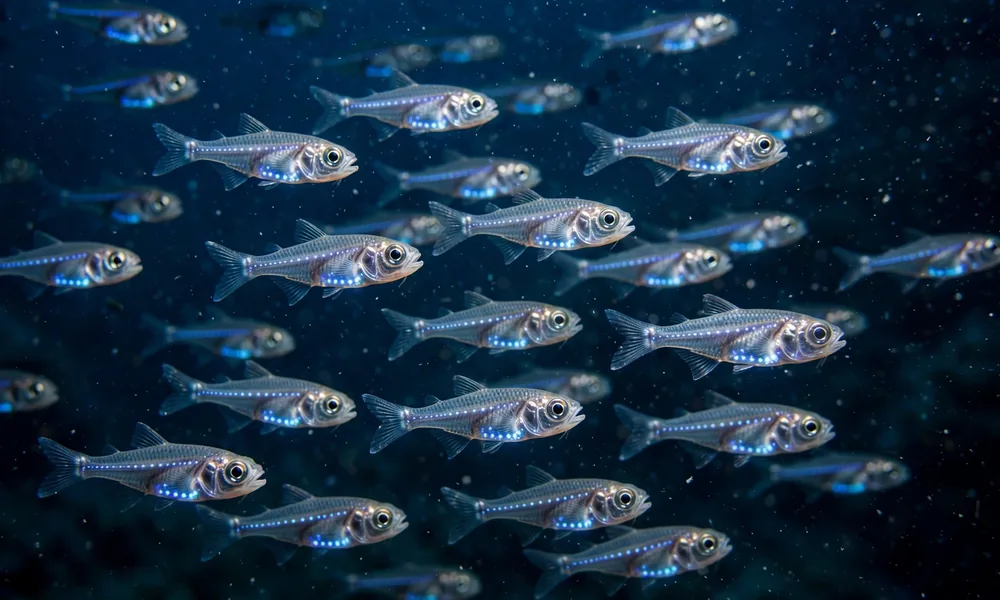
Humboldt squid eat fish, crustaceans, and other squid, and nothing else, and they are hunters rather than scavengers. Their main food is small mesopelagic fish, above all the lanternfish that rise to the surface at night in vast numbers, and they also eat sardines, anchovies, hake, rockfish, krill, and small crustaceans. A Humboldt squid grabs its prey with its two long tentacles, which can lash out with great speed, and holds it fast with the toothed suckers on the arms. Then it draws the prey to its beak and slices and tears the flesh with the beak and the radula, a ribbon of teeth inside the mouth.
The most famous part of the Humboldt squid diet is cannibalism, and it is well documented in the stomachs of animals caught by fishermen. Over half of the squid examined in one study had the beaks of their own species in their stomachs, and the Humboldt squid was the most common prey item in its own diet. A Humboldt squid will readily attack an injured or vulnerable squid in its own shoal, and smaller squid are at risk from larger squid in the same school. Like the crab, the Humboldt squid eats crustaceans when they are in reach, yet the crab is a slow animal of the sea floor that picks at what it finds while the Humboldt squid is a fast animal of the open water that chases its food in a school.
What a Humboldt squid eats depends on where it is and on what the water holds, and the diet changes as the animal grows. The young eat copepods and small crustaceans, and the adults eat fish and squid, and the largest animals can take prey as large as a small shark. The squid are opportunists, and they take whatever is abundant, from pelagic red crabs off Mexico to the lanternfish of the deep scattering layer. The squid need a lot of food to grow as fast as they do, and a single animal can put on 80 millimetres of mantle in a month as a juvenile.
How Humboldt squid behave
Humboldt squid are night hunters, and their day is a journey up and down the water. By day they sit in deep water, at 200 to 700 metres, and they rise to near the surface from dusk to dawn, following the fish and crustaceans that also migrate upward after dark. They swim by jet propulsion, drawing water into the mantle and forcing it out through a funnel, and they steer with their two large fins. They can swim at speeds of up to 24 kilometres per hour, which is 15 miles per hour, and they can change direction in a flash. They are almost always found in shoals, and a shoal can hold up to 1,200 animals, all of them moving together in the dark.
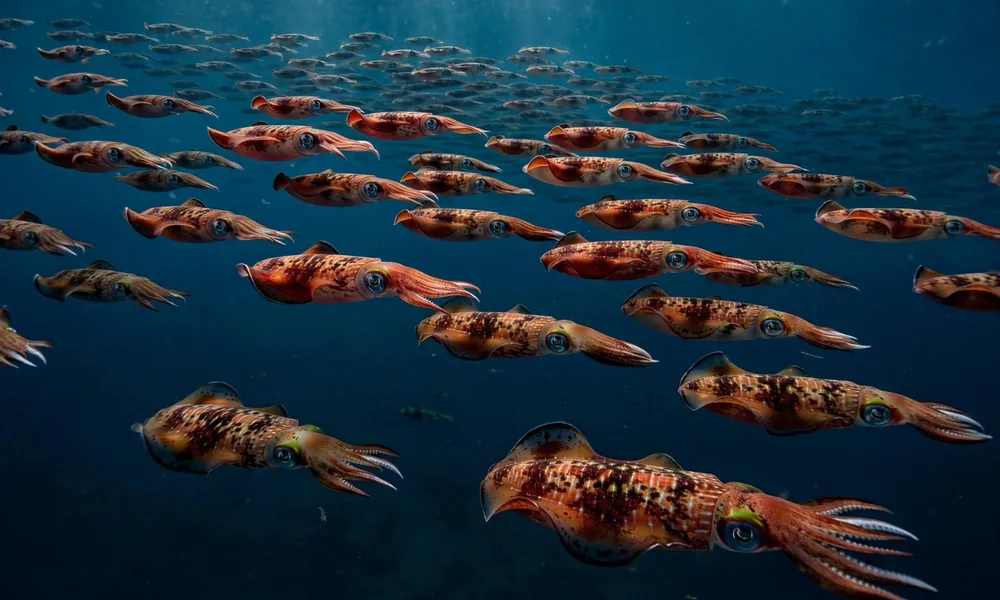
The shoal is a family of hunters, and it is a loosely ruled one, and the squid in it do not follow a leader but respond to each other. The flashing of the skin is thought to be a signal between animals in a shoal, and a squid that flashes red and white at two to four times a second may be telling its neighbours where it is and what it is doing. The squid also hunt together, and researchers have watched them work as a group to herd small fish, which would be the first observation of cooperative hunting in an invertebrate.
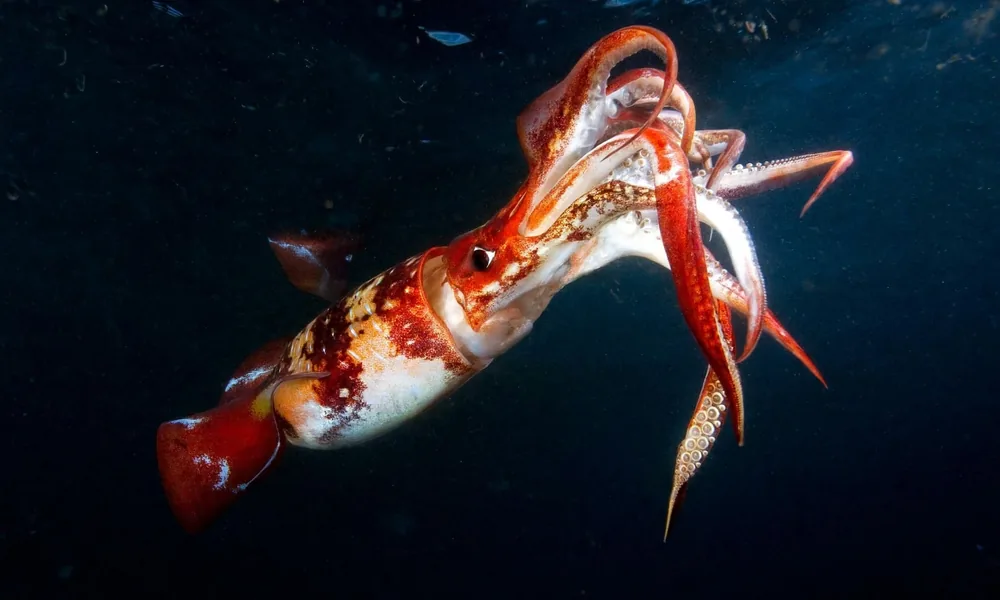
Humboldt squid have a reputation for aggression toward people, and the reputation is real, though it needs care. Fishermen in Baja California call the animal the red devil, because it flashes red and white when it is caught, and divers have been bitten through wetsuits and have had cameras pulled away from them. The aggression seems to happen mainly at feeding time, when the squid are in a shoal and the water is full of food, and at other times the squid are quite passive. A diver who meets a Humboldt squid at night, when the shoal is rising to feed, is meeting the animal at its most dangerous hour, and the squid can be a genuine danger in open water, above all when it is in a large group.
Breeding and life cycle
A Humboldt squid lives for only one to two years, and the whole life turns on speed. It hatches at about one millimetre long, as a paralarva, and it grows at up to 80 millimetres of mantle a month in its early stages, and at up to 60 millimetres a month in its later stages. That is the highest growth rate reported for any squid, and it lets the animal reach a mantle of more than a metre in a single year. The squid matures in less than a year in warm water, and the largest animals may live for up to two years.
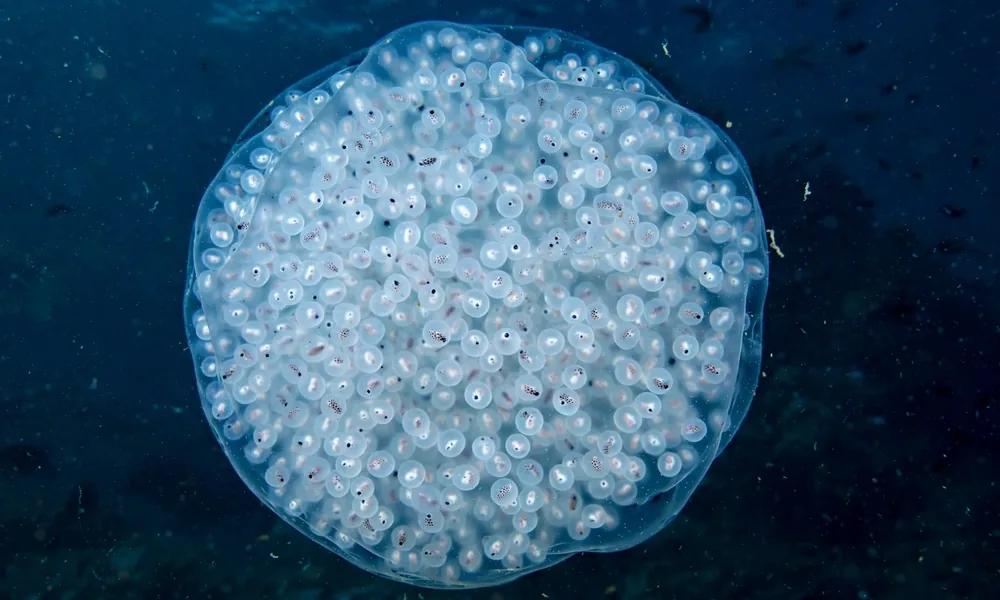
The breeding of a Humboldt squid is a single great effort, and the animal dies after it. The males transfer sperm to the female with a specialised arm, and the female lays her eggs in large gelatinous masses that drift in the midwater. A female can lay as many as 20 million eggs in her short life, and the potential fecundity averages around 18 to 21 million oocytes, with a maximum of 32 million, the largest ever recorded for any cephalopod. A rare egg mass collected in the Gulf of California in 2006 was a neutrally buoyant sphere of jelly, several feet across, holding hundreds of thousands of eggs. The eggs hatch in six to nine days at 18 degrees Celsius, and temperatures below 15 degrees and above 25 degrees do not allow the young to develop fully.
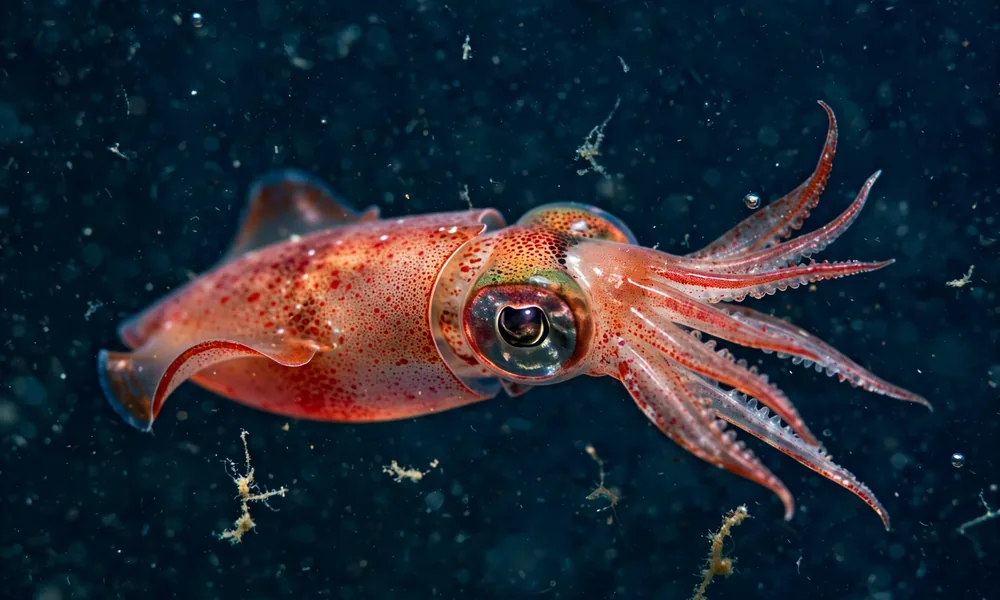
In the course of a single year the Humboldt squid passes from a millimetre of jelly to a metre of muscle, and then it spawns and dies. The males mature before the females, at a mantle length of more than 65 centimetres, while the females mature at more than 70 centimetres in some waters, though the size at maturity can be below 20 centimetres in the northern Humboldt Current, and it can more than double in one to two years after an El Nino event. The short life and the huge number of eggs mean that the population can turn over entirely within about two seasons, and a good year for food is a good year for squid.
Conservation status
The conservation status of the Humboldt squid is hard to judge, because the animal is short lived, fast growing, and hard to count. The International Union for Conservation of Nature lists the species as Data Deficient, assessed in 2014, because there is no global population estimate and the numbers rise and fall so fast with the ocean that a drop in the catch may mean a change in the climate rather than a fall in the population. The species is not thought to be in danger of extinction, and its range has grown in recent decades, yet the honest position is that nobody knows how many Humboldt squid there are in the sea, and the fishery that depends on them is one of the largest in the world.
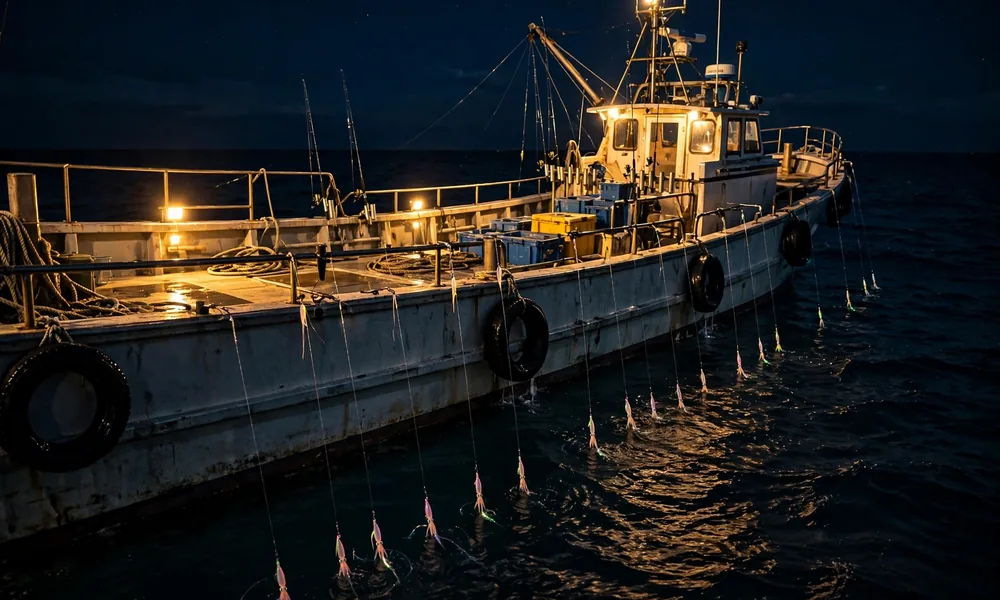
The Humboldt squid supports the largest invertebrate fishery in the world, and the catch is landed mainly in Chile, Peru, and Mexico. The fleets in Peru and Chile land close to a million tonnes a year in good years, and the squid is jigged at night, when the animals rise to the surface to feed. The fishery is enormous, and it rises and falls sharply with the same climate cycles that drive the squid, so a warm year can bring a boom and a cold year can bring a collapse. The fishery in the Gulf of California collapsed in 2015 and has not recovered, and the squid there have grown smaller and fewer.
The pressures on Humboldt squid are the same ones pressing on the ocean everywhere, and they act together rather than one at a time. Warming water is the first, because it changes the currents that bring food to the surface and it changes the size at which the squid mature. Overfishing is the second, and a fishery that takes close to a million tonnes a year can take too much in a bad year, when the population is already low. The oxygen minimum zone is the third, because the squid depend on it as a refuge from predators, and a change in its size or depth could change where the squid can live. The good news is that the squid grows fast and breeds in huge numbers, and a population can recover in a year or two when the water is right, yet the honest position is that the fishery needs care, and the Data Deficient label is a warning that the numbers are not known.
Best seasons for Humboldt squid watching
The best time to look for Humboldt squid is the warm half of the year, when the water is rich and the shoals are rising to feed at night. The squid are present in the eastern Pacific through the year, yet they are easiest to find in summer and autumn, when the upwelling is strong and the lanternfish are abundant. The best hours are the night hours, from dusk to dawn, when the squid rise from depths of 200 to 700 metres to within tens of metres of the surface. A boat with lights at night can draw a shoal to the surface, and a fisherman jigging in the Gulf of California or off Peru can catch a squid in minutes.
The best places are the waters off Peru and Chile, the Sea of Cortez in Mexico, and the coast of California, where the squid are most abundant and the fishery is largest. The most famous Humboldt squid of all is the red devil of Baja California, and a night on a fishing boat in the Sea of Cortez, with the deck lights on and the jigging lines in the water, is the best way to meet one in the wild. A watcher should stay on the boat, and should never swim with a feeding shoal at night.
Staying safe around Humboldt squid
A Humboldt squid is dangerous to people who meet it in the water at feeding time, and there is a safety warning that belongs to the squid itself. Do not swim with a shoal at night, and do not put your hands in the water when squid are feeding. A Humboldt squid has a large, sharp beak that can shear through fish bone, and its suckers are lined with sharp teeth that can cut human skin. Divers have been bitten through wetsuits, and cameras and equipment have been pulled away from researchers. A squid that is hooked or handled will flash red and white and thrash, and it can injure a person who is not careful.
If you are on a fishing boat, keep your hands clear of the squid as it comes aboard, and use a gaff or a net rather than grabbing the animal by the arms. If you are diving, stay out of the water when a shoal is rising to feed, and keep your distance from any squid you meet. The squid is not a monster, and it is a wild animal that hunts in the dark, so the safe way to watch it is from a boat, with the deck lights on and the animal in the water below you.
Humboldt squid watching checklist
A little preparation turns a night on the water into a real chance of seeing Humboldt squid at their best, rising to feed in the dark.
- A night on a fishing boat in the Sea of Cortez or off Peru in summer or autumn, when the shoals are rising to feed.
- A warm, calm night with little wind, when the sea is flat enough to see the squid flashing beneath the surface.
- A boat with deck lights, because the lights draw the lanternfish to the surface and the squid follow them.
- Binoculars and a camera with a night setting, so you can watch the squid without putting your hands in the water.
- A field guide to the squids of the eastern Pacific, so you can tell a Humboldt squid from a smaller flying squid.
- A notebook for the time of night, the depth of the water, and the size of the shoal, so you can compare one season with the next.
- Respect for the squid and the sea, keeping your distance from any feeding shoal, keeping your hands out of the water, and leaving the animals alone.
Frequently asked questions
How big do Humboldt squid get?
Humboldt squid are the largest squids in their family, and a large adult reaches a mantle length of 1.5 metres, a total length of about 2 metres, and a weight of up to 50 kilograms, which is 110 pounds. Most mature animals have a mantle of 1 to 1.5 metres, and the females mature at larger sizes than the males, on average. The mantle makes up about 56 to 62 per cent of the mass of the animal, while the arms and tentacles make up about 11 to 15 per cent. A Humboldt squid is much smaller than a giant squid, which is a different animal altogether.
What do Humboldt squid eat?
A Humboldt squid eats fish, crustaceans, and other squid, and nothing else. Its main food is lanternfish, the small fish that rise to the surface at night, and it also eats sardines, anchovies, hake, rockfish, krill, and small crustaceans. The squid grabs its prey with its two long tentacles, holds it fast with the toothed suckers on its arms, and slices it with its large, sharp beak. It also eats its own kind, and over half of the squid examined in one study had the beaks of Humboldt squid in their stomachs.
Are Humboldt squid dangerous?
Yes, they can be dangerous, above all at night when they are feeding in a shoal. A Humboldt squid has a large, sharp beak that can shear through fish bone, and its suckers are lined with sharp teeth that can cut human skin. Divers have been bitten through wetsuits, and cameras have been pulled away from researchers. The aggression seems to happen mainly at feeding time, and at other times the squid are quite passive. The safe way to watch them is from a boat, with the deck lights on and the animal in the water below you.
Where do Humboldt squid live?
Humboldt squid live in the open eastern Pacific Ocean, from Tierra del Fuego in the south to California in the north, and their range now spreads further north in warm years, to Oregon, Washington, British Columbia, and Alaska. They are most commonly found at depths of 200 to 700 metres by day, and they rise to near the surface at night to feed. Their heartland is the Humboldt Current off Peru and Chile, the California Current off Mexico and the United States, and the Costa Rica Dome off Central America.
How long do Humboldt squid live?
Humboldt squid live for only one to two years, and that short life is one of the most remarkable things about them. They hatch at about one millimetre long, and they grow at up to 80 millimetres of mantle a month as juveniles, the fastest growth reported for any squid. They mature in less than a year in warm water, and they spawn once and then die. A female can lay as many as 20 million eggs in her short life, and the potential fecundity averages around 18 to 21 million oocytes, with a maximum of 32 million.
How is this guide different from the honeybee guide?
This guide covers the Humboldt squid, a large red predator of the open eastern Pacific that lives for one to two years, hunts in shoals of up to 1,200 animals, flashes its skin from red to white, and grows to a mantle of 1.5 metres and a weight of up to 50 kilograms, while our honeybee guide covers a small golden insect that lives in a large perennial colony of 20,000 to 80,000 bees, builds wax comb, stores honey, and talks by dancing. One is a fast growing squid you meet from a boat at night in the dark ocean, and the other is a social bee you meet on a flower in a sunny meadow, and the giant squid that dwarfs them both is a different animal altogether, with a mantle of up to about 2.25 metres, a total length of up to about 13 metres, a largest specimen of about 18 metres, and a weight of up to about 275 kilograms.
Conclusion
The Humboldt squid species is a reminder that a short life can be a large one. A millimetre of jelly, a year of fast growth, a shoal of 1,200 animals flashing red and white in the dark, and a single great spawning have made the Humboldt squid the largest squid in its family and the most important squid in the world for fishermen, at home in the open eastern Pacific from Tierra del Fuego to Alaska.
If you go looking for one, go to the Sea of Cortez in summer, go at night, and stay on a boat with the deck lights on and the jigging lines in the water.