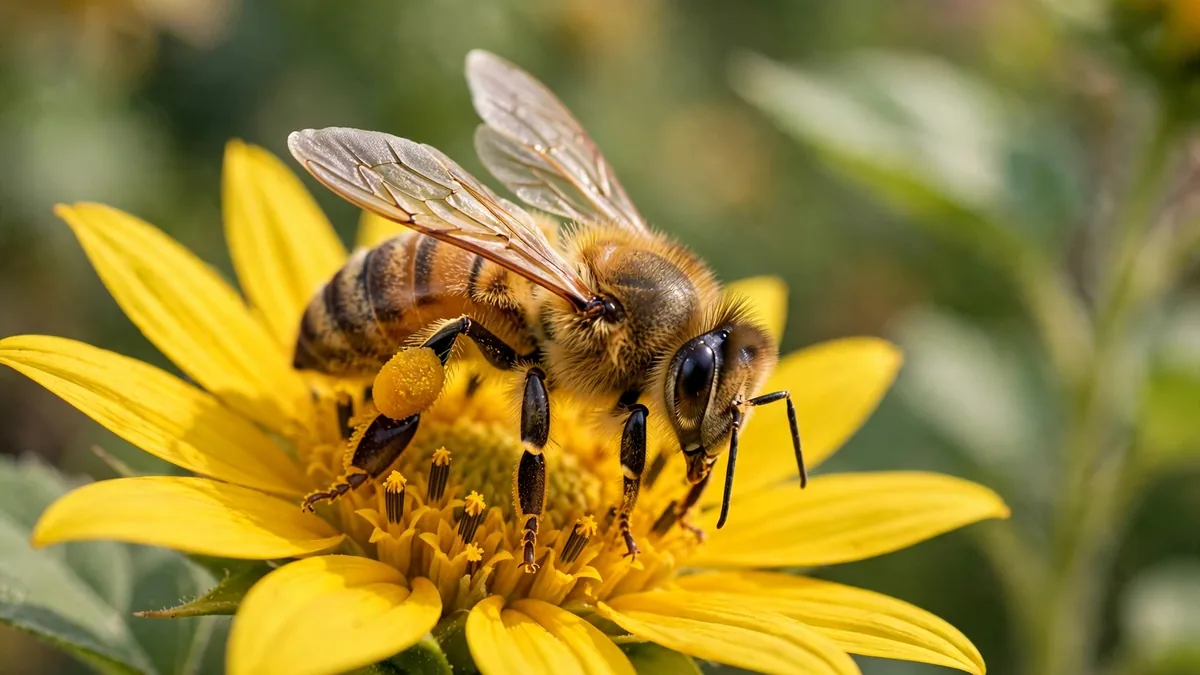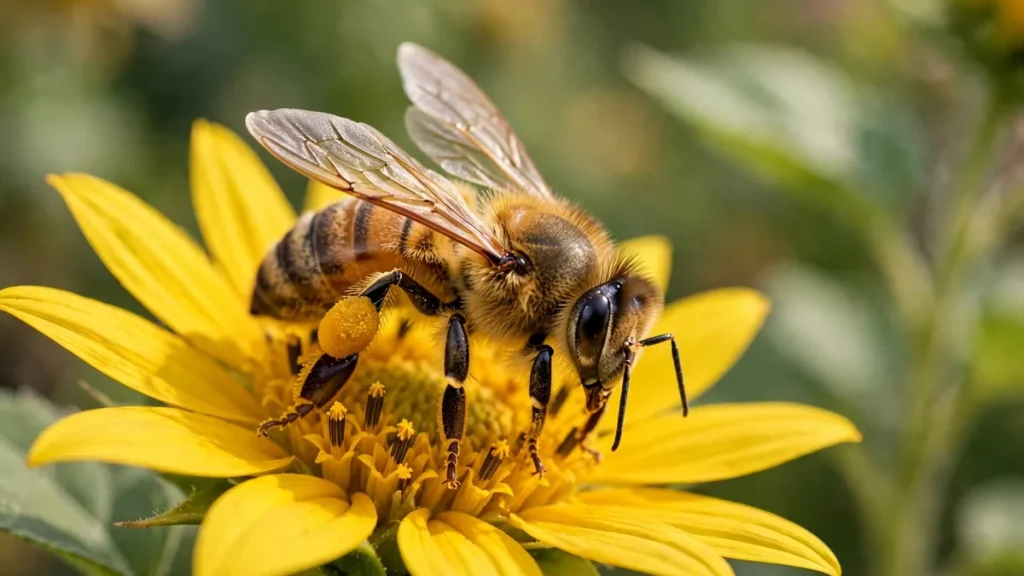
The honeybee species most people mean is the western honey bee, Apis mellifera, a small golden brown insect that lives in a large colony, builds wax comb, and stores honey for the winter. If you are asking what a honeybee is, the short answer is a social bee that keeps one queen, thousands of female workers, and a few hundred male drones in a single hive through the whole year, and it feeds the colony on nectar and pollen while it pollinates the flowers it visits. There are eight living honeybee species in the genus Apis, and only two of them are kept by people, yet the western honey bee alone has spread to every continent except Antarctica.
What makes the honeybee worth a whole guide is the life it leads as one body made of many bees. A single worker makes only about one twelfth of a teaspoon of honey in her whole life, and a colony still gathers enough to fill a hive and to feed a family through a cold winter. This guide follows that whole story, from the eight species and the castes of the hive through looks, habitat, diet, behaviour, breeding, and conservation to the seasons and the checklist that will help you watch honeybees well.
Key takeaways
- The honeybee species in this guide is the western honey bee, Apis mellifera, one of eight living species in the genus Apis, and the only honey bee kept by beekeepers around the world.
- A strong colony holds 20,000 to 80,000 bees, with one queen, thousands of female workers, and a few hundred male drones in the mating season.
- A forager tells her nestmates where food lies by a waggle dance, a figure of eight run that encodes direction and distance from the sun.
- A worker is 10 to 15 millimetres long, a queen is 18 to 20 millimetres long, and a drone is 15 to 17 millimetres long.
- Wild honeybee colonies in the European Union were assessed as Endangered by the International Union for Conservation of Nature in 2025, with a median decline of 56 per cent per decade.
The honeybee species and their relatives
Honeybees belong to the family Apidae, the great family of long tongued bees that also holds the bumblebees, the carpenter bees, and the stingless bees, and the family sits in the order Hymenoptera, alongside the ants, the wasps, and the sawflies. The honeybees are the tribe Apini, a single tribe of bees that live in large colonies and store honey. There are eight living honeybee species known worldwide, and all of them belong to the genus Apis. The genus began in tropical Asia, and only the western honey bee has been carried far beyond its native range by people.
The western honey bee, Apis mellifera, is the lead species of this guide, and it is the honeybee most people meet first, a golden brown bee that is out on the flowers from the first warm days of spring to the last ivy of autumn. Its workers are 10 to 15 millimetres long, its queen is 18 to 20 millimetres long, and its drones are 15 to 17 millimetres long. It is native to Europe, western Asia, and Africa, and it was carried to the Americas by colonists in the early 1600s. It now lives on every continent except Antarctica, in managed hives and in wild colonies in hollow trees, wall cavities, and rock crevices. Like the ant, the honeybee is a social insect that lives in a colony where most members never breed, yet the ant colony is ruled by scent trails on the ground while the honeybee colony is ruled by dances on the comb and by the scent of one queen.
| Type | Animal | Where it lives | Best-known food | Length or Weight |
|---|---|---|---|---|
| Family | Long-tongued bees (Apidae) | Worldwide | Nectar and pollen | About 7 mm to 20 mm long |
| Genus | Honey bees (Apis) | Europe, Africa and Asia | Nectar and pollen | About 7 mm to 20 mm long |
| Species | Western honey bee (Apis mellifera) | Europe, Africa and worldwide | Nectar and pollen | Worker 10 to 15 mm long |
| Species | Eastern honey bee (Apis cerana) | South and East Asia | Nectar and pollen | About 10 mm to 12 mm long |
| Species | Giant honey bee (Apis dorsata) | South and Southeast Asia | Nectar and pollen | About 17 mm to 20 mm long |
| Species | Red dwarf honey bee (Apis florea) | South Asia and Middle East | Nectar and pollen | About 7 mm to 10 mm long |
The closest relatives of the western honey bee are the other honey bees of the genus Apis, and the genus holds eight living species, from the dwarf bees of Asia to the giant bees of the Himalayas. The eastern honey bee, Apis cerana, is the traditional hive bee of South and East Asia, about 10 to 12 millimetres long, and it is the only other honey bee that people keep in hives. The giant honey bee, Apis dorsata, is a bee of South and Southeast Asia, about 17 to 20 millimetres long, that builds one huge open comb under a high branch or a rock ledge. The red dwarf honey bee, Apis florea, is a small bee of South Asia and the Middle East, about 7 to 10 millimetres long, that builds one small open comb in a shrub.
What honeybees look like
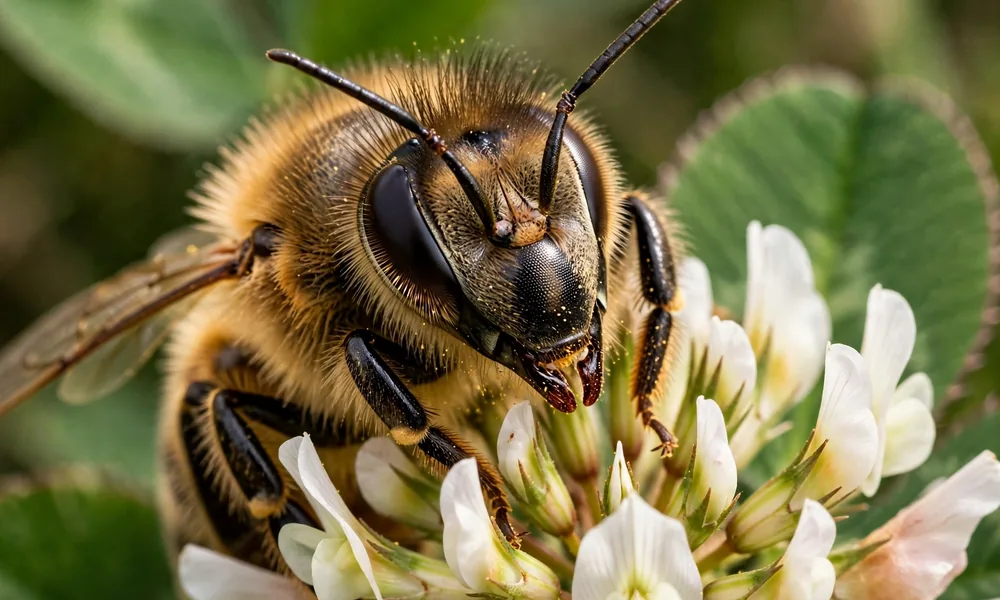
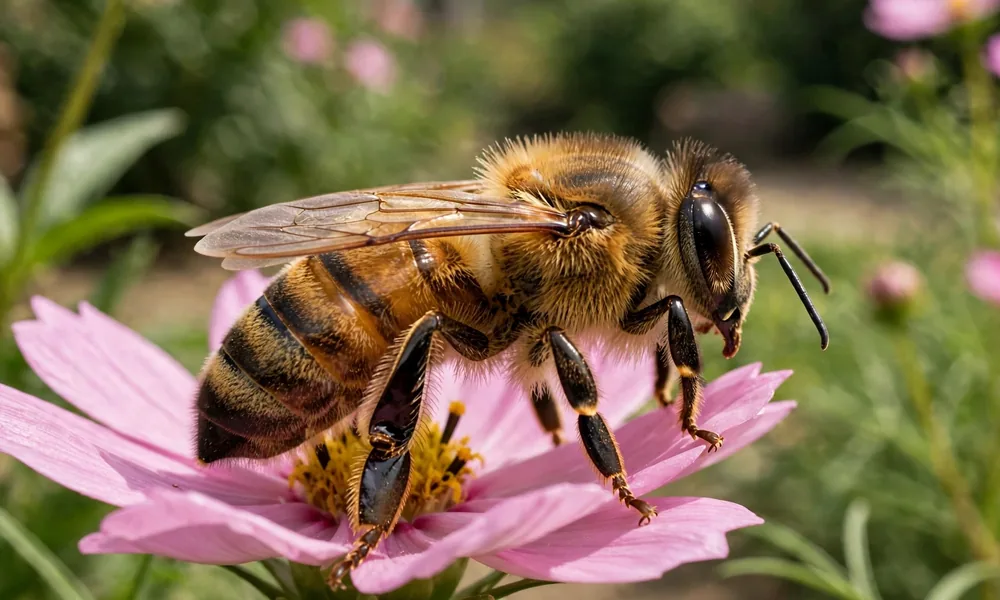
A honeybee looks like a small, neat, golden insect, and the first thing anyone notices is the colour. The body is amber brown with bands of black and orange yellow across the abdomen, and the thorax is covered in short golden hairs that catch the light as the bee moves. The head carries large dark compound eyes, short elbowed antennae, and a long tongue that folds away beneath it, and the thorax is a solid block of flight muscle with two pairs of thin, clear wings that hook together in flight. The abdomen is smooth and striped, and it ends in a sting in the females, while the hind legs of a worker carry a smooth hollow, the pollen basket, where she packs the pollen she gathers.
The size of a honeybee depends on the caste, and the difference is easy to see once you know to look for it. A worker is 10 to 15 millimetres long, a queen is 18 to 20 millimetres long, and a drone is 15 to 17 millimetres long. The queen is not only longer but slimmer and smoother, with a long tapering abdomen and shorter wings that do not reach the end of her body. The drone is broader and heavier, with very large eyes that meet at the top of his head, and he has no sting and no pollen basket. The worker is the smallest of the three, yet her wings are longer than the wings of a drone, and her body is built for work, with wax glands under the abdomen and a sting that she can use only once.
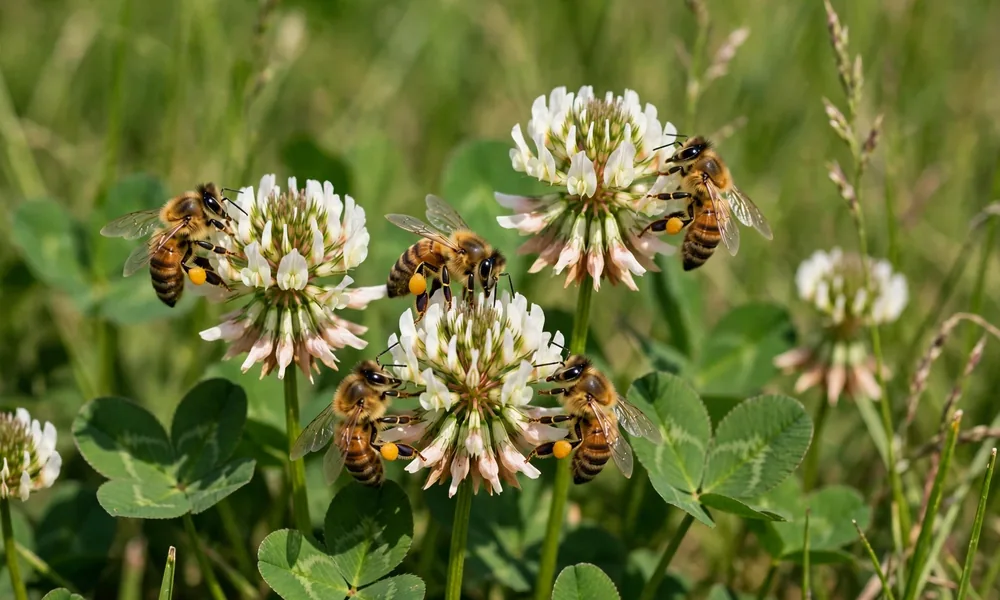
The hairs are not decoration. They are tools, and they are what make the honeybee such a good pollinator. Each hair is branched, like a tiny feather, and pollen clings to the hairs as the bee pushes into a flower, so a foraging honeybee is dusted in pollen as it works. The bee then grooms the pollen from its body with combs on its legs and packs it into the baskets on its hind legs, where it sits as a bright orange or yellow lump. The eyes see ultraviolet light that people cannot see, and many flowers carry patterns in ultraviolet that act as guides to the nectar.
Where honeybees live
Honeybees live wherever flowers grow in warm country, and the western honey bee is now found on every continent except Antarctica. Its native range is Europe, western Asia, and Africa, from the cool woodlands of northern Europe to the dry scrub of the Middle East and the savannas of sub-Saharan Africa. People carried it to the Americas in the early 1600s, and from there it spread to Australia, New Zealand, and the islands of the Pacific, so that a honeybee in a garden in Texas or Tasmania is the same species as a honeybee in a garden in England or Kenya.
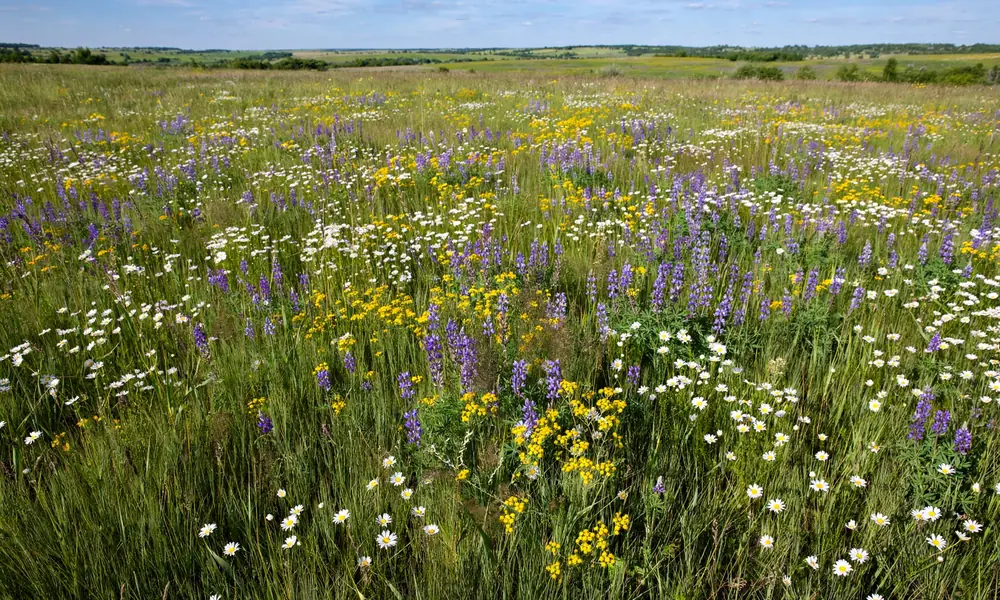
The home a honeybee needs is a dry, sheltered cavity with room for comb, and the wild colony chooses it with care. A hollow tree is the classic nest, and a wild colony will also settle in a rock crevice, a wall cavity, or an empty building, anywhere that keeps the rain out and the heat in. The managed colony lives in a wooden hive, a stack of boxes that a beekeeper can open and inspect, and the hive stands in an apiary, a group of hives in a garden, an orchard, or a field edge. The bees need flowers within flight range, and a good site is one where something is always in bloom, from willow and crocus in spring through clover and lavender in summer to ivy in autumn.
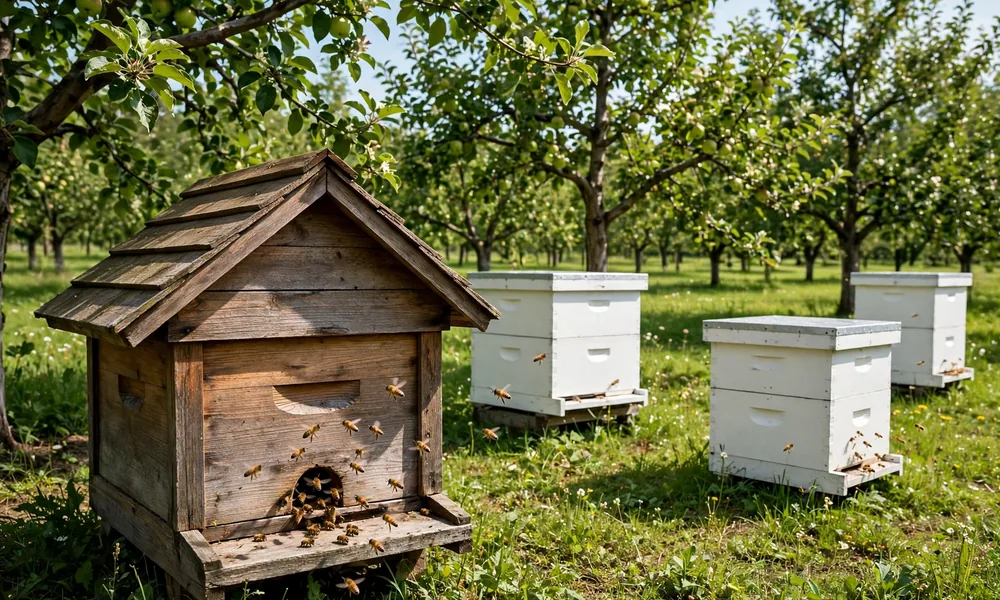
The range of a colony is set by the wings of its foragers, and a forager will fly several kilometres from the hive when the flowers demand it. Most trips are shorter, a few hundred metres to a good patch of clover or a flowering tree, and a forager learns the landmarks of her patch and the position of the sun. The old queen leaves with about half the bees, and they cluster on a branch while scouts search for a new cavity, then they move in together and start building comb from nothing. A wild colony can live in the same tree for years, and a managed colony can live in the same hive for decades, with queens replaced as they age.
What honeybees eat
Honeybees eat nectar and pollen, and nothing else, and the two foods do different jobs. Nectar is sugar water, the fuel that powers the flight muscles and keeps the colony warm, and the bee drinks it from the flower and carries it home in her honey stomach, a stretchy pouch in the gut, to share with the nest. Pollen is protein, the building material of new bees, and the bee gathers it on her hairy body, grooms it into the pollen baskets on her hind legs, and carries it home in bright orange or yellow lumps to feed the larvae. A foraging honeybee visits 50 to 100 flowers in a single trip, and a colony in full growth can bring home a surprising weight of pollen in a day.
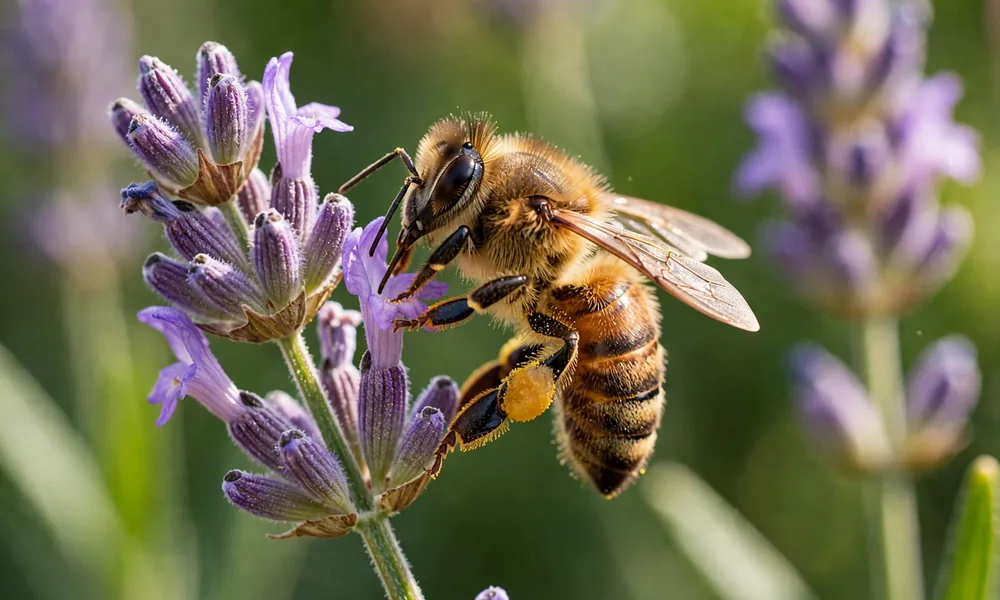
The most famous part of the honeybee diet is honey, and honey is simply nectar that the bees have changed and dried. A forager passes the nectar mouth to mouth to house bees in the hive, and enzymes in the bees break the sugars down into simpler sugars as the nectar moves from bee to bee. The house bees then spread the nectar in thin layers across the comb and fan it with their wings to drive the water out, until the moisture falls to about 18 per cent. Then they seal the cell with a thin cap of wax, and the honey inside will keep for years, because it is acidic, low in moisture, and hostile to microbes. A strong colony can store 25 to 50 kilograms of surplus honey in a good season, and it needs much of that store to survive a winter with no flowers.
What a honeybee eats depends on the season and on the flowers in reach, and the colony stores both foods for the lean months. In spring the bees work willow, crocus, and fruit blossom for early nectar and pollen. In autumn they work ivy, the last great flower of the year, and they build up the fat bodies of the winter bees on its pollen. The larvae eat only what the adults bring them, a paste of pollen mixed with nectar that beekeepers call bee bread, and a larva that is fed royal jelly, a rich food made by nurse bees, grows into a queen instead of a worker.
How honeybees behave
Honeybees are day bees, and their day starts early and ends late. A forager leaves the hive as soon as her flight muscles are warm, and she will fly at about 24 kilometres per hour when she is unloaded, slower when she is carrying a full load of nectar or pollen. She navigates by the sun and by landmarks, and she learns the flowers of her patch, returning to the same clump day after day while it is in bloom. She can forage in a cool wind and in light cloud, though she prefers a warm, still day, and she will work from dawn to dusk through the summer, visiting flower after flower in a steady circuit and returning to the hive with her baskets full.
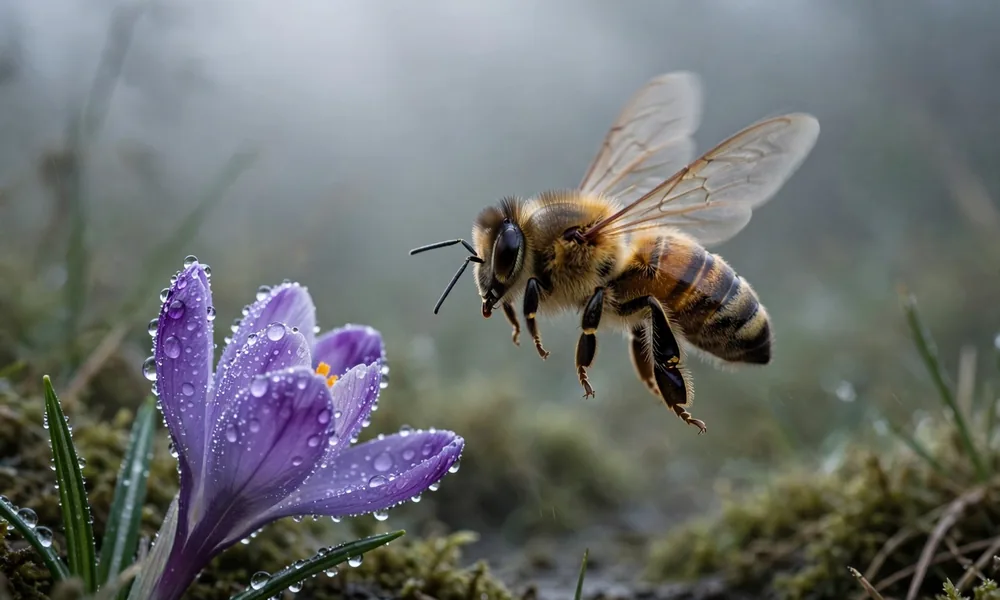
The colony is a family, and it is a tightly ruled one, and the queen does not command it by force but by scent. Her pheromones spread through the hive on the bodies of the workers that touch her, and they tell the colony that the queen is alive and laying, so the workers do not raise a new queen. The workers divide the work by age, with the youngest cleaning cells and feeding larvae, the middle aged bees building comb and guarding the entrance, and the oldest flying out to forage.
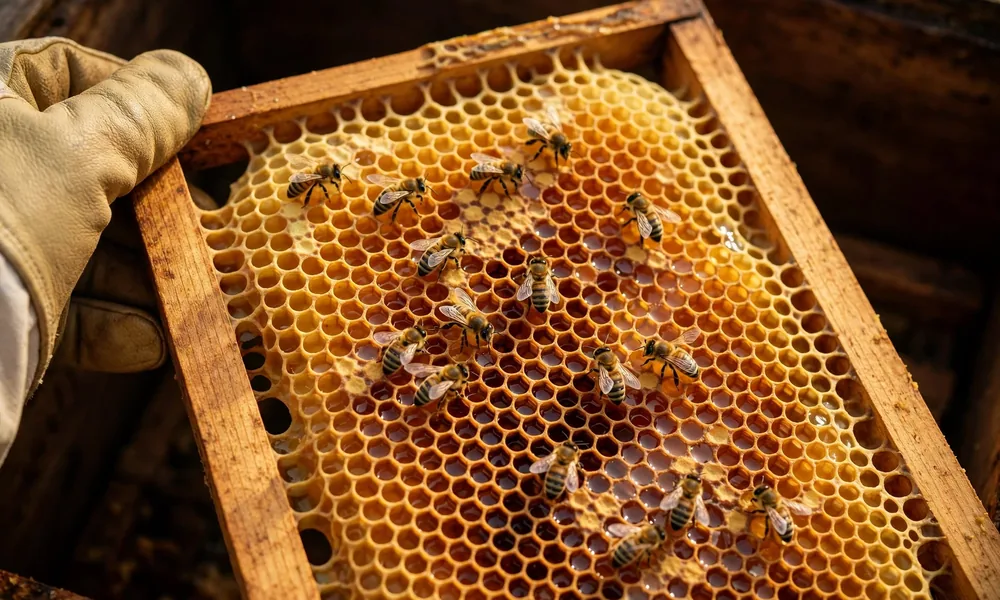
The waggle dance is the most famous behaviour of the honeybee, and it is one of the most remarkable kinds of communication in the animal world. A forager that has found a rich patch of flowers returns to the hive and dances on the vertical face of the comb, in a figure of eight with a straight waggle run in the middle. The angle of the waggle run against the vertical tells the other bees the direction of the food relative to the sun, and the length of the run tells them the distance. Karl von Frisch decoded the dance, and he shared the Nobel Prize in Physiology or Medicine in 1973 for his work on it.
Breeding and life cycle
A honeybee colony lives for many years, and the whole year turns on the queen. She is the only fertile female in the hive, and she lays eggs nearly all year, pausing only in the coldest weeks of winter. A productive queen can lay up to 1,500 to 2,000 eggs a day in the peak season, and she may lay 200,000 eggs in her lifetime. She mates only in her first weeks of life, on a few mating flights when she meets drones from other colonies in the air, and she stores the sperm in her body for the rest of her life. Fertilised eggs become females, workers or new queens, and unfertilised eggs become males, drones.
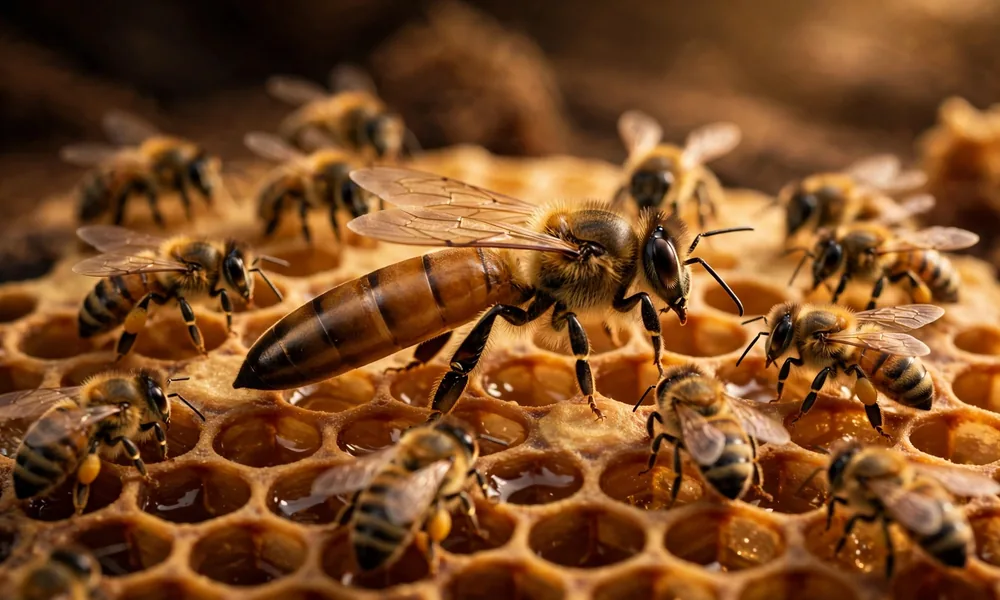
The young of a honeybee grow through four stages, egg, larva, pupa, and adult, and the time each stage takes depends on the caste. A queen takes about 16 days to grow from egg to adult, a worker takes about 21 days, and a drone takes about 24 days. The egg hatches into a small white larva, and nurse bees feed it on royal jelly at first and then on bee bread, until it is sealed into its cell to pupate. The adult chews its way out of the wax cap and starts work at once, cleaning the cell it came from. A summer worker lives only about five to six weeks, worked hard by foraging, while a worker born in autumn can live several months, because she stays in the hive and keeps the winter cluster warm.
In late spring the colony may swarm, and swarming is how a honeybee colony reproduces. The old queen leaves with about half the bees, and they cluster on a branch while scouts search for a new cavity, dancing for the sites they have found until the scouts agree on one. The bees left behind raise a new queen from a young larva, feeding her on royal jelly until she grows into a queen, and she mates and starts laying. A colony that swarms has divided itself in two, and each half must build up its stores before winter.
Conservation status
The conservation status of the honeybee is not one story but two, because the managed colony and the wild colony live different lives. The managed honeybee is abundant, and there are millions of hives in the world, kept by beekeepers for honey and for pollination. The wild honeybee is a different matter, and for many years it was assumed that wild colonies had died out in Europe, so the International Union for Conservation of Nature listed the species as Data Deficient in 2014, because there was too little information to judge it. A citizen science project called Honey Bee Watch, begun in about 2020, then found free living colonies across the continent, in trees, walls, and cliffs, and the picture changed.
In 2025 the International Union for Conservation of Nature reassessed the wild colonies of the western honey bee in the European Union as Endangered, the first time the species had been given that status. The assessment drew on nearly 700 monitored wild nests in seven countries, and it found a median decline of 56 per cent per decade if no new swarms escaped from managed hives. Wild colonies now make up about one sixth to one fifth of the honeybee population in Europe, and in five of the six countries first studied they were shrinking on their own, because too few wild colonies survived long enough to replace themselves. At the wider European scale the status stayed Data Deficient, because data outside the European Union are still sparse.
The pressures on honeybees are the same ones pressing on pollinators everywhere, and they act together rather than one at a time. The parasitic mite Varroa destructor is the first, because it feeds on developing and adult bees and spreads viruses, above all deformed wing virus, and a colony weakened by mites can fail in winter. Pesticides are the second, and the neonicotinoid insecticides that coat the seeds of many crops have been shown to reach the nectar and pollen the bees eat, and to leave colonies smaller and less able to raise queens. Habitat loss is the third, because a landscape of single crops offers a feast for a few weeks and a famine for the rest of the year. Disease is the fourth, and pathogens carried by managed bees can spill over into wild colonies. In the United States annual colony losses have often exceeded 40 per cent in recent years, well above the 15 to 20 per cent that beekeepers regard as sustainable.
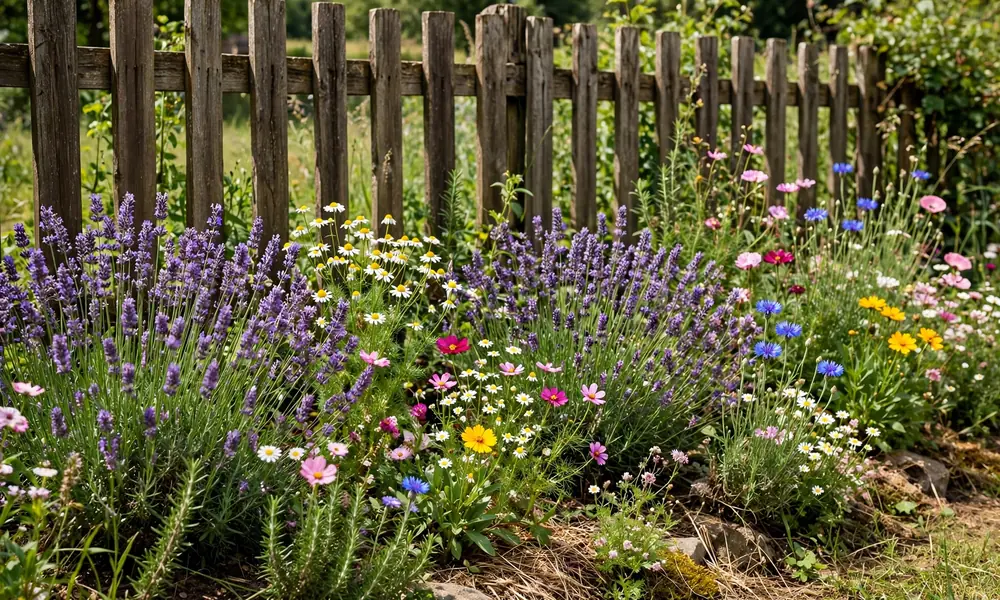
The good news is that honeybees respond quickly when the flowers come back and the mites are kept down. Farmers who leave field margins unsprayed and sow wildflower strips see numbers rise within a year or two, and gardens planted with the right flowers, left a little wild at the edges, can support a colony through a whole season. The honest position is that the managed honeybee is not about to vanish, while the wild honeybee in Europe is in real trouble, and the two stories should not be confused.
Best seasons for honeybee watching
The best time to look for honeybees is the whole warm half of the year, because there is always a honeybee out somewhere between the first spring flowers and the last autumn ivy. The first bees appear in March and April in Britain, on the willow catkins and the crocuses, and they are the easiest to watch, flying low and stopping often to feed. The workers follow from May onwards, and by July and August the colonies are at their largest and the meadows are at their busiest, with a dozen bees on a single clump of lavender. The last bees of the year are usually out on the ivy in October, feeding hard before the winter, and a warm October day can still bring a hive to life.
The best hours are the morning and the late afternoon, when the light is soft and the bees are working steadily, and the best weather is a warm, still day with a little cloud. Honeybees will fly in weather that keeps other bees at home, so a cool, grey morning can be a good time to watch them, and a bee warming up on a flower in the early sun is a sight that rewards patience. The most famous honeybee of all is the western honey bee, and National Geographic keeps a live profile of the honeybee. A morning in a wildflower meadow in July, field guide in your pocket, is the best way to meet one in the wild.
Staying safe around honeybees
A honeybee is not dangerous to people who leave it alone, and there is no safety warning that belongs to the bee itself beyond the obvious one. Do not disturb a hive, and do not swat a bee. A honeybee worker can sting, and the sting is painful, and anyone allergic to bee stings should carry medication and seek help at once if stung. A worker bee dies after she stings, because her barbed sting stays in the skin and tears free from her body, so a honeybee stings only when she must, when the hive is threatened or when she is trapped against the skin.
If you find a swarm in your garden, leave it alone and give it space, and call a local beekeeper, who will often collect it gladly. A swarm is not looking for a fight, and the bees in a swarm are full of honey and gentle, because they have no hive to defend.
Honeybee watching checklist
A little preparation turns a morning in a meadow into a real chance of seeing honeybees at their best, busy on the flowers in the warm air.
- A wildflower meadow or a bee friendly garden in July or August, when the colonies are at their largest and the flowers are at their busiest.
- A morning walk in warm, still weather, when the bees are working steadily and the light is soft enough to see their colours clearly.
- A field guide to the bees of your country, so you can tell a honeybee from a bumblebee and from a solitary bee.
- Binoculars and a camera with a close up setting, so you can watch the bees without crowding them or blocking their flight path.
- A patch of clover, lavender or lime blossom to sit beside, because the bees come to the flowers and you only have to wait.
- A notebook for the species you see, the flowers they visit, and the time of day, so you can compare one summer with the next.
- Respect for the bees and the meadow, keeping your distance from any hive, keeping your hands off the bees, and leaving the flowers standing.
Frequently asked questions
How big do honeybees get?
Honeybees are the small bees of the garden, and a western honey bee worker is 10 to 15 millimetres long, a queen is 18 to 20 millimetres long, and a drone is 15 to 17 millimetres long. The queen is the longest of the three, with a long tapering abdomen and wings that do not reach the end of her body. The drone is broader and heavier, with very large eyes that meet at the top of his head. Most honey bee species fall in the same range, about 7 to 20 millimetres long, and the giant honey bee is the largest of them, at about 17 to 20 millimetres.
What do honeybees eat?
A honeybee eats nectar and pollen, and nothing else. Nectar is the sugar water that fuels its flight and warms its hive, and pollen is the protein that feeds the larvae and builds new bees. The bee drinks nectar from flowers and carries it home in its honey stomach, and it gathers pollen on its hairy body and packs it into the baskets on its hind legs. In the hive the bees turn nectar into honey by adding enzymes and fanning it dry, and they store the honey in wax comb for the winter, when there are no flowers to work.
Do honeybees sting?
Yes, but only the females can sting, and they almost never do unless the hive is threatened. The sting is barbed, so a honeybee worker dies after she stings, because the sting stays in the skin and tears free from her body. In practice a honeybee on a flower will simply move away if disturbed, and a bee at the hive entrance will buzz loudly before it stings. The drones cannot sting at all, and a drone that flies up to your face in late summer is looking for a queen, not threatening you.
Where do honeybees live?
Honeybees live on every continent except Antarctica, in meadows, orchards, woodland edges, hedgerows, and gardens, from the cool woodlands of northern Europe to the savannas of Africa. They need three things close together. Flowers to feed on from spring to autumn, a dry sheltered cavity for the comb, and water close by for cooling the hive. A wild colony lives in a hollow tree, a rock crevice, or a wall cavity, while a managed colony lives in a wooden hive in an apiary.
Can you keep honeybees as pets?
You cannot keep honeybees as pets in the way you keep a dog, and you should not try without learning the craft first. A honeybee colony is a farm animal in miniature, and it needs a hive, regular checks for disease and mites, and a beekeeper who knows when to feed it and when to leave it alone. What you can do is take a beekeeping course, join a local association, and start with one hive under the eye of an experienced beekeeper. If a colony moves into your garden on its own, call a beekeeper, because a swarm in a wall can be hard to remove once it has built comb.
How is this guide different from the hermit crab guide?
This guide covers the honeybee, a small flying insect of the genus Apis that lives in a large perennial colony of 20,000 to 80,000 bees, builds wax comb, stores honey, and talks by dancing, while our hermit crab guide covers a crustacean that lives on the shore and in the sea, carries a borrowed shell on its back, and changes shells as it grows. One is a social bee you meet on a flower in a sunny meadow. The other is a shell carrying crab you meet on a beach or a rock pool at low tide.
This guide also goes further than our general bee guide, which covers bees as a whole, from honey bees to solitary bees to bumblebees, in a single broad sweep. That guide is the place to start if you want to know what a bee is, while this guide stays with one group for its whole length, following the honeybee from its eight species and its waggle dance through its meadow habitat, its nectar and pollen diet, its one queen colony and its decline to the seasons and the checklist that will help you see one for yourself.
Conclusion
The honeybee species is a reminder that a small animal can carry a whole landscape on its back. A neat golden bee, a colony that lives for years, a dance that points to flowers several kilometres away, and a queen that lays up to 2,000 eggs a day have made the honeybee the most loved pollinator in the world, at home in meadows and gardens from Europe and Africa to the Americas and Australia.
If you go looking for one, go to a wildflower meadow in July, go in the morning, and sit beside a patch of clover or lavender and wait.