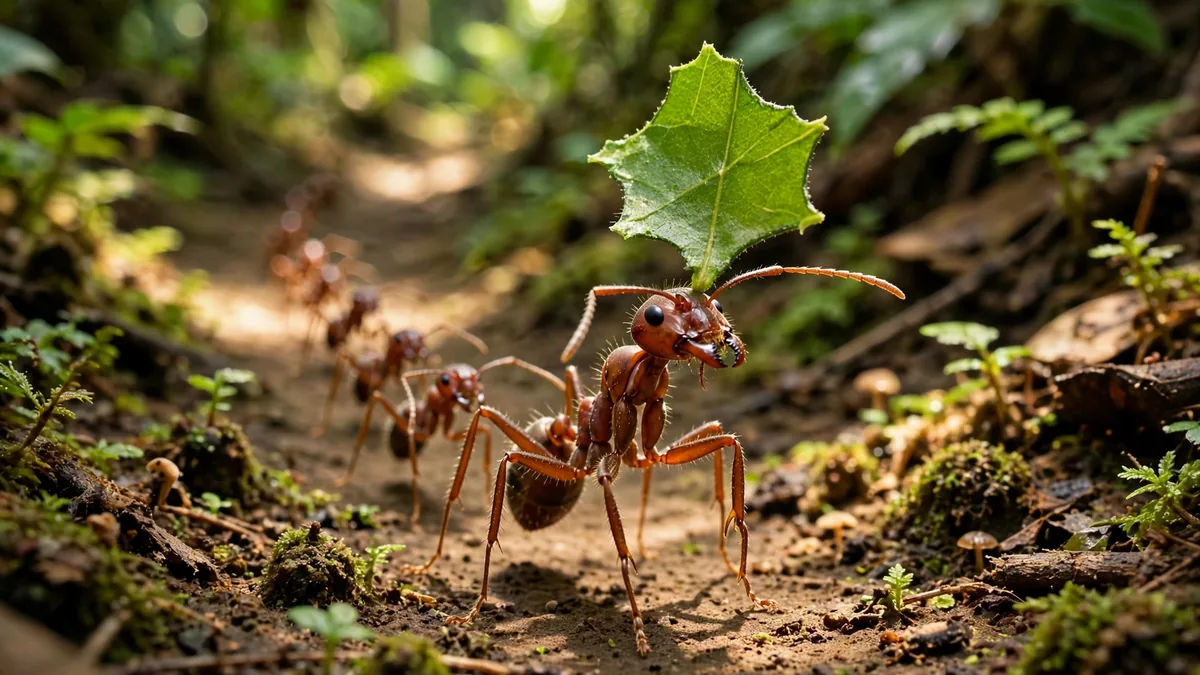
The leafcutter ant species is a fungus-farming ant of the tropical Americas, and the hairy-headed leafcutter ant, Atta cephalotes, is its best-known member. If you are asking what a leafcutter ant is, the short answer is a reddish-brown ant that cuts pieces from living leaves, carries them overhead along cleared trails, and feeds them not to itself but to a fungus garden deep underground. The fungus is the colony food. The leaves are only its compost.
That single habit makes the leafcutter ant one of the most remarkable insects on Earth. A mature colony can hold up to about five million workers, all daughters of one queen. Its nest can stretch more than 30 metres across and reach 6 metres deep. Its foragers can carry leaf pieces up to 50 times their own body weight. Yet no worker ever eats a leaf. Every fragment goes to the garden, and the garden feeds the colony.
Key takeaways
- The leafcutter ant species in this guide is the hairy-headed leafcutter ant, Atta cephalotes, a reddish-brown fungus-farming ant of Mexico, Central America and South America.
- Workers range from tiny minims about 2 millimetres long to big-headed soldiers up to 16 millimetres long, and each size has its own job in the colony.
- Leafcutter ants do not eat leaves. They chew cut leaves into pulp to feed a fungus, Leucoagaricus gongylophorus, and they eat the swollen tips of that fungus.
- A mature colony can hold up to about five million workers, and its nest can stretch more than 30 metres across and reach 6 metres deep.
- Foragers carry leaf fragments up to 50 times their own body weight along trails that can run for more than 100 metres from the nest.
The leafcutter ant species and their relatives
Leafcutter ants belong to the family Formicidae, the great family of ants that occurs on every continent except Antarctica. The family sits in the order Hymenoptera, alongside the bees and the wasps. Within the family, leafcutters sit in the subfamily Myrmicinae and in the tribe Attini, the fungus-farming ants. Like the ant in general, the leafcutter is a social insect that lives in a colony built around a queen. Unlike most ants, it farms its food instead of hunting or gathering it ready-made.
The hairy-headed leafcutter ant, Atta cephalotes, is the lead species of this guide. It was first described by Carl Linnaeus in 1758, and it is one of the earliest ants ever given a formal scientific name. Its range runs from southern Mexico through Central America to Brazil and Bolivia. It lives in wet lowland forest and at forest edges, and it nests in the ground. Its common name comes from the fine hairs on the heads of its workers.
| Type | Animal | Where it lives | Best-known food | Length or Weight |
|---|---|---|---|---|
| Family | Ants (Formicidae) | Worldwide except Antarctica | Seeds, insects and honeydew | About 2 mm to 30 mm long |
| Genus | Leafcutter ants (Atta) | Central and South America | Fungus grown on cut leaves | About 2 mm to 16 mm long |
| Genus | Leafcutter ants (Acromyrmex) | Central and South America | Fungus grown on cut leaves | About 3 mm to 6 mm long |
| Species | Hairy-headed leafcutter ant (Atta cephalotes) | Mexico to Brazil and Bolivia | Fungus grown on cut leaves | About 2 mm to 16 mm long |
| Species | Texas leafcutter ant (Atta texana) | Texas, Louisiana and Mexico | Fungus grown on cut leaves | About 5 mm to 13 mm long |
| Species | Leafcutter ant (Atta sexdens) | Costa Rica to Argentina | Fungus grown on cut leaves | About 5 mm to 16 mm long |
The closest relatives of Atta cephalotes are the other leafcutter ants of the genera Atta and Acromyrmex. Together the two genera hold about 47 species. Atta species are the larger leafcutters, with three pairs of spines on the thorax and colonies that can run into the millions. Acromyrmex species are smaller, with four pairs of spines on the thorax and colonies that are far more modest in size. Both genera cut fresh leaves and farm the same kind of fungus. The wider tribe Attini holds about 250 fungus-farming species, but only the leafcutters cut fresh leaves at such a scale.
Atta texana is the leafcutter of the southern United States, found in Texas, Louisiana and Mexico. Atta sexdens is a South American species with very large colonies, found from Costa Rica to Argentina and Paraguay. Atta colombica lives in Central and South America and is often seen cutting leaves in Panama. Like the bee, the leafcutter ant is a social insect with a single queen and a strict division of labour, but a bee colony stores honey for the winter while a leafcutter colony tends a living fungus garden all year round.
What leafcutter ants look like
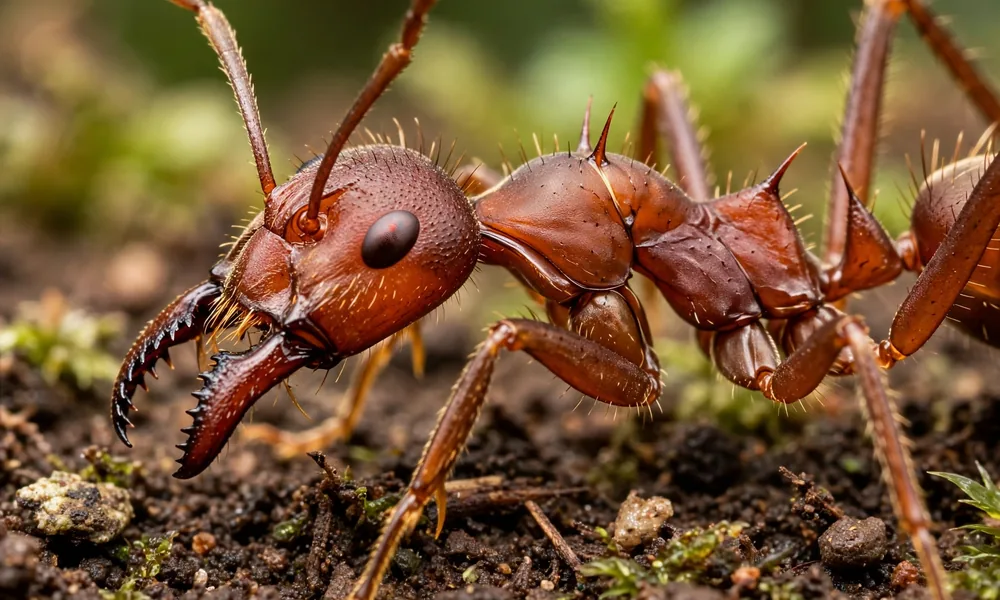
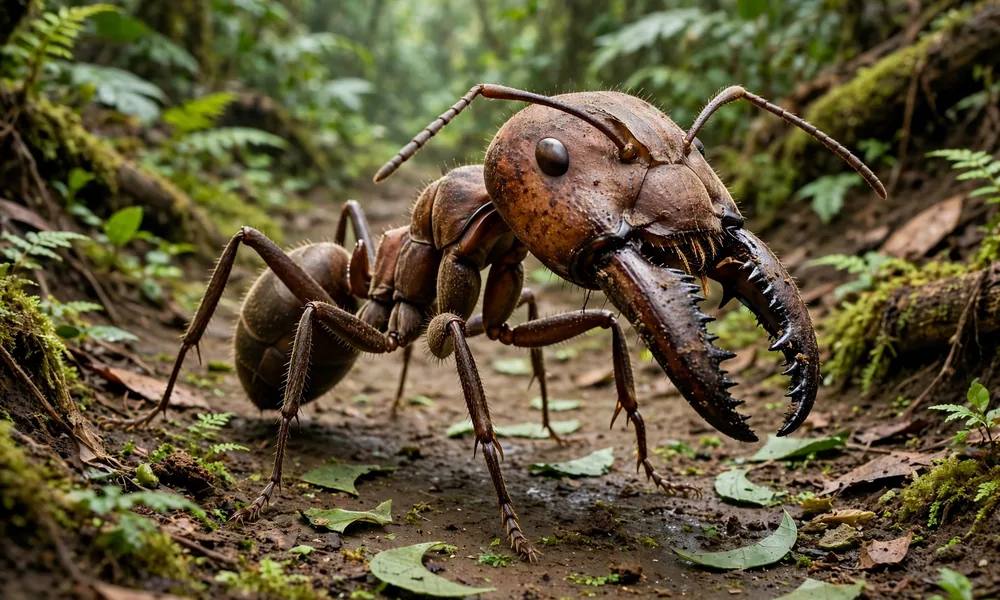
A leafcutter ant is a reddish-brown ant, and it is easy to recognise by the load it carries rather than by its body alone. The workers are polymorphic, which means they come in many sizes within a single colony. The smallest workers, the minims, are only about 2 to 3 millimetres long. The middle-sized workers, the mediae, do most of the cutting and carrying. The largest workers, the majors or soldiers, can reach 16 millimetres long and have huge heads filled with jaw muscle.
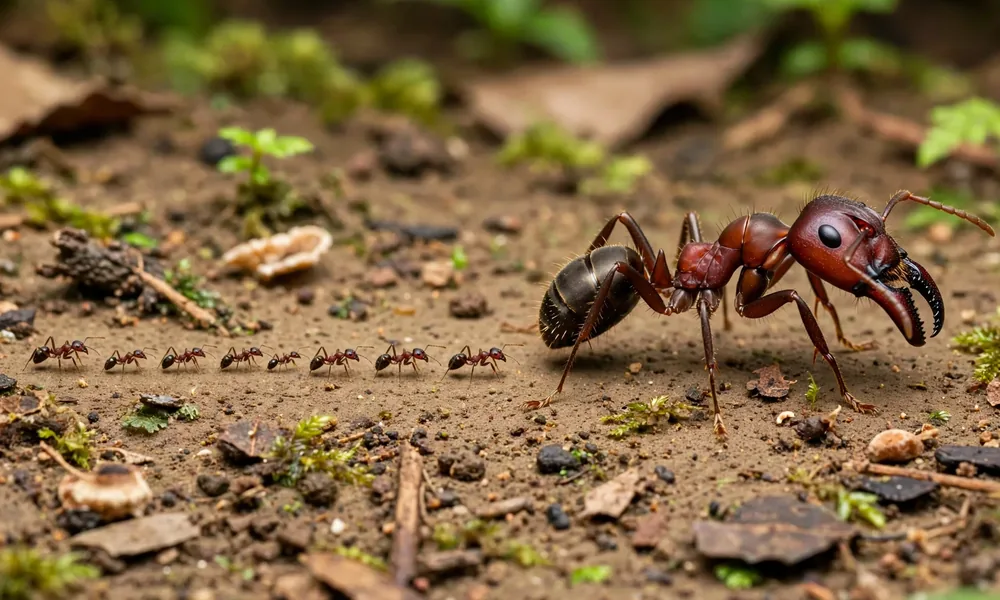
The details are what give Atta cephalotes away to anyone who looks closely. The thorax carries three pairs of prominent spines, one pair each on the pronotum, the mesonotum and the propodeum. The head of a soldier is broad and heart-shaped, with powerful mandibles that can bite hard enough to cut skin. The queen is far larger than any worker, about 20 to 25 millimetres long, with a huge gaster and a bulky thorax built for flight before she founds her colony.
Colour also helps with identification. Atta cephalotes workers are a rusty reddish-brown, darker on the head and gaster and paler on the legs. The body is covered in fine hairs, which is why the species is called the hairy-headed leafcutter ant. Acromyrmex workers look rougher, with four pairs of spines and a more tuberculate body. A single worker on its own can be hard to name with confidence, but a trail of ants carrying green leaf pieces overhead is unmistakable.
Where leafcutter ants live
Leafcutter ants are animals of the tropical forest floor, and their home is a nest that is far larger underground than it looks from above. Atta cephalotes lives in wet lowland forest and at forest edges, from southern Mexico through Central America to the Amazon basin and Bolivia. It prefers warm, humid ground with plenty of trees and shrubs to cut. It does not live in dry open desert, and it does not live in cool temperate forest.
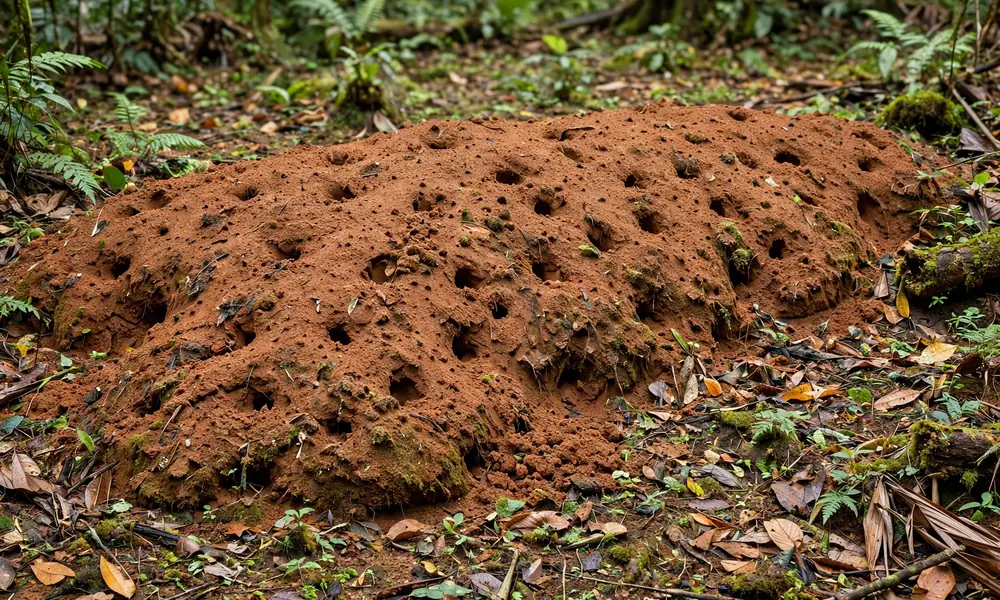
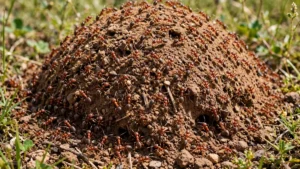
The nest is a remarkable piece of building. A mature nest can have a central mound more than 30 metres across, with smaller mounds reaching out to 80 metres from the centre. The tunnels and chambers run down to 6 metres deep. Inside are hundreds or even thousands of chambers, filled with fungus gardens, brood nurseries and stores. The whole nest can cover 30 to 600 square metres of forest floor, and a large colony can dig out tonnes of earth to make it.
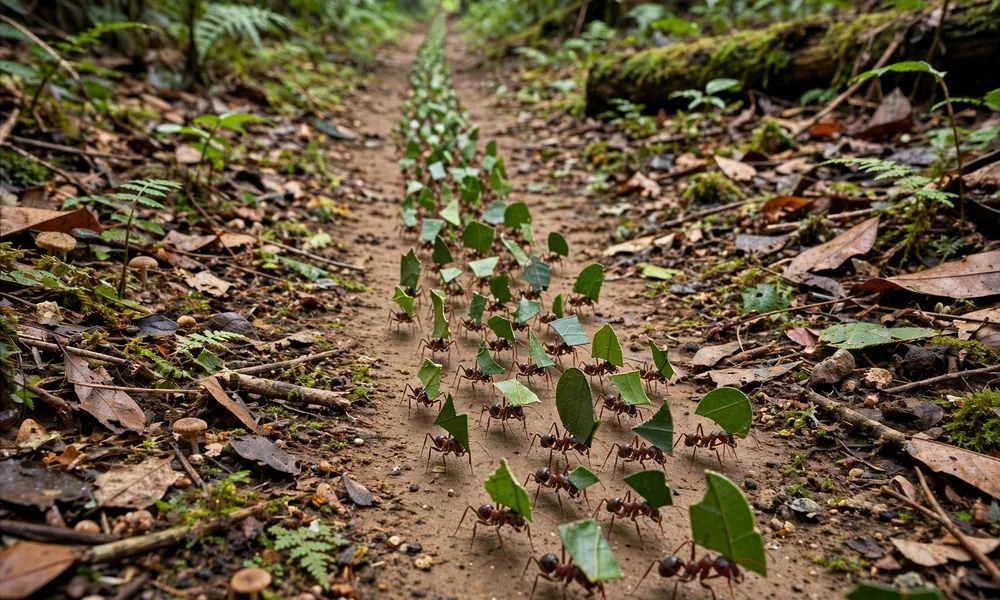
From the nest, cleared trails run out to the trees where the ants cut. A trail can stretch for more than 100 metres, and the ants walk it day and night. The trails are kept clear of leaves and twigs, and they are marked with scent so that foragers can find their way home. Some trails climb into the canopy, where the mediae cut discs from leaves high above the ground. Other trails run along the forest floor to shrubs and fallen leaves.
Ventilation matters as much as digging. The fungus gardens and millions of ants produce heat and carbon dioxide, so the nest is built to breathe. Tall central vents and lower side openings let wind draw stale air out and fresh air in. The ants also move the gardens between chambers to keep them at the right warmth. The fungus must stay near 20 to 30 degrees Celsius, and it fails above 30 degrees or below 10 degrees.
What leafcutter ants eat
Leafcutter ants do not eat leaves. That is the first thing to understand about them, and it surprises most people who see a trail of green fragments. The workers cut leaves, petals, buds and young shoots, then carry them underground. There, smaller workers chew the fragments into pulp and feed them to the fungus. The fungus breaks down the tough plant tissue and produces swollen tips called gongylidia, and those tips are the colony food.
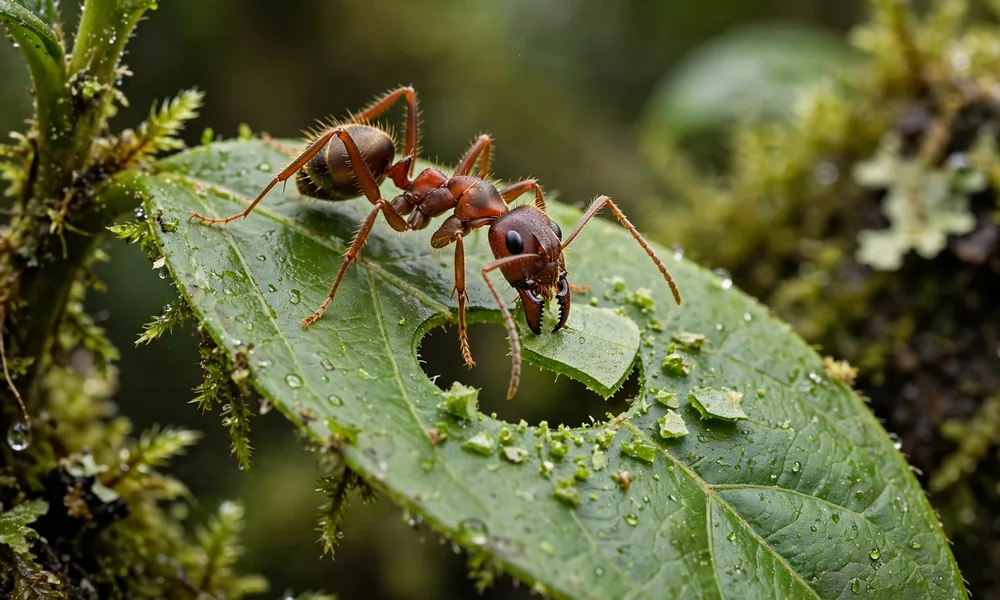
The larvae live on the fungus alone. They get all of their food from the gongylidia, which are rich in lipids, carbohydrates and amino acids. The queen also feeds on the fungus. Adult workers get only a small share of their energy from the fungus, and they top up on plant sap taken while they cut. The fungus itself is Leucoagaricus gongylophorus, a species that can no longer survive in the wild without the ants. It has been farmed for so long that it no longer makes working spores in nature.
Foraging is done by the mediae, and it is done mostly at night or in the cooler parts of the day. The ants cut with mandibles that vibrate about a thousand times a second, sawing through leaf tissue like a tiny blade. A forager can carry a leaf fragment up to 50 times its own body weight, held above its head as it walks home. A single large colony can strip a tree of its leaves in a night, and it can defoliate the same tree again when the leaves grow back.
How leafcutter ants behave
Leafcutter ant behaviour is built around the farm, and every caste has its part in keeping the crop alive. The minims stay inside the nest, tending the gardens and caring for the brood. They weed out foreign moulds, pluck out spores that do not belong, and plant fresh fungus on new pulp. The mediae cut and carry. The majors defend the trails and the nest, clearing heavy branches and biting anything that threatens the colony.
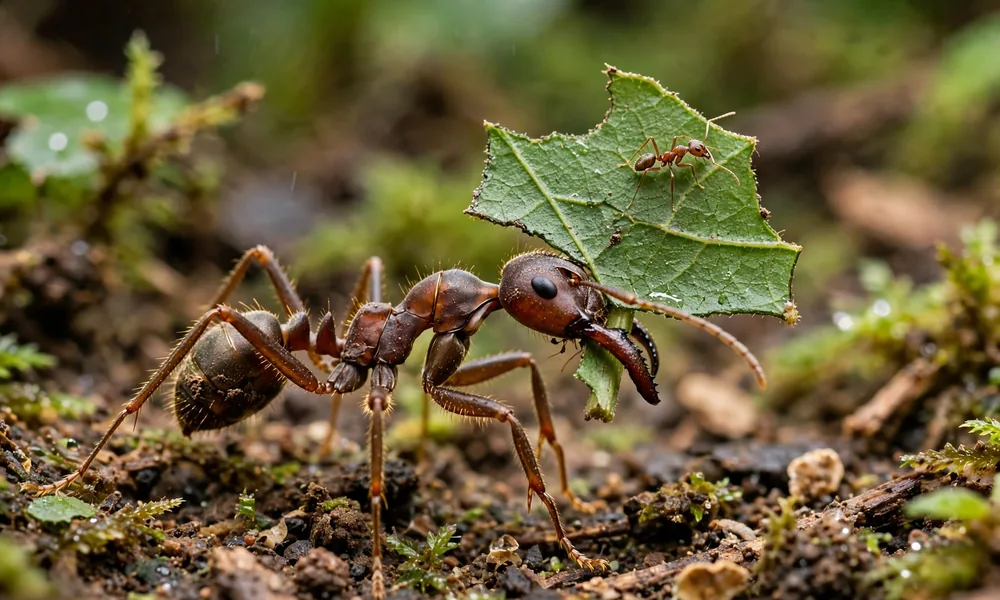
One of the strangest sights on a trail is the hitchhiker. Tiny minims ride on top of the leaf fragments carried by larger workers, and they are not resting. They guard the carriers against parasitic phorid flies, which try to lay eggs in the necks of the leaf-carrying workers. When a fly approaches, the minim waves its legs and snaps at it. The threat of the flies shapes when the ants forage, and the colony forages more at night when the flies are less active.
The fungus garden is a monoculture, and like all monocultures it is fragile. A mould called Escovopsis attacks the crop, and the ants fight it with care and with chemistry. They carry antibiotic-producing bacteria on their bodies, and they spread those bacteria over the garden. They also exile waste to refuse chambers, tended by older workers who never return to the clean parts of the nest. A worker that tends the refuse stays with the refuse, so that disease does not spread to the gardens.
Communication on the trail runs on scent. A forager that finds a good tree lays a trail pheromone for others to follow, and the trail grows stronger as more ants use it. Alarm scents bring soldiers running when the nest is disturbed. The ants also stridulate, making high-frequency sounds that travel through leaves and soil. Together, scent and sound let a colony of millions act as one animal, with no single ant in charge.
Breeding and life cycle
A leafcutter ant colony begins with a single queen, and her start in life is one of the most dangerous moments any ant faces. After the mating flight, which takes place at dawn or dusk, the new queen lands, sheds her wings, and digs a burrow 20 to 30 centimetres deep. She carries a tiny pellet of live fungus from her mother nest in a pouch under her mouth. She spits the pellet out in a chamber and feeds it with fluid from her own body until it swells into a pale sponge.

Development from egg to adult takes about eight weeks at 25 degrees Celsius. The egg stage lasts about 22 days, the larva about 25 days, and the pupa about 10 days. The first workers are small, only about 5 millimetres long, and they are short-lived. The queen feeds them from the reserves in her own body, breaking down her wing muscles to nourish them. Once they are grown, they take over the work of tending the garden, and the queen settles into a life of laying eggs.

A queen mates with several males on her one mating flight, and she stores about 300 million sperm for the rest of her life. She never mates again. She can live for 10 to 15 years, with 13 years recorded in nature, and she lays eggs for most of that time. Workers live for about 120 days as adults. A mature colony releases hundreds or thousands of winged queens and males on its mating flights, and only a tiny fraction of the new queens ever found a colony of their own.
Growth is fast once the garden is established. A colony that survives its first year can grow to hundreds of thousands of workers within a few years. A mature Atta cephalotes colony holds up to about five million workers, while the largest Atta colonies, of Atta laevigata, can hold up to eight million. The nest grows with the colony, adding chambers and trails year by year. A colony that loses its queen cannot replace her, and it slowly dies as its workers age and are not replaced.
Conservation status
Atta cephalotes has not been given an IUCN Red List assessment, and it is not a species in danger of disappearing. It is common across a huge range, from Mexico to Bolivia, and its colonies are counted in the millions. The problem with the leafcutter ant is the opposite of rarity. In farmland and gardens it is seen as a pest, because a single colony can strip a crop or a young tree in a night. Farmers spend time and money trying to keep it out of their fields.

Yet the same ant is a vital part of the forest. Leafcutter colonies are ecosystem engineers, and they move tonnes of plant matter and soil every year. They aerate the soil with their tunnels, and they bring nutrients from the canopy down into the ground. Their refuse chambers enrich the soil, and their gardens recycle plant biomass that would otherwise rot slowly on the forest floor. A forest without leafcutters would be a poorer forest, with slower nutrient cycling and less open ground for seedlings.
The real threat to the leafcutter ant is the loss of its forest. When rainforest is cleared for farms or towns, the trees the ants cut are gone, and the warm humid ground they need dries out. Small forest fragments can still hold colonies, but the largest nests need large areas of forest to feed them. Protecting rainforest protects the leafcutter ant, and it protects the fungus, the bacteria and the flies that live only with it. The ant is common today, but its future depends on the forest staying standing.
Best seasons for leafcutter ant watching
Leafcutter ants are active all year in the warm tropics, but the best time to watch them is the wet season, when the forest is green and the trails are busy. In Central America the wet season runs roughly from May to November, and the ants cut hardest when new leaves are soft and plentiful. In the dry season the trails are still used, but the cutting slows and the ants take more fallen leaves and dry material. A colony never sleeps for the winter, because the tropics have no winter to sleep through.
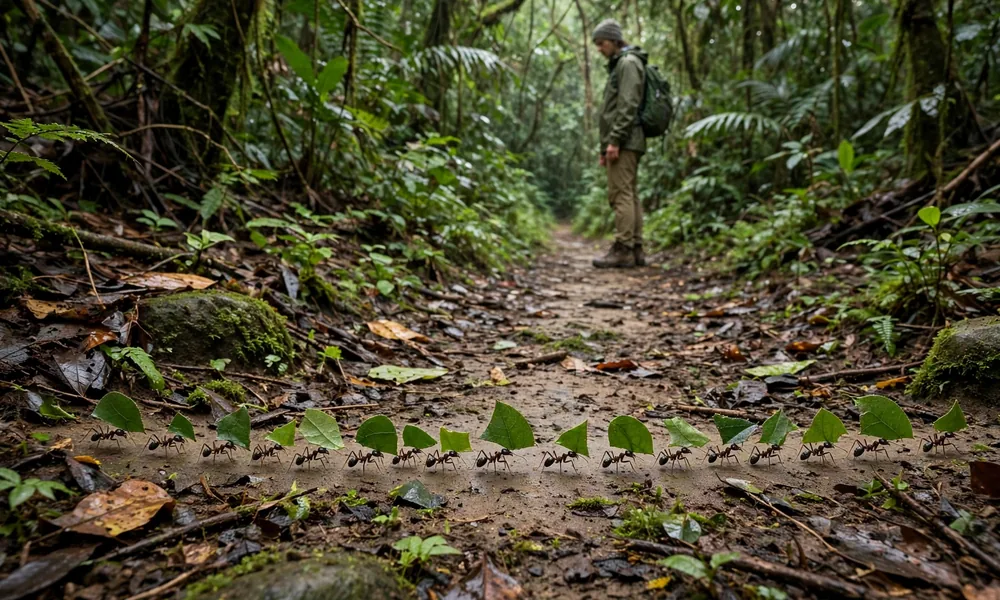
The time of day matters as much as the season. Leafcutter ants forage mostly at night or in the cooler parts of the day, to avoid drying out and to avoid the phorid flies that hunt them by day. The best watching is done in the early morning or the late afternoon, when the trails are full of carriers and the light is soft enough to see them well. After rain, the ants are out in force, repairing the trails and cutting the fresh leaves that the rain has brought out. At midday, in full sun, the trails go quiet.
The mating flights are the most dramatic event in the colony year, and they are worth planning a trip around. They take place at dawn or dusk, often after rain, when hundreds or thousands of winged queens and males rise from the nest in a swarm. The queens are large and slow, and they are easy to see as they climb into the air. Most will not survive the day, caught by birds or lost in the forest, but the few that land and dig in will start the next generation of colonies.
Staying safe around leafcutter ants
Leafcutter ants are not dangerous in the way a stinging ant is, but they can give a painful bite. A soldier that is handled or trodden on will bite hard with its mandibles, and the bite can break the skin. The ants do not sting, and they do not inject venom, so the bite is a pinch rather than a poisoning. The first rule of staying safe is simple: watch the trail, do not stand on it, and never put your hands into a nest entrance.
Wear closed boots and long trousers when you walk in rainforest where leafcutters live, and watch where you step on the trails. A trail can cross a path without warning, and a boot that lands on it will crush carriers and bring soldiers running. If a soldier bites you, brush it off gently rather than pulling it away, since pulling can tear the skin. Wash the bite with soap and water, and keep it clean. Most bites fade within a day, and they need no treatment beyond cleaning.
Leave the nest alone. Do not dig into a mound to see the fungus garden, since digging destroys chambers that took years to build and can kill the garden. Do not block a trail with your bag or your foot, since the ants will climb over it and may bite. Take photographs from the side of the trail, and use a torch with a red filter at night so that you do not blind the ants or the flies that hunt them. The colony will carry on working long after you have gone home.
Leafcutter ant watching checklist
Use this checklist before you go looking for leafcutter ants in a tropical forest, and tick each item off as you prepare.
- Learn what a leafcutter trail looks like before you go, so you can spot the green fragments moving along the forest floor.
- Wear closed boots, long trousers and insect repellent, and carry drinking water and a torch with a red filter for night watching.
- Go in the early morning or late afternoon, when the trails are busy and the light is soft enough for photographs.
- Stand to the side of the trail, never on it, and never put your hands into a nest entrance or a mound.
- Take binoculars for the canopy, so you can watch the cutters working high in the trees above the trail.
- Keep children close and show them the hitchhiker minims riding on the leaves, so they learn to watch without touching.
- Leave every trail and mound exactly as you found it, and take all litter home with you when you leave the forest.
Frequently asked questions
How big do leafcutter ants get?
Leafcutter ant workers range from tiny minims about 2 millimetres long to big-headed soldiers up to 16 millimetres long, and the size of a worker decides its job. The minims tend the fungus garden and ride on the leaves to guard the carriers, the mediae cut and carry the leaves, and the majors defend the nest. The queen is far larger, about 20 to 25 millimetres long, with a huge gaster. They are medium to large ants, and a single colony can hold up to about five million of them.
What do leafcutter ants eat?
Leafcutter ants do not eat leaves. They cut leaves, petals and buds and carry them underground to feed a fungus, Leucoagaricus gongylophorus, which grows in gardens inside the nest. The fungus breaks down the plant tissue and produces swollen tips called gongylidia, and those tips are the colony food. The larvae live on the fungus alone, and the queen feeds on it too. Adult workers get only a small share of their energy from the fungus, and they top up on plant sap while they cut.
How strong are leafcutter ants?
A leafcutter ant forager can carry a leaf fragment up to 50 times its own body weight, held above its head as it walks along the trail. That is the equivalent of a person carrying a small car, and the ant does it over rough ground for more than 100 metres. The strength comes from the muscles in its thorax and from the way it holds the load high, where it balances well. The soldier bite is also strong, and it can break human skin, so the ants should be watched rather than handled.
Where do leafcutter ants live?
Atta cephalotes lives in wet lowland forest and at forest edges, from southern Mexico through Central America to Brazil and Bolivia. Its nests are underground, with a central mound more than 30 metres across and tunnels down to 6 metres deep. Cleared trails run from the nest to the trees where the ants cut, and those trails can stretch for more than 100 metres. The ants need warm, humid ground, and the fungus garden must stay near 20 to 30 degrees Celsius.
Can you keep leafcutter ants as a pet?
You can, but only with care and the right setup, and only where it is legal to do so. Leafcutter ants are kept by expert ant keepers in large formicariums with a separate fungus garden, kept at 24 to 26 degrees Celsius. The colony needs fresh leaves every day, and it needs space to grow into the millions. A small tank will not do, and a colony that escapes can damage gardens and crops. Beginners should start with a simpler ant species and leave leafcutters to experienced keepers.
How is this guide different from the ladybug guide?
This guide covers the leafcutter ant, a single species, Atta cephalotes, a reddish-brown fungus-farming ant of 2 to 16 millimetres that lives in colonies of up to about five million workers, builds nests more than 30 metres across and 6 metres deep, and feeds a fungus garden with leaves carried up to 50 times its own body weight, while our ladybug guide covers a small spotted beetle of gardens and fields that lives alone or in small groups, hunts aphids on plant stems, and spends the winter sheltering in leaf litter or a house wall. One is a tiny farmer that works by the million underground in a tropical forest; the other is a lone hunter you meet on a single leaf in a garden.
This guide also goes further than our general ant guide, which covers ants as a whole, from garden ants to fire ants to army ants. That guide is the place to start if you want to know what an ant is, while this guide stays with one species for its whole length, following the hairy-headed leafcutter ant from its place among the leafcutters and its forest home through its castes and its trails, its fungus garden and its hitchhikers, its long-lived queen and its huge nest, to the seasons and the checklist that will help you watch it safely.
Conclusion
The leafcutter ant species is a reminder that farming did not begin with people. Long before the first human planted a seed, Atta cephalotes was cutting leaves, carrying them underground, and tending a fungus garden that feeds millions. A reddish-brown ant only a few millimetres long, carrying 50 times its own weight along a trail more than 100 metres long, it has built one of the largest and most complex societies on Earth, and it has done it without a single ant ever eating a leaf.
If you walk a rainforest trail in Central America, stop and watch the green fragments moving along the ground. Each one is carried by an ant, guarded by a smaller ant riding on top, and bound for a garden deep below your feet. Stand to the side, let the trail pass, and the leafcutter ants will carry on with their harvest, as they have done for millions of years.