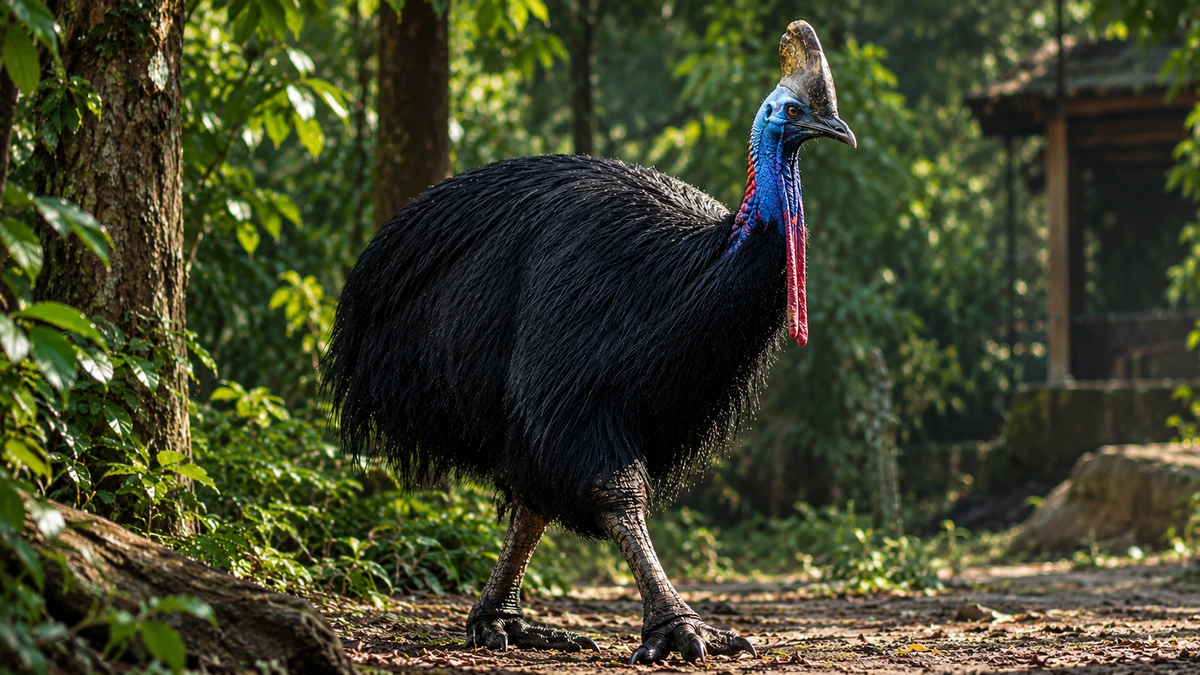
Cassowaries are large, flightless birds found in the tropical forests of New Guinea, nearby islands and northeastern Australia. Their striking blue skin, red neck wattles, helmet-like casques and powerful legs make them among the most distinctive birds on Earth.
These birds are best known for their size and potentially dangerous kicks. However, their role in rainforest regeneration is just as remarkable. By swallowing fruit and dispersing seeds through their droppings, cassowaries help maintain the diversity of the forests they inhabit.
Learning these cassowary facts helps you understand their appearance, behavior, diet, habitat and the precautions people should take when encountering one in the wild.
Cassowary Quick Facts
| Feature | Details |
| Scientific genus | Casuarius |
| Class | Aves |
| Order | Casuariiformes |
| Family | Casuariidae |
| Living species | Three |
| Main habitat | Tropical rainforests and associated vegetation |
| Geographic range | New Guinea, nearby islands and northeastern Australia |
| Maximum height | Approximately 2 meters |
| Maximum recorded weight in southern cassowaries | About 76 kg in females |
| Running speed | Reported up to 50 km/h |
| Main food | Fruit |
| Distinctive feature | A helmet-like casque on the head |
| Main ecological role | Dispersing rainforest seeds |
| Major threats | Habitat loss, vehicle collisions and dog attacks |
What Is a Cassowary?
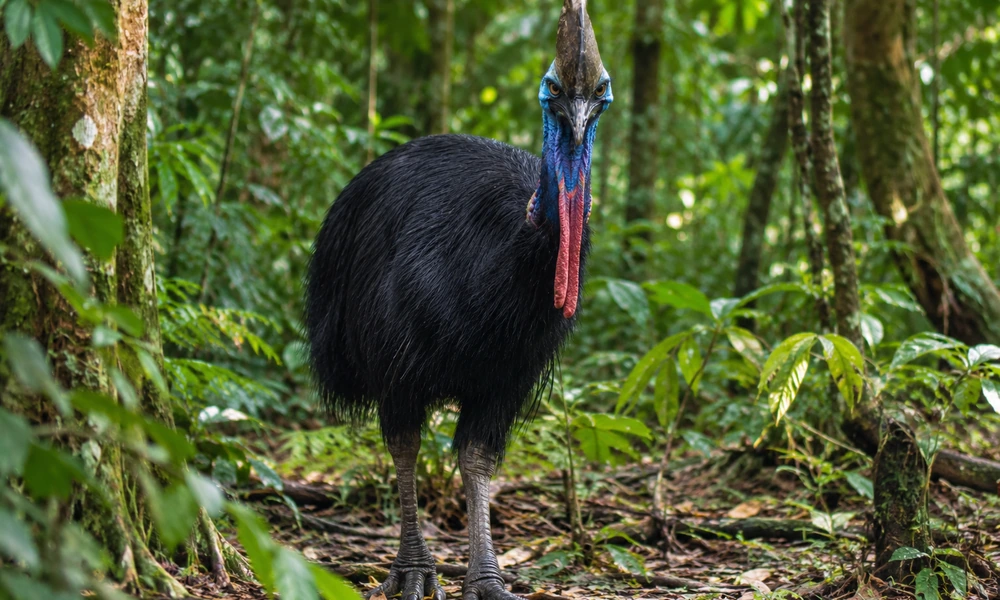
A cassowary is a large, flightless bird belonging to the genus Casuarius. It belongs to the ratite group, which also includes ostriches, emus, rheas and kiwis. These birds have reduced flight-related anatomy and are adapted primarily for life on the ground.
Cassowaries have strong legs, compact wings and coarse, hair-like feathers. Their bodies are well suited to moving through dense vegetation, where they forage for fallen fruit and other food.
The genus Casuarius was established by French naturalist Mathurin Jacques Brisson in 1760. Cassowaries also have longstanding cultural significance for Indigenous peoples of Australia and New Guinea, whose relationships with these birds vary across communities and regions.
What Are the Three Living Cassowary Species?
Scientists recognize three living cassowary species. A fourth species, known from fossils, is extinct.
Southern cassowary (Casuarius casuarius):
The largest and best-known species, found in southern New Guinea, northeastern Australia and the Aru Islands. It is also called the double-wattled cassowary.
Northern cassowary (Casuarius unappendiculatus):
Also known as the single-wattled cassowary, it lives mainly in northern and western New Guinea and nearby islands.
Dwarf cassowary (Casuarius bennetti):
The smallest living species, found in New Guinea and nearby islands, including New Britain. It occurs in mountainous and other forested habitats.
Pygmy cassowary (Casuarius lydekkeri):
An extinct species known from prehistoric fossil remains. It should not be counted among living cassowaries.
Distinction Between Them:
| Species | Distinguishing feature | General range |
| Southern cassowary | Two red neck wattles | Southern New Guinea, northeastern Australia and Aru Islands |
| Northern cassowary | One neck wattle | Northern and western New Guinea |
| Dwarf cassowary | Smaller body and distinctive casque | New Guinea and nearby islands |
| Pygmy cassowary | Extinct fossil species | Known from prehistoric remains |
Conservation status depends on the species, geographic population and assessment system. The southern cassowary is endangered in Queensland and under Australian national environmental law, but this regional classification should not automatically be applied to every cassowary population worldwide.
How Big Is a Cassowary?
The southern cassowary is one of the world’s heaviest living birds. It ranks behind ostriches in body mass, and adult females are generally larger and heavier than males.
An adult southern cassowary typically stands about 1.5 to 1.8 meters tall. Some females reach approximately 2 meters and may weigh up to 76 kilograms. Measurements vary with age, sex, species and individual condition, so these figures should not be treated as universal measurements for every cassowary.
What Physical Features Make Cassowaries Unique?
Cassowaries have several features that distinguish them from other large birds:
- The head and neck can display vivid blue coloration.
- Southern cassowaries have two long, drooping red wattles. Northern cassowaries have one.
- Their coarse body feathers resemble hair more than the smooth feathers many people associate with birds.
- Their muscular legs help them run, jump and defend themselves.
- Each foot has three toes, including an inner toe with a long, dagger-shaped claw.
- Their wings are greatly reduced and cannot support powered flight.
The inner claw of a southern cassowary can reach roughly 12 centimeters in length. Combined with the bird’s strength, this claw makes a defensive kick potentially dangerous.
What Is the Casque on a Cassowary’s Head?
The casque is the tall, helmet-like structure that rises from a cassowary’s head. It consists of a keratin-covered outer surface and an internal structure containing a network of supporting tissues and fibres.
Its exact purpose is not fully understood. Researchers have proposed several possible functions, including helping the bird move through vegetation, regulating heat, producing or transmitting low-frequency sounds and displaying information to other cassowaries.
A 2026 scientific study reported that the casques of southern and northern cassowaries fluoresce under ultraviolet light in species-specific patterns. This finding adds evidence that the casque may play a role in visual signaling, although it does not prove that this is its primary function.
Cassowaries also produce deep booming calls that travel through forest environments. The relationship between these sounds and the casque remains an area of scientific interest.
Where Do Cassowaries Live?
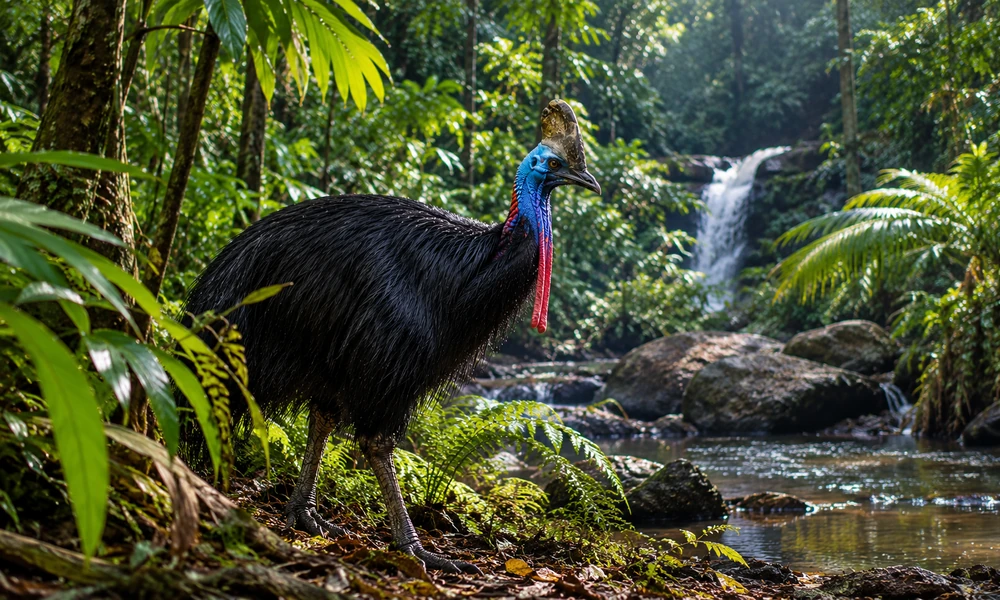
Cassowaries are native to the tropical forests of New Guinea, nearby islands and northeastern Australia. They depend on landscapes that provide sufficient food, water, cover and connected areas through which they can move.
Although dense rainforests are their principal habitat, cassowaries also use other environments when food is available.
What Is the Cassowary’s Natural Habitat?
Their habitat includes:
- Tropical lowland and mountain rainforests.
- Palm scrub and other dense vegetation.
- Swamp forests and wetlands.
- Some woodlands and coastal vegetation.
- Forest edges and modified landscapes near human settlements.
A dependable supply of fruit is especially important. Cassowaries may use different parts of their home ranges as fruit availability changes throughout the year.
In Australia, southern cassowaries occur in parts of Queensland’s Wet Tropics and Cape York Peninsula. In New Guinea, cassowaries inhabit a broader range of forested landscapes, including lowland and montane forests.
How Large Is a Cassowary’s Home Range?
Cassowaries are generally solitary and maintain individual home ranges. Research on southern cassowaries in Queensland has documented ranges varying from approximately 0.52 to 2.35 square kilometers, depending on the bird and local conditions.
Females may use areas that overlap with the ranges of several males. Home-range size is not fixed: seasonal food supplies, habitat quality, landscape fragmentation and other local factors can influence how far a bird travels.
This movement also explains why roads, housing and other development can become serious hazards when they divide suitable forest habitat.
What Do Cassowaries Eat?
Cassowaries are primarily frugivores, meaning that fruit makes up most of their diet. They consume fallen fruit from a wide variety of rainforest plants and swallow many fruits whole.
Their diet is broader than fruit alone, however. Depending on availability, cassowaries also eat fungi, insects, snails, plant material and small animal remains.
What Foods Are Included in a Cassowary’s Diet?
Common food sources include:
- Fallen fruit from palms, laurels, myrtles and other rainforest plants.
- Native rainforest fruits, including cassowary plums.
- Fungi and mushrooms.
- Insects and snails.
- Some small animals and carrion when available.
Cassowaries can consume fruit that is toxic to humans. Their ability to eat these fruits reflects adaptations in their digestive system and should not be interpreted as evidence that such fruit is safe for people.
Wild cassowaries find their own food by foraging through the forest. People should not feed them human food or attempt to supplement their natural diet.
How Do Cassowaries Help Rainforests Grow?
Cassowaries play an important role in rainforest regeneration because they transport seeds away from the parent plants. After eating fruit, they deposit seeds in their droppings, often far from where the fruit was collected.
Some seeds remain viable after passing through the bird’s digestive tract. In certain plant species, this process can improve germination, making the cassowary more than just a seed transporter.
Research on the Australian rainforest tree Ryparosa found a striking difference in germination: approximately 92% of seeds that passed through a cassowary’s digestive system germinated, compared with about 4% of seeds that had not. This result applies to the studied plant and conditions, not to every seed species.
Cassowaries can disperse seeds over distances exceeding a kilometer. Their movements therefore help connect plant populations and support the diversity of tropical forests.
For this reason, cassowaries are often described as keystone seed dispersers. A decline in their numbers can affect plants that depend on large animals to carry their seeds.
How Do Cassowaries Behave and Reproduce?
Cassowaries are usually solitary and avoid close contact with other adults outside breeding or feeding situations. They can be difficult to spot in dense forest because they often move away before people notice them.
Their behavior changes during breeding and when a bird feels threatened, particularly when a male is protecting chicks.
How Do Cassowaries Communicate?
Cassowaries produce low-frequency booming calls that can be felt or heard as deep sounds. These calls travel through the forest understory and are associated with communication between birds.
They also use body posture, movement and visual features during social interactions. The precise role of each signal can vary with the situation, and not every proposed function has been conclusively demonstrated.
How Do Cassowaries Breed?
Cassowary reproduction involves an unusual division of parental responsibilities. The female lays the eggs, while the male incubates them and cares for the chicks.
The breeding process generally follows these stages:
- Egg laying: The female lays a clutch, commonly around three to five eggs, although larger clutches have been recorded. The eggs are large and green to pale green-blue.
- Incubation: The male sits on the eggs for approximately 50 to 52 days.
- Hatching: The chicks emerge with striped plumage that helps distinguish them from adults.
- Parental care: The male guards and leads the chicks while they feed and develop.
- Independence: The young eventually leave their father’s care as they become capable of living independently.
The female may mate with more than one male during a breeding season. After laying eggs, she generally does not take part in incubation or chick rearing.
How Long Do Cassowaries Live?
Wild cassowaries are reported to live for roughly 18 to 20 years, although individual lifespan varies and long-term observations are limited. Birds in managed care may live considerably longer, sometimes reaching around 40 years.
These figures are approximate rather than guaranteed lifespans for every species or individual.
Why Can Cassowaries Be Dangerous to Humans?
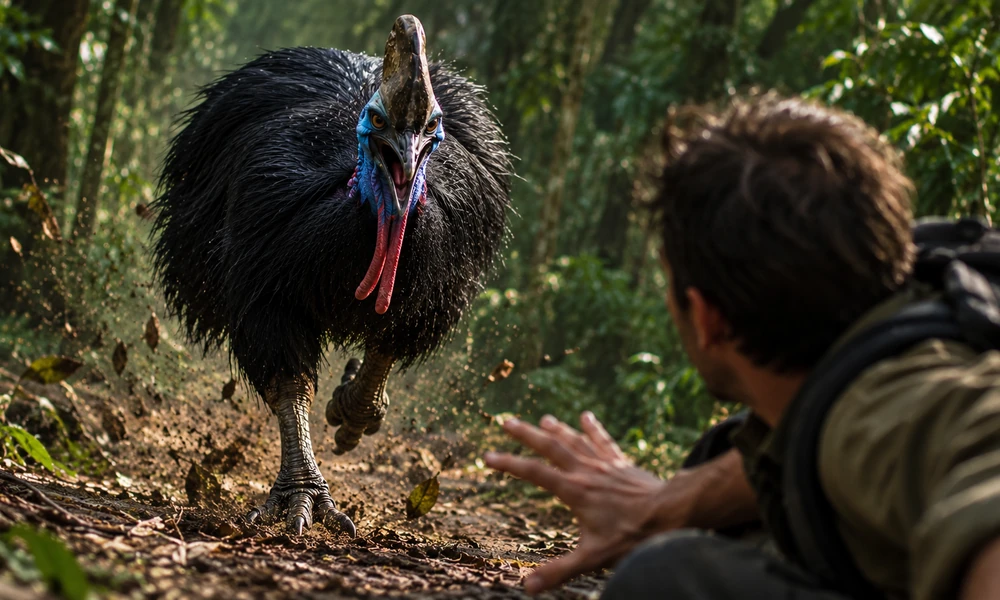
Cassowaries can cause serious injuries because they are large, powerful birds with strong legs and sharp claws. When threatened, cornered or defending their young, they may charge or kick.
The southern cassowary is often called the world’s most dangerous bird. That label is attention-grabbing, but it does not mean cassowaries routinely attack people or are statistically the most dangerous bird in every situation. They are generally wary of humans, and serious attacks are uncommon.
How Can a Cassowary Injure Someone?
A cassowary can deliver a forceful kick with its powerful legs. Its long inner claw can cause deep cuts or puncture injuries, and a strike may result in severe trauma.
Risk increases when people approach too closely, attempt to touch a bird, feed it or get between a male and his chicks. Dogs can also trigger dangerous encounters and may be injured or killed during a confrontation.
Human feeding is a particularly serious problem. A cassowary that learns to associate people, houses or vehicles with food may approach more boldly and behave aggressively when food is unavailable.
Have Cassowaries Ever Killed Humans?
Yes. Historical records document two widely recognized fatal human incidents: one in Queensland, Australia, in 1926 and another in Florida, United States, in 2019.
These deaths demonstrate that cassowaries can be lethal, but they should not be used to suggest that fatal attacks are common. The risk is better understood through the bird’s physical capabilities and the circumstances that lead to close encounters.
How Can You Stay Safe Around a Cassowary?
If you encounter a wild cassowary, follow these precautions:
- Keep your distance. Never approach, chase, corner or attempt to touch the bird.
- Do not approach chicks. A male may defend them aggressively.
- Never feed it. Human food can change its behavior and increase the risk of conflict.
- Stay calm. Avoid sudden movements and do not provoke the bird.
- Back away slowly. Face the bird rather than turning your back and running.
- Use a barrier. If the bird approaches, put a tree, backpack or another substantial object between you and it.
- Secure food and rubbish. Keep food scraps in closed bins and secure compost.
- Protect pets. Keep dogs under control, behind secure fencing or on a leash.
- Drive carefully. Slow down in cassowary habitat and watch for birds crossing roads.
If a cassowary appears injured or behaves dangerously near people, contact the relevant local wildlife authority rather than trying to handle it yourself.
What Threats Do Cassowaries Face?
Despite their size, cassowaries are vulnerable to changes in their environment. Their survival depends on healthy forests, reliable food supplies and safe movement between habitat areas.
Why Is Cassowary Habitat Disappearing?
Clearing land for roads, agriculture and housing can reduce the amount of suitable rainforest available. Remaining habitat may become fragmented into smaller patches, making it harder for birds to move safely between feeding and breeding areas.
Fragmentation can also increase encounters with people and domestic animals. Even where some forest remains, a landscape may no longer support a stable population if essential food sources and safe travel routes are lost.
What Other Threats Affect Cassowary Survival?
Major threats include:
- Vehicle collisions: Roads crossing cassowary habitat expose birds to traffic.
- Dog attacks: Domestic and roaming dogs can injure or kill cassowaries, including chicks.
- Feral pigs: Pigs can damage nests, eat eggs and compete for food.
- Human feeding: Food conditioning can draw birds into roadsides, residential areas and campsites.
- Extreme weather: Severe storms and cyclones can damage habitat and disrupt food supplies.
- Human disturbance: Approaching, chasing or attempting to handle birds can create avoidable risks.
How Are Cassowaries Protected?
Conservation work includes protecting and restoring rainforest, maintaining habitat connections, reducing road deaths, controlling threats from domestic and feral animals and educating the public about safe wildlife encounters.
In Queensland, the southern cassowary has specific legal protection and recovery measures. Conservation status and population estimates can vary by region, so figures should always be linked to the place and assessment date they describe.
People can contribute by keeping food scraps secure, never feeding wild cassowaries, keeping dogs under control and reporting injured birds to wildlife authorities.
Conclusion
Cassowaries are remarkable rainforest birds whose size, vivid coloration and powerful legs deserve respect. Their ability to disperse seeds also makes them important contributors to forest regeneration.
The best way to protect both people and cassowaries is to give wild birds space, keep food away from them and preserve the habitats they depend on. Their reputation for danger is only one part of the story; their ecological importance makes their continued survival equally worth understanding.
Wildlife information note: Cassowary behavior and conservation status vary by species and region. Readers should follow local wildlife guidance when visiting cassowary habitat.
Frequently Asked Questions About Cassowaries
Can a cassowary fly?
No. Cassowaries are flightless birds with reduced wings and anatomy adapted for ground movement. They rely on their strong legs to run, jump and move through forest vegetation.
What should you do if a cassowary approaches you?
Remain calm, face the bird and slowly back away. Place a substantial object, such as a tree or backpack, between yourself and the bird if possible. Never approach it, try to feed it or get between a male and his chicks.
Why do cassowaries have a helmet on their heads?
The helmet is called a casque. Researchers have proposed roles in visual signaling, temperature regulation and sound-related behavior, but its complete function remains uncertain. Research published in 2026 found ultraviolet fluorescence patterns in the casques of two living species, providing further evidence for possible visual signaling.
How fast can a cassowary run?
Cassowaries have been reported to reach speeds of up to 50 kilometers per hour. They can also jump and are capable swimmers, although their speed and abilities vary with circumstances.
Are cassowaries endangered?
The answer depends on the species and location. The southern cassowary is listed as endangered in Queensland and under Australian national environmental law. Those regional classifications should not be confused with the global conservation status of all cassowary species.
What is the difference between a southern and a northern cassowary?
The southern cassowary has two red wattles hanging from its neck, while the northern cassowary has one. They also differ in geographic distribution and some details of their coloration and casque shape.
Why are cassowaries important to the rainforest?
Cassowaries eat a wide range of fruit and carry seeds through the forest before depositing them in their droppings. Some seeds remain viable after digestion, and some plant species may germinate more successfully after passing through a cassowary’s digestive system.
