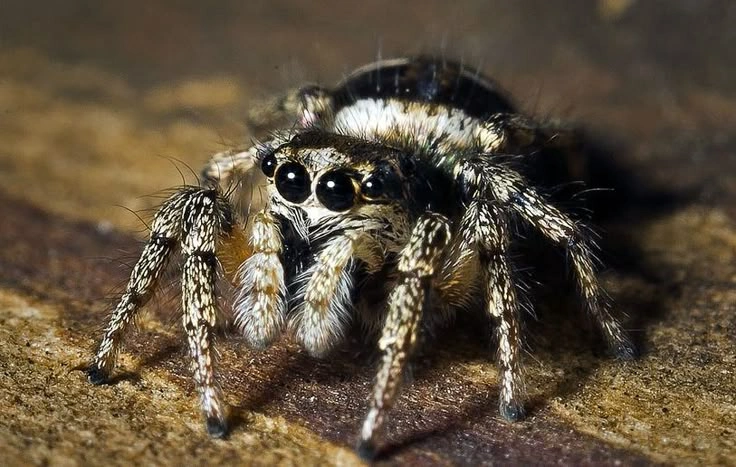
If you have ever seen a tiny jumping spider suddenly turn toward you, watch you closely, or make an unexpected jump, there is a good chance you were looking at a jumping spider. These small spiders belong to the family Salticidae and are famous for their excellent eyesight, quick movements, and unusual hunting style.
Unlike spiders that depend mainly on webs to catch prey, jumping spiders actively search for food. They use their remarkable vision to spot insects, judge distance, stalk their target, and then make a carefully controlled leap. Researchers have found that their visual system is among the most sophisticated known in animals of their size.
This guide from Viltnemnda explains what makes jumping spiders so interesting, where they live, how they hunt, whether they bite, and what you should know if you find one around your home.
Key Takeaways
- Jumping spiders belong to the family Salticidae and include thousands of described species.
- Their most impressive feature is their highly developed vision.
- Their large front eyes provide sharp visual information, while other eyes help detect movement.
- Most jumping spiders actively hunt instead of using large webs to capture prey.
- They can jump accurately toward prey and use silk as a safety line.
- They live in many habitats, including forests, grasslands, gardens, dry areas, and human structures.
- Most are harmless to people and rarely bite.
- A jumping spider bite, when it happens, is generally expected to cause mild local effects.
What Are Jumping Spiders?
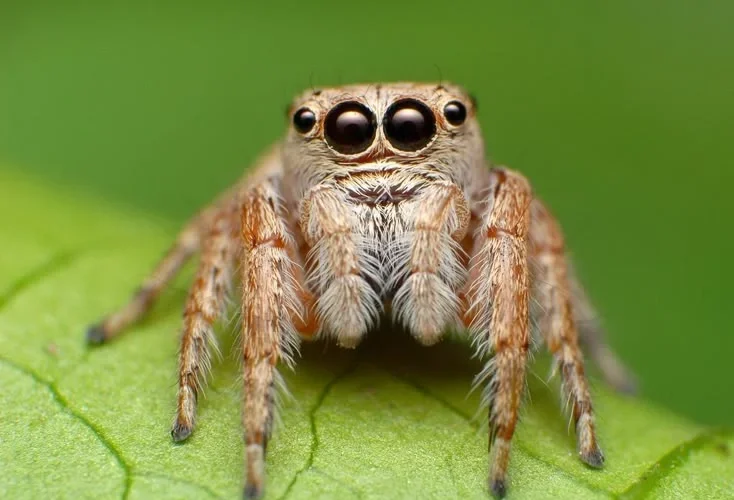
Jumping spiders are members of the spider family Salticidae. They are one of the most diverse spider groups in the world, with more than 6,000 described species. Most are relatively small, although their size, shape, color, and behavior can vary greatly between species.
The easiest way to recognize a jumping spider is by its eyes. They have four pairs of eyes, with the large forward-facing middle pair being especially noticeable. These principal eyes provide sharp vision, while the other eyes help detect movement around the spider. Together, the eyes give jumping spiders a wide view of their surroundings.
Their name comes from their ability to jump, but jumping is only one part of their behavior. They can walk slowly, pause to observe their surroundings, and carefully approach prey before making a final attack.
Why Do Jumping Spiders Have Such Good Vision?
Vision is one of the biggest reasons jumping spiders stand out from many other spiders. Their forward-facing principal eyes have excellent spatial resolution. The other eyes have wider fields of view and are especially useful for noticing movement. When something catches the spider’s attention, information from these different eyes helps it orient toward the object and examine it more closely.
Some jumping spiders can also distinguish colors. Research has shown that certain species can detect ultraviolet light, which humans cannot see. Some Habronattus species have a form of three-channel color vision that includes sensitivity to red wavelengths.
Their vision is not simply about seeing prey. It also helps with navigation, communication, recognizing rivals, and courtship. In other words, these spiders use their eyes for much more than hunting.
Can Jumping Spiders See in the Dark?
Most jumping spiders are active during daylight, so they generally rely on good lighting for their vision-based lifestyle. However, some species can still perform visual tasks under surprisingly low light.
Research on Cyrba algerina and Cyrba ocellata found that these spiders could identify prey and rivals under low-light conditions, although their performance eventually declined as the light became extremely dim.
So, jumping spiders are not simply “daylight-only” creatures. Their visual abilities can vary depending on the species and its habitat.
How Do Jumping Spiders Hunt?
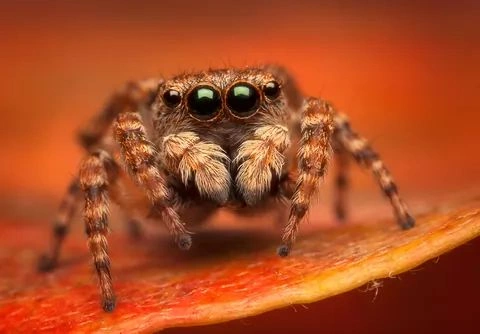
Jumping spiders are active hunters. Instead of waiting for an insect to become trapped in a prey-catching web, they usually locate prey visually and approach it.
Their hunting behavior can look surprisingly deliberate. A spider may notice an insect, turn toward it, move closer, stop, and then adjust its position before attacking. Research has shown that different eye pairs can contribute to different stages of this process, including chasing moving prey and stalking prey that remains still.
Once the spider is close enough, it makes a rapid jump toward the target. The jump is not random. Its excellent vision helps the spider estimate where the prey is and coordinate the attack.
Jumping spiders also produce silk before making a major jump. This silk safety line can help prevent a dangerous fall if the spider misses its landing.
What Do Jumping Spiders Eat?
Most jumping spiders are predators that feed on small animals, particularly insects and other arthropods. Their prey can include flies, mosquitoes, moths, small bugs, and other spiders.
Some species are highly specialized. For example, certain jumping spiders have been observed hunting ants even though ants can be dangerous prey because of their bites, stings, chemicals, or defensive behavior.
This variety shows that jumping spiders are not all hunting in the same way. Their prey choices can depend on their species, environment, and available food.
Where Do Jumping Spiders Live?
Jumping spiders occur across a wide range of terrestrial environments. They can be found in forests, grasslands, gardens, fields, rocky areas, and around buildings.
Because they are visual hunters, many species spend time in places where they can see their surroundings. You may notice them on leaves, tree trunks, fences, walls, windowsills, rocks, or other surfaces where small insects are available.
Their habitats can be surprisingly varied. Some species live in dry environments, while others are associated with forests or more humid conditions. Studies have also shown that some jumping spiders adapt their hunting behavior to the structure of their particular microhabitat.
At night, many species retreat to small silk shelters where they can rest safely.
Are Jumping Spiders Dangerous?
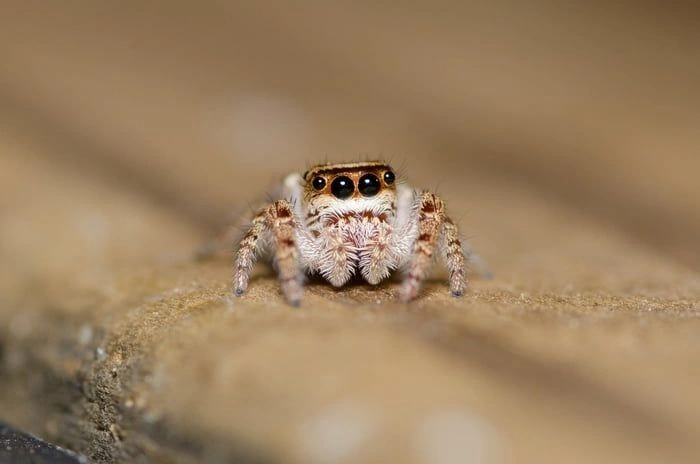
For most people, jumping spiders are not considered dangerous. They are small predators that generally have little reason to bite humans. Like other spiders, they can bite if they are trapped, handled roughly, or feel seriously threatened. However, jumping spiders are not known for aggressively attacking people.
Their impressive behavior can sometimes make them appear more threatening than they really are. A jumping spider may turn toward you because it is visually investigating movement. That does not necessarily mean it is preparing to attack.
Do Jumping Spiders Bite?
Yes, jumping spiders are capable of biting, but bites are uncommon.
If a bite does occur, the result is generally expected to be mild. A person may experience temporary pain, redness, itching, or minor swelling around the area. The reaction can vary between individuals.
It is important not to confuse jumping spiders with medically important spider species simply because both are capable of biting. Identification matters, and a spider should not be handled just to determine what species it is.
If someone develops severe or unusual symptoms after a suspected spider bite, medical advice should be sought rather than assuming the bite came from a harmless jumping spider.
How Can You Identify a Jumping Spider?
Look for a combination of features rather than relying on color alone.
Large Front Eyes
The large forward-facing eyes are one of the most obvious characteristics. They give jumping spiders their distinctive appearance.
Compact Body
Many jumping spiders have a relatively compact body with short-looking, sturdy legs compared with many other spider groups.
Quick Movements
They often move in short bursts and can suddenly jump when hunting, exploring, escaping danger, or crossing a gap.
No Typical Prey-Catching Web
Most jumping spiders do not build large webs to trap prey. They use vision and active movement instead.
Are Jumping Spiders Good to Have Around?
Usually, yes. Jumping spiders are natural predators and can help control populations of small insects and other arthropods.
Finding one in a garden or around a building does not automatically mean there is an infestation. In many cases, it is simply looking for food.
If you see one indoors and would rather not have it there, the simplest option is to gently encourage it into a container and release it outside instead of killing it.
Note
This article is based on established zoological and behavioral research concerning the family Salticidae, including published studies on jumping spider vision, hunting behavior, and low-light visual performance. Sources such as peer-reviewed research and Smithsonian educational material were used to distinguish well-supported facts from common spider myths.
FAQs
Are jumping spiders poisonous?
Jumping spiders are venomous because they use venom to subdue prey, but their venom is generally not considered dangerous to humans. Their small size and feeding behavior make them very different from spiders known for medically significant bites.
Can jumping spiders recognize humans?
They have excellent vision and can respond to visual objects and movement, but that does not mean they understand humans in the same way people recognize one another. Their visual system is mainly adapted for hunting, navigation, and interactions with other spiders.
Do jumping spiders jump at people?
They may jump toward a person if they are exploring, escaping, or trying to move from one surface to another. A jump does not automatically mean the spider is attacking.
Do jumping spiders make webs?
Most jumping spiders do not build webs to capture prey. They use silk for other purposes, including making shelters and creating safety lines while moving or jumping.
What should I do if I find a jumping spider?
If it is outside, the easiest option is usually to leave it alone. If it is indoors and bothers you, gently move it outside using a container rather than handling it directly.
Are jumping spiders good for gardens?
Yes. They are predators of small insects and other arthropods, so their presence can be a natural part of a healthy garden ecosystem.
