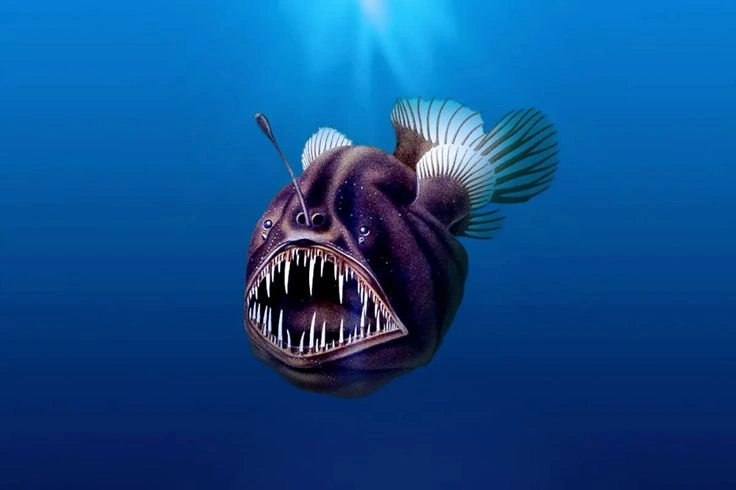
Anglerfish facts become much more interesting when you look beyond their scary appearance. These unusual fish have adapted to some of the darkest and most difficult parts of the ocean. Their famous glowing lure helps them find food, their huge mouths help them catch surprisingly large prey, and some deep-sea species have an extraordinary way of finding a mate.
The name “anglerfish” covers a large group of fishes in the order Lophiiformes. More than 200 species are known, and they do not all look or live the same way. Some live thousands of meters below the surface, while other anglerfish relatives live closer to the seafloor or even in shallow tropical waters.
For Viltnemnda readers who enjoy unusual animal facts, the anglerfish is a great example of how evolution can produce completely different solutions to the same problem: surviving where food is scarce and sunlight barely reaches.
Key Takeaways
- Anglerfish are highly specialized predators with adaptations for difficult ocean environments.
- Many deep-sea species use a glowing lure to attract prey instead of actively chasing it.
- The light is often produced by bioluminescent bacteria living inside the lure.
- Their large mouths, sharp teeth, flexible bodies, and dark coloration help them survive in the deep sea.
- Some species have extremely unusual reproductive behavior in which tiny males attach permanently to females.
- The anglerfish group is diverse, so not every species lives in deep water or has the classic scary appearance.
What Is an Anglerfish?
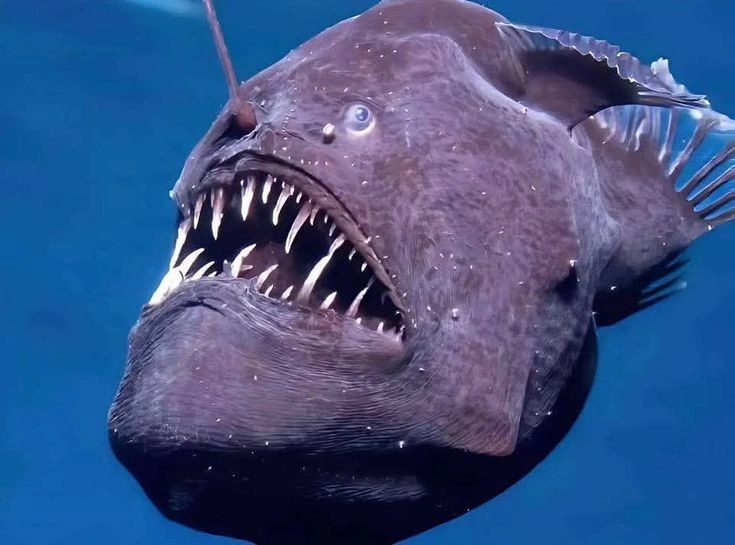
An anglerfish is a predatory fish known for a special structure that looks like a tiny fishing rod growing from its head. In many deep-sea species, this structure ends in a glowing organ called an esca. The rod itself is a modified dorsal fin ray called the illicium.
The classic deep-sea anglerfish usually has a large head, a wide mouth, sharp teeth, and a relatively soft body. Its appearance may look frightening, but nearly every feature has a practical purpose.
Instead of spending lots of energy swimming around looking for prey, the fish can remain relatively still and use its lure to bring potential food closer. This is especially useful in the deep ocean, where meals can be difficult to find.
Where Do Anglerfish Live?
Deep-Sea Habitat
Deep-sea anglerfish are strongly associated with the open ocean and the dark parts of the sea. MBARI reports that deep-sea anglerfish can occur from roughly 300 to 4,000 meters below the surface, with different species occupying different parts of the water column and seafloor.
At these depths, sunlight is extremely limited or completely absent. The environment is also cold, under intense pressure, and generally poor in available food compared with surface waters. NOAA notes that darkness, pressure, cold temperatures, and limited food availability create major challenges for animals living in the midnight zone.
Not every anglerfish lives in the deep sea, however. The larger anglerfish group includes frogfish, batfish, sea toads, goosefish, and other relatives that occupy different habitats. Some live on the seafloor, while others can be found in shallower waters.
Life in Almost Complete Darkness
For a deep-sea anglerfish, darkness is not simply an inconvenience. It shapes almost every part of its lifestyle.
There is no bright environment where the fish can easily spot prey. Swimming constantly would also require valuable energy. Anglerfish solve this problem with patience, camouflage, sensitive senses, and their remarkable glowing lure.
Their dark skin can absorb available light and help them remain difficult to detect in the surrounding water. This combination of hiding and attracting prey makes the anglerfish a highly specialized deep-sea predator.
How Does an Anglerfish Catch Its Food?
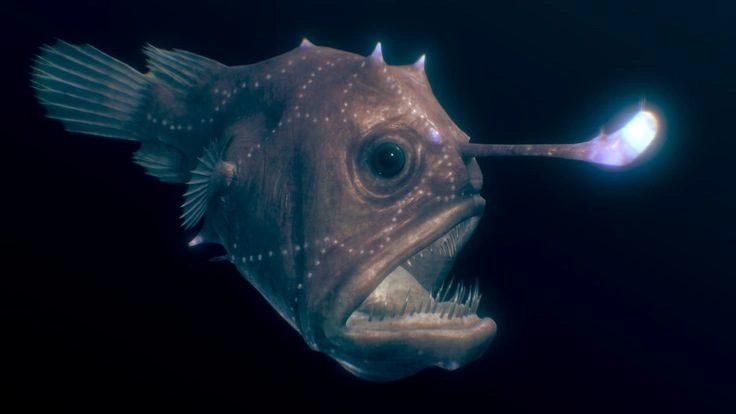
The most famous anglerfish adaptation is its built-in “fishing rod.” The female deep-sea anglerfish uses the modified fin ray to hold a lure in front of its mouth. In many species, the lure contains bioluminescent bacteria that produce light. The glowing point can attract curious animals toward the waiting predator.
The method is simple but effective. The anglerfish does not necessarily need to chase its prey across the darkness. Instead, it uses light as bait and waits for an animal to come close enough to capture.
This is a smart energy-saving strategy because food is limited in the deep ocean. NOAA describes the use of bioluminescent lures as an important adaptation for deep-sea predatory fishes because actively searching for food can be energetically expensive.
What Do Anglerfish Eat?
Deep-sea anglerfish mainly feed on small fishes and crustaceans, although their unusual jaws and expandable bodies allow some species to handle surprisingly large meals.
Their large mouths are particularly useful in an environment where the next meal may not appear for a long time. When an opportunity arrives, being able to swallow a substantial meal can make a major difference.
Some anglerfish have flexible jaws and bodies that help them consume prey that appears large compared with their own size. Research on deep-sea anglerfish has also described their retractable jaws, lack of ribs, and pliable bodies as adaptations that help them deal with large prey.
Their sharp teeth also serve an important purpose. Once prey enters the mouth, the teeth make escape difficult.
Why Do Anglerfish Glow?
Bioluminescence as a Hunting Tool
The glow of many deep-sea anglerfish comes from bioluminescent bacteria living in the lure. These bacteria produce light, creating what looks like a tiny underwater lamp.
This relationship between the fish and bacteria is a form of symbiosis. The bacteria provide the light, while the fish provides a suitable environment for them.
The glowing lure is not just there to make the fish look strange. It is an important hunting adaptation. In the deep sea, even a small source of light can become an effective way to attract nearby animals.
The Lure Is Different Among Species
There is no single anglerfish lure design. Different species have developed different shapes and arrangements.
Some have simple lures, while others have more complicated structures. Certain species can even have additional light-producing structures. This diversity shows that “anglerfish” is not one identical animal but a broad group with many specialized forms.
How Do Anglerfish Survive in the Deep Ocean?
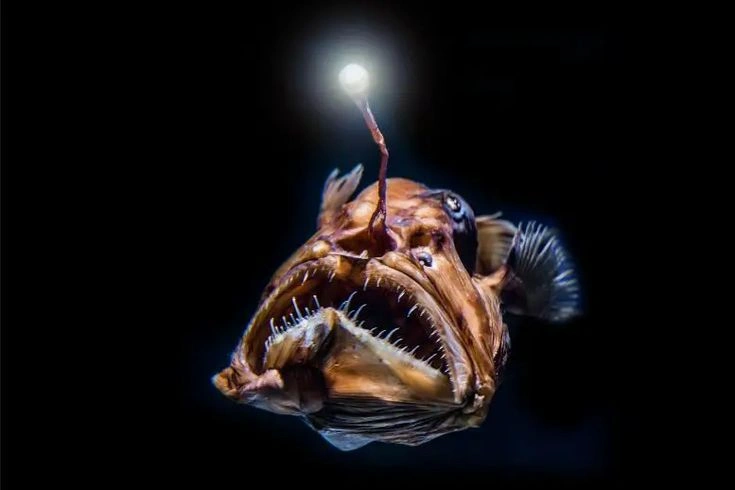
Anglerfish have several adaptations that work together rather than relying on one special feature.
Energy Conservation
Food is unpredictable in the deep sea, so wasting energy can be dangerous. Using a lure instead of constantly chasing prey can reduce the energy required for hunting.
Large Mouth and Sharp Teeth
A large mouth gives the anglerfish an advantage when prey finally approaches. Sharp teeth help hold onto slippery prey and reduce the chance of escape.
Dark Body
Many deep-sea anglerfish have dark bodies that help them blend into their surroundings. Their dark appearance can make them difficult for other animals to see in an environment where there is almost no sunlight.
Specialized Senses
Finding food and a mate in complete darkness requires more than eyesight. Male deep-sea anglerfish, for example, have strong sensory abilities that help them locate females. Some rely heavily on smell and pheromones when searching for a mate.
How Do Anglerfish Reproduce?
Anglerfish reproduction is one of the strangest parts of their biology.
In several deep-sea species, males are dramatically smaller than females. A male may grow to only a few centimeters, while the female can be many times larger. This extreme difference between the sexes is called sexual dimorphism.
The tiny male searches for a female in the enormous darkness of the ocean. Once he finds a suitable mate, males of certain species attach themselves permanently to the female.
In some species, the male eventually becomes physically integrated with the female and shares a circulatory connection with her. This unusual reproductive strategy is known as sexual parasitism. It helps solve one of the biggest problems of life in the deep sea: finding a mate in a huge environment where individuals may rarely encounter each other.
It is important to remember that this behavior does not apply to every anglerfish species. Anglerfish reproduction varies across the group.
Are All Anglerfish Scary-Looking?
Not at all.
The famous deep-sea anglerfish is only one type. Anglerfish relatives include frogfish, batfish, sea toads, and goosefish. Their bodies can look completely different depending on where and how they live. Some are colorful and adapted to reefs, while others have flattened bodies suited to life on the seafloor.
This is one reason anglerfish facts can be surprising. The word “anglerfish” creates an image of one terrifying creature with glowing teeth, but the actual group is much more diverse.
Interesting Anglerfish Facts
- Deep-sea anglerfish can live at depths of around 300 to 4,000 meters.
- The glowing lure is found on female deep-sea anglerfish.
- In many species, bioluminescent bacteria help produce the lure’s light.
- The lure works like bait on a fishing line.
- Anglerfish can eat fishes and crustaceans.
- Their large mouths and flexible bodies help them handle relatively large prey.
- Male and female deep-sea anglerfish can look dramatically different.
- In some species, tiny males permanently attach to much larger females.
- Not every anglerfish lives in the deep sea.
- More than 200 species of anglerfish are recognized within the broader group.
- Anglerfish are found in oceans around the world.
Note
The information in this article is based on marine biology resources from organizations and scientific literature, including MBARI, Smithsonian Ocean, NOAA Ocean Exploration, Monterey Bay Aquarium, and peer-reviewed research on anglerfish reproduction. These sources provide evidence for the species’ habitat, feeding behavior, bioluminescence, adaptations, and unusual reproductive strategies.
Frequently Asked Questions
Are anglerfish dangerous to humans?
Deep-sea anglerfish are not considered a normal threat to humans. They live far below the surface, and most people will never encounter one in its natural habitat.
Why does an anglerfish have a light?
The light is mainly used to attract prey in the darkness of the deep ocean. In many deep-sea species, bioluminescent bacteria inside the lure produce the glow.
How deep can anglerfish live?
Some deep-sea anglerfish have been recorded from around 300 meters down to about 4,000 meters. Different species occupy different depths and habitats.
What do anglerfish eat?
Deep-sea anglerfish commonly eat small fishes and crustaceans. Some species can also swallow surprisingly large prey because of their large mouths and flexible bodies.
Why are male anglerfish so small?
In some deep-sea anglerfish, the male’s main reproductive role is to find a female and provide sperm. Being extremely small can reduce the energy needed to survive while searching for a mate, and in certain species the male permanently attaches to the female.
Do all anglerfish have a glowing lure?
No. The famous glowing lure is especially associated with deep-sea anglerfish, but the broader anglerfish group contains many species with different body shapes, habitats, and feeding adaptations.
