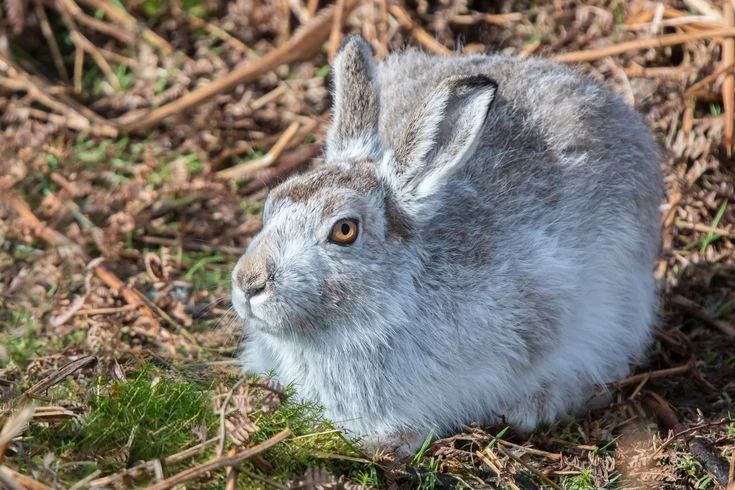
The mountain hare decline looks like one of those animals that should be doing fine in Norway. It is widespread, lives in forests and mountains, and can reproduce quickly. But the story gets less simple when we look at the long-term data.
The mountain hare decline in Norway is real enough to have placed Lepus timidus on the Norwegian Red List as Near Threatened. At the same time, there is no reliable national count telling us exactly how many mountain hares are alive today. That makes the situation a little unusual. We can see strong warning signs, but we cannot put one exact population number on them.
So what is happening in 2026? The best answer is that hare bestand appears to have fallen over the long term in several parts of Norway, especially in southern areas. Researchers have linked this pattern to several possible pressures including predators, shorter snow seasons, habitat changes, disease and other ecological changes.
Key Takeaways
- Mountain hare is currently listed as Near Threatened in Norway.
- There is no reliable national estimate of the total mountain hare population.
- Hunting statistics show a major long-term decline, but they are only an indicator.
- Predator pressure, especially from generalist predators, can affect hare survival.
- Shorter snow seasons may increase camouflage problems and interact with predator pressure.
- Rype and grouse trends can provide ecological context but cannot replace hare monitoring.
- Red fox control and corvid management should not be treated as automatic nationwide solutions.
- Better long-term monitoring is one of the biggest needs for understanding the hare bestand.
What does mountain hare decline look like in 2026?
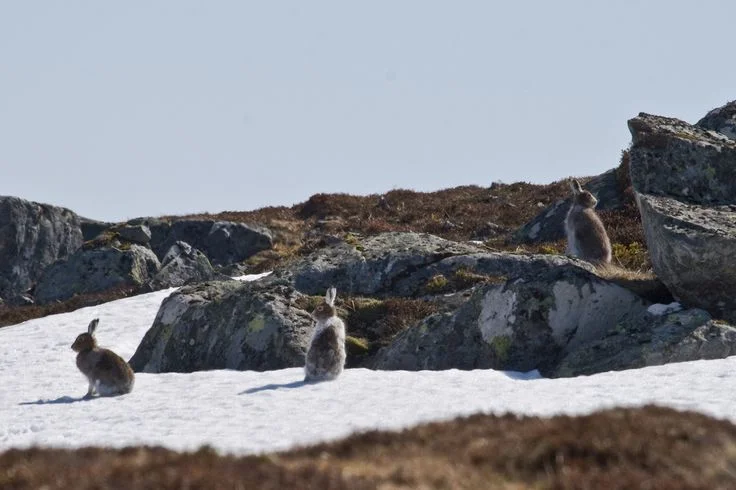
There is no nationwide mountain hare census that can tell us exactly how the population changed between 2025 and 2026. This is one of the first things readers should understand before looking at any dramatic claim about the species.
Artsdatabanken says there are no good estimates of the total Norwegian mountain hare population. The species can also have large natural fluctuations, which makes a simple year-to-year comparison difficult.
Still, there is a strong historical signal in hunting data. Around 115,000 hares were reported shot in Norway in 1991. By the 2019/2020 hunting season, that figure had fallen to about 12,500. A model using hunting statistics estimated a 31% decline in the number of hares shot during the decade from 2009/2010 to 2019/2020.
That does not mean Norway had exactly 31% fewer hares. Hunting bags are only an indicator, and changes in hunting effort and reporting can affect them.
This is why the current picture needs some care. Artsdatabanken also reports that observations submitted to its database increased during part of the 2010s. Researchers suggested that better reporting may explain at least some of that increase. In other words, the observation data and hunting data do not give a perfectly matching story.
Why is the hare population falling?
There probably isn’t one single answer. Mountain hare numbers can change because several pressures work together. A hare might have enough food but face more predators. It might survive the summer but struggle when winter snow conditions change. A local population can also behave differently from one somewhere else.
Predator pressure matters
Predation is one of the main factors researchers have looked at. The mountain hare is prey for animals such as red foxes, golden eagles and lynx. Pine martens can also take hares. Older Norwegian research found that predators can have a strong effect on hare survival, although predator removal experiments have not produced identical results everywhere.
Red foxes are especially interesting because their numbers and distribution can influence several small-game species at the same time.
A Norwegian study looking at the period when sarcoptic mange caused a major reduction in red fox numbers found changes in hunting bags for mountain hare, capercaillie, black grouse and willow grouse. The study found relationships between red fox hunting bags and several prey species.
That does not mean every hare decline can simply be blamed on foxes. Predator populations move, habitats change and prey species respond differently.
Could less snow be part of the problem?
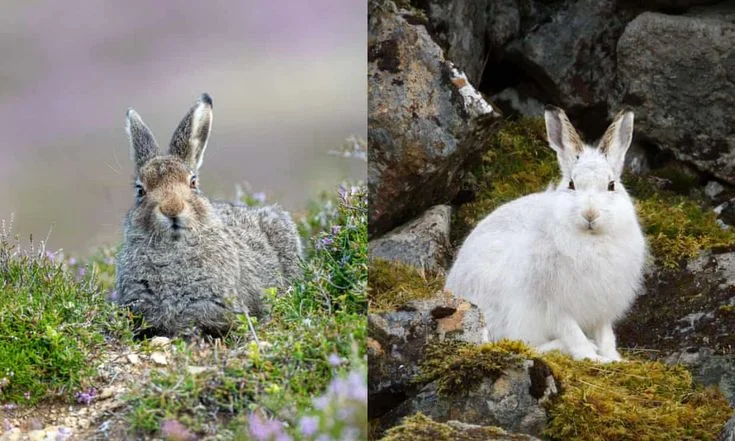
This is where the mountain hare becomes especially interesting. Mountain hares change their coat colour with the seasons. In winter they normally become white, helping them blend into snowy surroundings. When snow arrives later or disappears earlier, that camouflage can become less effective.
Research from southeast Norway found that mountain hare abundance was lower where snow cover lasted for a shorter period. The effect was stronger in areas with more generalist predators such as red foxes and pine martens.
Think of it as a timing problem. The hare changes colour because winter is expected. If the landscape turns brown while the hare is still white, the animal can stand out more clearly.
This does not mean climate change is the only cause of the decline. It means changing snow conditions can interact with other pressures and make survival harder.
What do rype and grouse counts tell us?
The connection between mountain hare and rype or grouse is useful, but it should not be misunderstood. Hares and grouse are different species with different population patterns. A fall in grouse counts does not automatically prove that hare numbers are falling too.
The reason they are often discussed together is that they are all part of Norway’s small-game ecosystem. Predators can affect several prey species, while weather, food availability and habitat conditions can influence more than one species at the same time.
Historical Norwegian research has examined mountain hare alongside capercaillie, black grouse and willow grouse. Hunting statistics have also been used for these species because direct population counting can be difficult.
So grouse counts can provide useful ecological context, but they should not be treated as a substitute for proper hare monitoring.
Does red fox control help mountain hares?
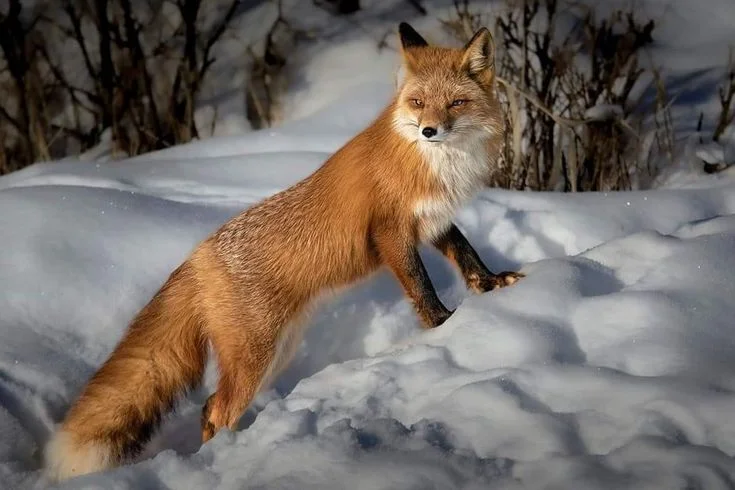
This question sounds simple, but the answer isn’t. Red fox control can change predator pressure in an area. There is evidence from Norway that fox numbers can influence small-game species. Historical research also found that hare hunting bags increased after the major red fox decline caused by sarcoptic mange.
But that does not mean widespread fox control is automatically the answer to the mountain hare decline.
Predators are part of natural ecosystems. Removing one predator can also change relationships between other predators and prey. Results can vary between landscapes, so wildlife management needs local evidence rather than a one-size-fits-all approach.
The same caution applies to corvid management. Crows and other corvids can prey on eggs and young animals of some species, but there is not enough evidence to treat corvid control as a simple national solution for mountain hare decline.
What role does habitat play?
Mountain hares use a wide range of Norwegian habitats, from forests to open mountain areas. The species is found across the country. Habitat fragmentation can affect food, shelter and the way predators move through the landscape.
Climate change can also alter vegetation and snow conditions. These changes may not kill hares directly. Instead, they can slowly change the conditions that determine whether young animals survive and adults can reproduce successfully.
There is another issue in southeastern Norway. The introduced brown hare, or European hare, occurs in parts of the region. Artsdatabanken identifies potential competition and other interactions between the introduced species and native mountain hare.
Why does mountain hare decline matter right now?
A falling hare population matters for more than hunters. Mountain hares are part of the food web. They provide prey for several predators and connect vegetation with higher levels of the ecosystem.
Their decline can therefore be a useful warning signal. When a widespread species begins showing long-term problems, it can tell researchers that something in the wider environment is changing.
For wildlife sites such as Viltnemnda, this is also why monitoring matters. The useful question isn’t only whether there are fewer hares. It is why numbers are changing and whether the same pattern is appearing across different regions.
What changes could happen next?
The next step should be better monitoring. Norway currently lacks a dedicated national system that produces a reliable annual mountain hare population trend. The Norwegian Red List assessment specifically points to the value of establishing better population monitoring.
Future monitoring could combine several types of information:
- Field observations and snow tracking
- Hunting statistics
- Camera and other wildlife monitoring methods
- Predator abundance
- Snow-cover duration
- Habitat and vegetation changes
- Disease observations
Using several sources together would give a much clearer picture than relying on hunting bags alone.
Management may also become more local. An area with heavy predator pressure and very little winter snow may face a different problem from an area where habitat quality is the main concern.
Sources Note
This article uses information from Artsdatabanken’s Norwegian Red List, Norwegian Institute for Nature Research research, Statistics Norway, and published ecological studies. The latest formal Norwegian Red List assessment available for mountain hare is the 2021 assessment, which classified Lepus timidus as Near Threatened. Current 2026 conditions should therefore be understood alongside the limitations of available monitoring rather than presented as an exact national population count.
Frequently Asked Questions
Is the mountain hare population declining in Norway?
The available evidence indicates a long-term decline, but the exact size of the current population is unknown. Norway does not have a reliable national population estimate for mountain hare.
How many mountain hares are there in Norway?
Nobody currently has a reliable national number. Mountain hare populations can fluctuate naturally and are difficult to count, which is one reason better monitoring has been recommended.
Is the red fox responsible for the mountain hare decline?
Red foxes can have a strong effect on hare survival, but they are not the only possible cause. Research points to several interacting pressures, including predators and changing snow conditions.
Does climate change affect mountain hares?
It can. Shorter periods of snow cover may reduce the effectiveness of the hare’s white winter camouflage. Research in southeast Norway found lower hare abundance where snow cover lasted for shorter periods, especially where generalist predators were more common.
Are grouse and mountain hare declines connected?
They can be influenced by some of the same ecological pressures, including predators and weather. However, grouse counts cannot be used as direct evidence of mountain hare numbers because the species have different biology and population dynamics.
What should happen next?
Better monitoring is the clearest need. Combining field observations, hunting statistics, snow conditions, predator data and habitat information would make it easier to understand where mountain hares are declining and what is driving the change.
Disclaimer:
This article is intended for general educational and informational purposes. Wildlife populations, habitat conditions and conservation information can vary by region and may change as new research becomes available. Always refer to recognized Norwegian wildlife and conservation authorities for the latest information.
