
Raven Facts: A raven is easy to recognize. Its glossy black feathers, heavy bill, shaggy throat, and deep call give it a look that feels almost mysterious. But the most interesting thing about a raven is not its appearance. It is the way this bird thinks, learns, explores, and adapts.
Among the many raven facts researchers have discovered, their intelligence stands out the most. Common ravens can solve problems, use tools, remember useful information, work together, and quickly take advantage of new food sources.
The Common Raven, scientifically known as Corvus corax, lives across a huge part of the Northern Hemisphere. It can survive in forests, mountains, deserts, tundra, coastal areas, grasslands, and even places influenced by people.
Key Takeaways
- Ravens are among the most intelligent birds known.
- They are omnivores and eat both animals and plant-based foods.
- Common ravens can live in forests, deserts, mountains, tundra, and coastal areas.
- They can use tools and solve unfamiliar problems.
- Ravens communicate through a wide range of calls and sounds.
- They are usually seen alone or in pairs, although groups gather around rich food sources.
- Their adaptability helps them survive in very different environments.
What Is a Raven?
The Common Raven is one of the largest members of the crow family, known as Corvidae. It is much larger than an American Crow and has a heavier bill, thicker neck, and distinctive wedge-shaped tail.
An adult Common Raven is usually around 56 to 69 centimeters long, with a wingspan of roughly 116 to 118 centimeters. Its entire body is generally black, including the bill, legs, and feathers around its eyes.
The difference becomes especially noticeable when a raven flies. Instead of constantly flapping, it often glides and soars through the air with long, controlled movements. That effortless flight is one reason ravens can sometimes look more like birds of prey than typical songbirds.
How Intelligent Are Ravens?
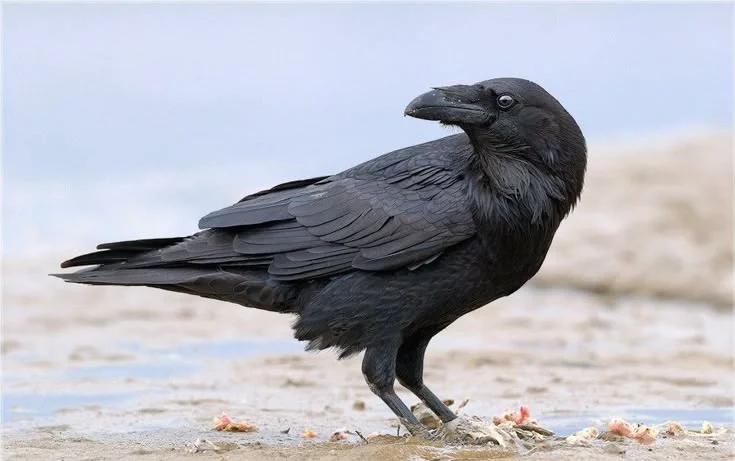
This is where raven facts become especially fascinating. Ravens are widely considered among the smartest birds. Their intelligence is not simply about remembering where food is. They can investigate unfamiliar objects, learn from experience, solve new problems, and sometimes cooperate with other ravens.
Researchers have also documented tool use in ravens. Their strong bills can help them manipulate objects and reach food that would otherwise be difficult to access.
Ravens Learn From Experience
A raven does not always need to discover everything from scratch. These birds can learn by watching what happens around them. The National Park Service notes that ravens can learn from one another and from observing other predators when searching for food.
Young ravens are particularly curious. They investigate unfamiliar objects, pick things up, and appear to learn what is useful through exploration.
This combination of curiosity, memory, and problem-solving gives ravens a major advantage when their surroundings change.
What Do Ravens Eat?

Ravens are omnivores, which means their diet is extremely flexible. They are not dependent on one particular type of food. Their diet can include carrion, insects, rodents, reptiles, eggs, young birds, fish, grains, berries, and other available foods. They also take advantage of human food and garbage when these resources are accessible.
Ravens Are Skilled Opportunistic Feeders
A raven does not simply wait for food to appear. It searches, investigates, follows potential food sources, and takes advantage of opportunities. Ravens may scavenge from carcasses, hunt smaller animals, search for bird nests, or gather around places where food is concentrated.
They have even been observed following wolves toward carcasses. This is a clever way of finding a meal without doing all the work of locating or killing large prey themselves. Their flexible diet is one of the reasons ravens can survive in such different habitats.
Where Do Ravens Live?
One of the most impressive raven facts is their enormous geographic range. Common Ravens occur across much of the Northern Hemisphere, including large areas of North America, Europe, and Asia. They can also be found in parts of North Africa. Their habitat is just as varied.
From Mountains to Deserts
Ravens can live in coniferous and deciduous forests, mountains, deserts, grasslands, tundra, coastlines, beaches, agricultural areas, and open landscapes.
They are also comfortable around rural settlements and some urban environments when food and nesting opportunities are available.
This adaptability is a major part of their success. A raven does not need one perfect environment. It needs enough food, a suitable place to nest, and room to survive.
How Do Ravens Behave?
Ravens are curious, confident, and surprisingly playful. Unlike crows, which often appear in large groups, Common Ravens are frequently seen alone or in pairs. Groups can still form when there is an especially valuable food source, such as a carcass or landfill.
Ravens Love Aerial Acrobatics
Watch a raven in the sky and you may see much more than simple flight. Ravens can roll, dive, glide, tumble, and play with objects while flying. These movements are particularly noticeable during social interactions and courtship.
Their ability to soar efficiently also allows them to travel across large areas while using relatively little energy.
How Do Ravens Communicate?
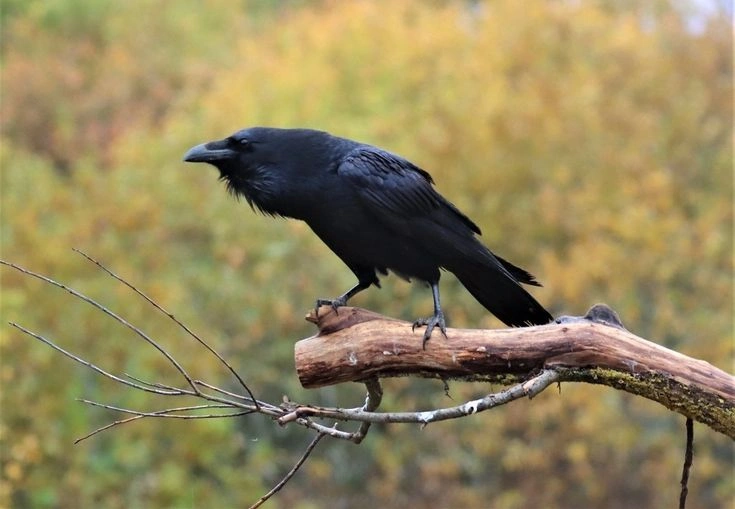
Ravens are highly vocal birds with a surprisingly varied communication system. Their best-known sound is a deep, rough croak, but that is only part of their vocal behavior. Smithsonian reports that more than 30 different raven vocalizations have been recorded.
Different sounds can be used during social interactions, territorial behavior, and other situations.
Their communication is another reminder that the familiar “caw” associated with black birds does not tell the whole story. Ravens have a much richer vocal world than their appearance might suggest.
Do Ravens Stay Together?
Common Ravens often form long-term pair bonds. Breeding pairs establish territories and defend them from other birds. They may also perform impressive aerial displays together, including soaring, diving, and rolling through the air.
Outside breeding pairs, ravens can still interact socially. Younger birds may gather together, while larger groups can form around concentrated food sources. This creates an interesting balance: ravens can be independent but are also capable of complex social behavior.
How Do Ravens Build Their Nests?
Ravens usually place their nests somewhere that provides protection and a good view of the surrounding area. Common nesting locations include cliffs, tall trees, and human-made structures such as towers, poles, bridges, and other elevated structures.
Both parents participate in raising the young, while the female does most of the nest construction. A typical clutch contains several eggs, and the young remain dependent on their parents after hatching. The parents work together to provide food until the young are ready to leave the nest.
Why Are Ravens So Adaptable?
Think of a raven as a bird that rarely says no to a new opportunity. If one food source disappears, it can search for another. If the landscape changes, it can adjust its behavior. If humans create new food opportunities, ravens may learn to use them.
This flexibility is closely connected to their intelligence.
The U.S. National Park Service describes ravens as highly adaptable opportunists, while Cornell notes that they can thrive in environments ranging from forests and beaches to deserts and tundra.
Raven Facts About Their Conservation Status
The Common Raven is currently considered a species of Least Concern. Its enormous range and adaptability mean it is not currently classified as threatened on a global level.
However, being widespread does not mean ravens face no problems.
Human persecution, poisoning, habitat changes, and conflicts around food and nesting areas can affect local populations. Their ability to adapt has helped them in many regions, but responsible wildlife management remains important.
Expert Perspective: Why Ravens Matter
The most useful way to understand ravens is to look beyond their reputation as mysterious black birds.
Wildlife research shows that their intelligence is connected to real survival skills. Their ability to explore, learn, remember, cooperate, manipulate objects, and exploit new food sources helps them deal with changing environments.
For readers of Viltnemnda, this is what makes ravens especially interesting. They are not simply scavengers flying over the landscape. They are active problem-solvers that interact with their environment in complex ways.
Final Thoughts
Ravens are much more than large black birds with a memorable call. Their intelligence, flexible diet, impressive communication, aerial skills, and ability to survive in very different environments make them one of the most fascinating birds in the world.
The strongest raven facts are perhaps the simplest ones: they watch, they learn, they adapt, and they remember. Whether a raven is searching a mountain landscape for food or investigating something new near a human settlement, it is constantly interacting with its surroundings. That ability to make the most of whatever environment it finds may be the real secret behind the raven’s remarkable success.
Frequently Asked Questions
Are ravens intelligent?
Yes. Ravens are considered among the most intelligent birds. They can learn from experience, solve problems, use tools, investigate unfamiliar objects, and sometimes cooperate with other birds.
What do ravens eat?
Ravens are omnivores. They can eat carrion, insects, rodents, reptiles, eggs, young birds, fish, grains, berries, and other available foods. They may also consume food from human sources.
Where do Common Ravens live?
Common Ravens have a huge range across the Northern Hemisphere. They can live in forests, mountains, deserts, tundra, coastal areas, grasslands, agricultural landscapes, and some urban environments.
Are ravens and crows the same bird?
No. Ravens and crows are closely related members of the corvid family, but they are different birds. Ravens are generally larger and have a heavier bill, shaggy throat feathers, and a wedge-shaped tail.
Do ravens live alone?
Not always. Ravens are commonly seen alone or in pairs, but groups can gather around rich food sources. Younger ravens may also form groups before establishing breeding territories.
How long can ravens live?
Wild Common Ravens can live for more than a decade, although survival varies greatly. Ravens kept under human care may live considerably longer than wild birds.
